
实验室玻璃仪器名称规格型 大全
- 格式:pdf
- 大小:10.26 MB
- 文档页数:47

常见化学实验室玻璃仪器Chemical laboratory glassware is a common tool used in scientific research and chemical experiments. With the help of these glassware instruments, chemists can carry out various operations with precision and accuracy. In this article, we will introduce the most commonly used chemical laboratory glassware and their functions.1. Erlenmeyer Flask (锥形瓶)The Erlenmeyer flask, also known as a conical flask, is a commonly used glassware instrument in chemical laboratories. It has a cone-shaped bottom and a narrow neck. The wide base of the flask provides stability during stirring and mixing, while the narrow neck allows for easy pouring and reduces thepossibility of spills.The Erlenmeyer flask can be used for a variety of purposes, such as holding, mixing, heating, andboiling liquids. It is ideal for use with solutions that need to be swirled or mixed, as its shape makesit easy to agitate the contents.2. Beaker (烧杯)A beaker is a cylindrical-shaped glassware instrument with a flat bottom and a spout for pouringliquids. It is commonly used in chemical experiments for measuring or mixing liquids.Beakers come in a range of sizes, from small to large volumes, and are often graduated for easy measurement. They are also often used for heating solutions on a hot plate.3. Test Tube (试管)A test tube is a small, thin glass tube used in chemical experiments. It is typically cylindrical in shape with a rounded bottom and an open top. Some test tubes come with a stopper or a cap to seal the contents.Test tubes are often used for holding and mixing small amounts of liquids, as well as for conducting small-scale experiments. They are ideal for heating small amounts of solutions in a water bath.4. Graduated Cylinder (量筒)A graduated cylinder is a cylindrical-shaped glassware instrument with a narrow neck and a flat base. It is mainly used for measuring liquids in chemical experiments.The cylinder is designed with markings along the side, allowing for precise measurement of the volume of liquid it contains. It is often used in conjunction with a pipette or burette for precise measurement of liquids.5. Burette (分液漏斗)A burette is a long and narrow glasswareinstrument that is used for delivering solution to a reaction mixture in a controlled and precise manner.It is often used in titration experiments.Burettes are typically long, thin, and graduated with markings indicating the volume of solution that has been dispensed. It is also equipped with astopcock at the bottom to control the flow of solution.6. Pipette (移液管)A pipette is a thin glass tube with a narrow, tapered tip used for measuring and transferringliquids in chemical experiments. It is also used when very precise and accurate measurements of fluid volume are required.There are two types of pipettes: volumetric and micropipette. Volumetric pipettes are used for measuring a precise volume of solution, while micropipettes are used for measuring very small volumes of liquids.7. Funnel (漏斗)A funnel is a glass cone-shaped instrument thatis used to channel liquids or fine-grained materials into a container with a small opening. It is commonly used in filtration experiments to transfer a liquid from one flask to another.Funnels are also used in decanting experiments, where a liquid is slowly poured off a precipitate, andin separating the different layers of immiscible liquids.8. Petri Dish (培养皿)A Petri dish is a small, shallow glassware instrument that is used for the culturing of microorganisms, such as bacteria and fungi. It is often used in microbiology experiments.Petri dishes are made with a lid to prevent contamination of the culture media inside. They are also equipped with a flat bottom to help spread the culture media evenly.9. Watch Glass (蒸发皿)A watch glass is a circular-shaped glassware instrument with a flat bottom and a slightly curved top. It is mainly used for evaporation experiments and to hold small quantities of solids.Watch glasses are often used to cover evaporating dishes to prevent dust or other contaminants from entering or to heat small amounts of liquid over a Bunsen burner.10. Thermometer (温度计)A thermometer is a glassware instrument used for measuring the temperature of liquids or gases in chemical experiments. It is available in both analog and digital forms.Thermometers are typically made with a long, skinny glass bulb filled with a liquid, usuallymercury or alcohol. As the temperature increases, the liquid expands and rises in the thin, calibrated tube. The temperature is read off the scale marked on the glassware instrument.In conclusion, chemical laboratory glassware is an essential tool in scientific research and chemical experiments. Each instrument has its purpose and is designed for precision and accuracy. It is essential to use the appropriate glassware to ensure accurate and reliable results and to maintain the safety of the experimenters.。

、玻璃仪器分类化学实验常用的仪器中,大部分为玻璃制品和一些瓷质类仪器。
瓷质类仪器包括蒸发皿、布氏漏斗、瓷坩埚、瓷研钵等。
玻璃仪器种类很多,按用途大体可分为容器类、量器类和其他仪器类。
容器类包括试剂瓶、烧杯、烧瓶等。
根据它们能否受热又可分为可加热的仪器和不宜加热的仪器。
量器类有量筒、移液管、滴定管、容量瓶等。
量器类一律不能受热。
其他仪器包括具有特殊用途的玻璃仪器,如冷凝管、分液漏斗、干燥器、分馏柱、砂芯漏斗、标准磨口玻璃仪器等。
标准磨口玻璃仪器,是具有标准内磨口和外磨口的玻璃仪器。
标准磨口是根据国际通用技术标准制造的,国内已经普遍生产和使用。
使用时根据实验的需要选择合适的容量和口径。
相同编号的磨口仪器,它们的口径是统一的,连接是紧密的,使用时可以互换,用少量的仪器可以组装多种不同的实验装置,通常应用在有机化学实验中。
目前常用的是锥形标准磨口,其锥度为1:10,即锥体大端直径与锥体小端直径之差:磨面锥体的轴向长度为1: 10。
根据需要,标准磨口制作成不同的大小。
通常以整数数字表示标准磨口的系列编号,这个数字是锥体大端直径(以mm为单位)最接近的整数。
常用标准磨口系列见表1。
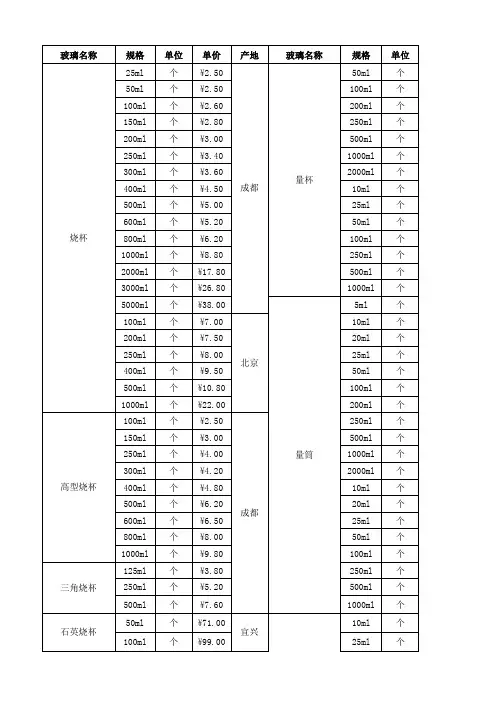
表1常用标准磨口系列有时也用D/H两个数字表示标准磨口的规格,如14/23,即大端直径为14.5mm 锥体长度为23mm、常见的玻璃仪器化学实验室常用的玻璃仪器的主要用途及使用注意事项烧杯规格及表示方法:玻璃质。
以容积(mL表示,如硬质烧杯400mL有一般型、高型;有刻度和无刻度几种。
一般用途:1、反应容器,尤其在反应物较多时用,易混合均匀。
2、也用作配制溶液时的容器或简易水浴的盛水器。
使用方法及注意事项:1、反应液体不能超过烧杯用量的2/3。
2、加热时放在石棉网上,使受热均匀。
刚加热后不能直接置于桌面上,应垫以规格及表示方法:以容积(mL表示,有有塞、无塞;广口、细口和微型几种。
容量瓶规格及表示方法:玻璃质。
以容积(mL)表示,分量入式(In)和量出式(Ex),塞子有玻璃、塑料两种一般用途:配制标准溶液用。
