英语句子成分
- 格式:docx
- 大小:18.87 KB
- 文档页数:5
英语句子成分
(一)英语句子成分划分
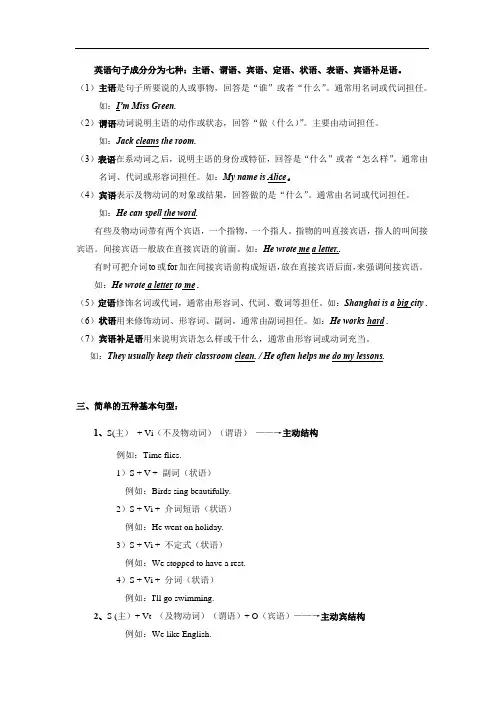
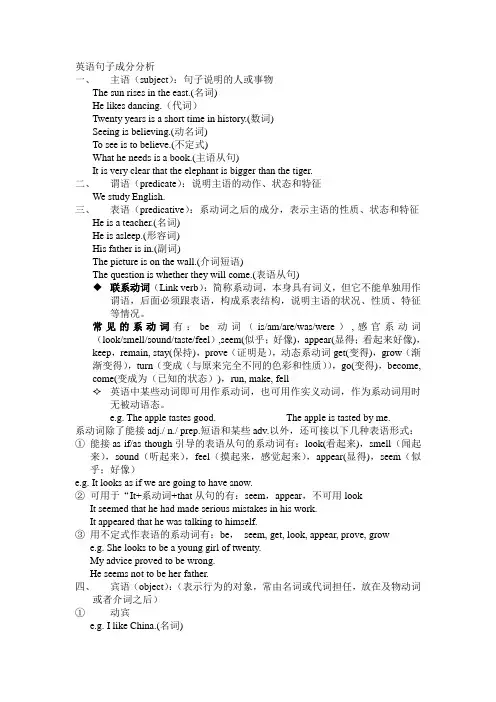
句子是按照一定的语法规律组成的,表达一个完整的意义。一个句子一般由两部分构成,即主语部分和谓语部分,这两部分也叫做句子的主要成分。句子的次要成分包括宾语、表语、定语、状语、补语、同位语等。
一.主语:
主语(subject) 是一个句子的主题,是句子所述说的主体、对象;它的位置一般在一句之首。可用作主语的有:单个的词、短语、从句乃至句子。
1.名词作主语。A tree has fallen across the road. (一棵树倒下横在路上。)
2.代词用作主语。He told a joke but it fell flat. (他说了个笑话,但没有引人发笑)
3.数词用作主语。Three is enough. 三个就够了。
4.名词化的形容词用作主语。
The old and the young are taken good care of in that village.
5.不定式用作主语。To find your way can be a problem.你能否找到路可能是一个问题。
6.动名词用作主语。Smoking is bad for you. 吸烟对你有害。
7. 从句用作主语,即主语从句。
That he finished writing the composition in such a short time
surprised us all.
Whether we will go for an outing tomorrow remains
unknown.
Who will be our monitor hasn't been decided yet.
What caused the accident has been found out..
为了防止句子头重脚轻,通常把it放在主语位置作形式主语,真正主语(从句)搁置于句末。 It is certain that he will win the match.
It is said that he has gone to shanghai.
It is known to all that the gun powder was first invented by
the Chinese.
二.谓语
谓语(predicate) 或谓语动词(predicate verb)由动词构成,说明主语的行为动作或所处的状态。谓语有简单谓语和复合谓语之分。
1.简单谓语由动词或动词词组构成。
What happened? 发生了什么事?
He worked hard all day today. 他今天苦干了一天。
The plane took off at ten o’clock. 飞机是十点起飞的。
2.复合谓语,由“情态动词或助动词+动词”或由是“连系动词+表语”构成。
I am reading. 我在看书。
Y ou can do it if you try hard. 你努力就可以做到。
They have lived here for twenty years.
Tom, you are too lazy. The work should have been finished
yesterday. 汤姆,你太懒惰了,这项工作本来应该昨天就做完的。
三.宾语
宾语(object)是及物动词或及物动词短语的接受者,也可以用在介词之后构成介词短语。宾语有直接宾语(direct object)和间接宾语(indirect object)之分如:
Our team beat all the others.我们的球队打败了所有其他球队。
He told me that he would go to the college the next year. 他告诉我他明年上大学
He gave me some ink.
四.表语
表语的功能是表述主语的特征、状态、身份等。它位于联系动词之后,与之构成所谓的系表结构。可以作表语的词有:名词、代词、数词、形容词、副词、不定式、动名词、分词、介词短语、从句等。 Her sister is a nurse.
The wedding was that Sunday. 婚礼是在那个星期天举行的。(名词)
All I could do was to wait. 我只能等待。(不定式)
Seeing is believing.百闻不如一见/眼见为实(动名词)
This is why he often cries.
除了系动词be外,还有些能做系动词的实义动词,也称为半系动词,其后也要接形容词做表语如:fell,sound ,smell , look , taste
(感观动词)seem, appear (似乎,好像)
He fell sick. 他病了。
五.补语
补语(complement)是一种补足主语和宾语的意义的句子成分。补足主语意义的句子成分叫做主语补语(subject complement),补足宾语意义的句子成分叫做宾语补语(object complement)。
宾语补足语We elected him monitor.
The teacher thought the girl rather clever.
主语补足语He was elected monitor by us.
The girl was thought rather clever by the teacher.
六.定语
定语是用来修饰、限定、说明名词或代词的品质与特征的,分前置定语和后置定语。主要有形容词此外还有名词、代词、数词、介词短语、动词不定式(短语)、分词、定语从句或相当于形容词的词、短语或句子都可以作定语。
Her promise to write was forgotten.她忘记了答应写信的事。
A walking stick 拐杖sleeping pills 安眠药
The wild look in his eyes spoke plainer than words. 他那凶暴的目光说明得再清楚不过了。The car that is parked outside is mine.
停在外面的车是我的。
七.状语
状语(adverbial)是修饰动词、形容词、副词、介词短语或句子的成分;有时间状语、地点状语、方式状语、目的状语、原因状语、结果状语等。
Y ou are quite right.
He speaks the language badly but read it well.
这种语言,他讲得不好,但阅读能力很强。
She will arrive in Beijing on Monday.
There are plenty of fish in the sea.
I eat potatoes because I like them.
She woke(醒) suddenly to find someone standing in the
doorway.
八.同位语
当两个指同一事物的句子成分放在同等位置时,一个句子成分可被用来说明或解释另一个句子成分,前者就叫做后者的同位语(appositive)。这两个句子成分多由名词(代词)担任,同位语通常放在其说明的名词(代词)之后。
We have two children, a boy and a girl.我们有两个孩子,一男一女。
They all wanted to see him. 他们都想见他。
They two went, we three stayed behind.他们俩去了,我们三个留了下来。
The first plan, attacking at night, was turned down.
第一个计划是夜袭,被拒绝了。
The news that we are having a holiday tomorrow is not true.
九.随堂练习:划分句子成分。
1. Little streams feed big rivers. ( 小河流入大江。)
2. Everybody enjoyed themselves on vacation.
3. Whatever you did is right.
4. It seems that he has seen the film.
5. He left there last week.
6. He didn’t tell me when we should meet again. 7. Tired and sleepy, I went to bed.
8. They named the child Jimmy.
9. I heard Jean singing this morning.
10. Y our hair needs cutting.
11. the room above
12. This is a map of China.
13. The car that is parked outside is mine.
14. He himself doesn’t know why.
15. Their latest proposal, to concentrate on primary
education, has met with
some opposition.
16. Naturally we expect hotel guests to lock their doors.
17. She kissed her mother on the platform(月台).