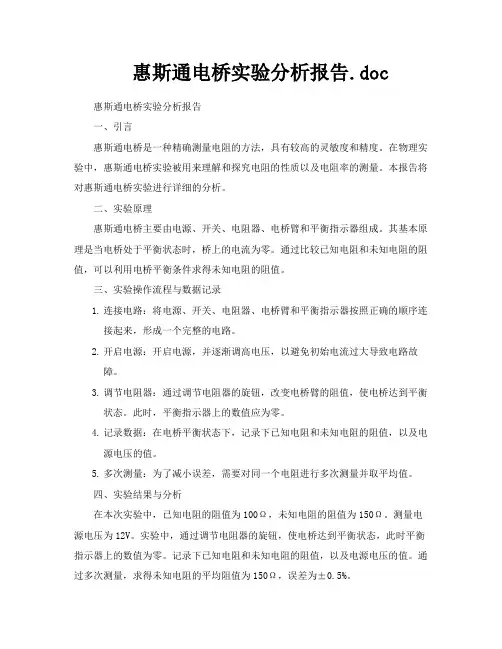
WHEATSTONE BRIDGE惠斯通电桥实验报告
- 格式:docx
- 大小:1.93 MB
- 文档页数:5
Title:WHEATSTONE BRIDGE
【Aim】
To determine the resistance of a wire specimen using a Wheatstonebridge.
【Theory】
For measuring accurately any electrical resistance,single bridge,also known asWheatstone bridge is widely used. Wheatstone bridge is an electrical circuit used to measure an unknownelectrical resistanceby balancing two legs of abridge circuit, one leg of which includes the unknown component. In many cases, the significance of measuring the unknown resistance is related to measuring the impact of some physical phenomenon (such as force, temperature, pressure, etc.) which thereby allows the use of Wheatstone bridge in measuring those elements indirectly.
When the bridge is balanced, that isVBD=0, thus
, (1)
So we can get that
(2)
That is
(3)
So (4)
In fact, it is difficult to exactly decide the value of , so we use "exchange measure method" to obtainRx. Exchange the positions ofR1andR2, orR0andRx, and adjustR0to a new value , the bridge can get a new balanced state,thus
AfterR1,R2were suitably selected, by adjusting the variable resistor,thenthevoltagebetween the two midpoints (BandD) will be zero and nocurrentwill flow through thegalvanometer.Thusthe bridge is in the status of balance. Detecting zero current with a galvanometer can be done to extremely high accuracy. Therefore, ifR1,R2andR0are known to high precision, thenRxcan be measured to high precision. Very small changes inRxdisrupt the balance andare readily detected.
Times
1
2
3
885.3
885.3
885.3
14.4
27.5
39.7
Number of theneedledeflection
1
2
3
61.5
64.4
66.9
64.3
【Resultsand error Analysis】
Levelof resistance box:=0.1
885.3╳0.1%=0.9(Ω)
【Table】
Table1 Test of theunபைடு நூலகம்nown resistor
Times
1
2
3
1000
2000
500
1000
2000
500
885.2
885.3
885.4
885.2
885.3
885.4
885.2
885.3
885.4
885.3
Table2Sensitivity of the bridge
885.3±0.9(Ω)
64.3
【Conclusions】
In this experiment, we use the Wheatstone bridge to measureRx, and adjust the resistance of four arms to make the current through the ammeter zero.We can calculate the resistance by .Wesolvethe difficulty of accurate measurement of bridge arm ratio by exchange measurement,and then with a final result 885.3(Ω).The result has an allowable error.
(5)
Combine equation (4) and (5), we can get
(6)
This equation has nothing to do withR1andR2. In this way, we can make the error only relate to the instrument error ofR0, which is the instrument error of the resistor box.
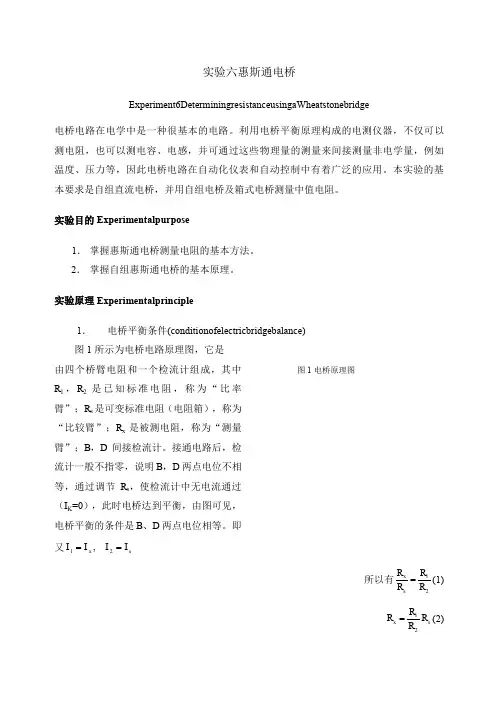
The apparatus used in this experiment is a simple form of the Wheatstone bridge.The basic circuitisshown in Fig. 1.Itconsists of four bridge arms,Rxrepresents an unknown resistance andR0, R1,R2aredecadevariable resistances. In addition, the circuit contains a "bridge" balance indicator (usually a galvanometer), workingpower E andslide-wire rheostat.
【Aim】
To determine the resistance of a wire specimen using a Wheatstonebridge.
【Theory】
For measuring accurately any electrical resistance,single bridge,also known asWheatstone bridge is widely used. Wheatstone bridge is an electrical circuit used to measure an unknownelectrical resistanceby balancing two legs of abridge circuit, one leg of which includes the unknown component. In many cases, the significance of measuring the unknown resistance is related to measuring the impact of some physical phenomenon (such as force, temperature, pressure, etc.) which thereby allows the use of Wheatstone bridge in measuring those elements indirectly.
When the bridge is balanced, that isVBD=0, thus
, (1)
So we can get that
(2)
That is
(3)
So (4)
In fact, it is difficult to exactly decide the value of , so we use "exchange measure method" to obtainRx. Exchange the positions ofR1andR2, orR0andRx, and adjustR0to a new value , the bridge can get a new balanced state,thus
AfterR1,R2were suitably selected, by adjusting the variable resistor,thenthevoltagebetween the two midpoints (BandD) will be zero and nocurrentwill flow through thegalvanometer.Thusthe bridge is in the status of balance. Detecting zero current with a galvanometer can be done to extremely high accuracy. Therefore, ifR1,R2andR0are known to high precision, thenRxcan be measured to high precision. Very small changes inRxdisrupt the balance andare readily detected.
Times
1
2
3
885.3
885.3
885.3
14.4
27.5
39.7
Number of theneedledeflection
1
2
3
61.5
64.4
66.9
64.3
【Resultsand error Analysis】
Levelof resistance box:=0.1
885.3╳0.1%=0.9(Ω)
【Table】
Table1 Test of theunபைடு நூலகம்nown resistor
Times
1
2
3
1000
2000
500
1000
2000
500
885.2
885.3
885.4
885.2
885.3
885.4
885.2
885.3
885.4
885.3
Table2Sensitivity of the bridge
885.3±0.9(Ω)
64.3
【Conclusions】
In this experiment, we use the Wheatstone bridge to measureRx, and adjust the resistance of four arms to make the current through the ammeter zero.We can calculate the resistance by .Wesolvethe difficulty of accurate measurement of bridge arm ratio by exchange measurement,and then with a final result 885.3(Ω).The result has an allowable error.
(5)
Combine equation (4) and (5), we can get
(6)
This equation has nothing to do withR1andR2. In this way, we can make the error only relate to the instrument error ofR0, which is the instrument error of the resistor box.
The apparatus used in this experiment is a simple form of the Wheatstone bridge.The basic circuitisshown in Fig. 1.Itconsists of four bridge arms,Rxrepresents an unknown resistance andR0, R1,R2aredecadevariable resistances. In addition, the circuit contains a "bridge" balance indicator (usually a galvanometer), workingpower E andslide-wire rheostat.