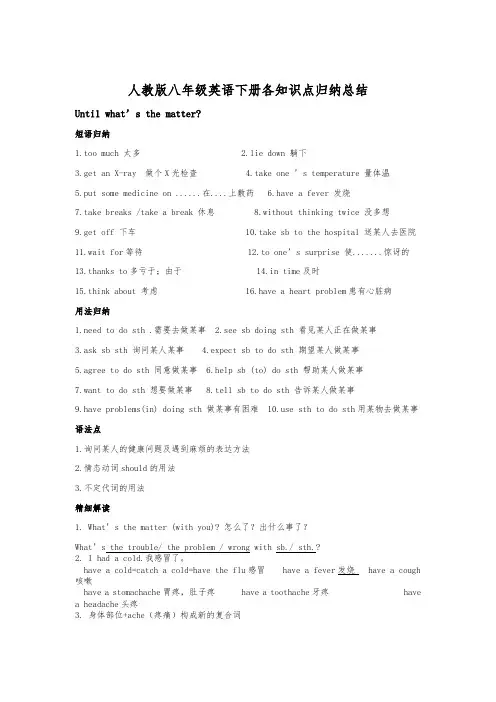
人教版八年级英语下册各单元语法点汇总
- 格式:doc
- 大小:51.50 KB
- 文档页数:18
Unit 1 What’s the matter一、询问某人的健康问运及遭到麻烦的表达方法(1)询问某人患了何种疾病或遇到了何种麻烦时,常用以下几种结构来表达:What’s the matter (with sb.)(某人)怎么了What’s wrong (with sb.)(某人)怎么了What’s the trouble (with sb.)(某人)出什么事了What happened (to sb.)(某人)发生了什么事Are you OK你没事吧Is there anything wrong with sb.某人有什么事吗(2)要表达身体疼痛或不舒服,可用以下结构:①某人+have/has+病症.The twins have colds.双胞胎感冒了。
某人+have/has+a+headache/toothache/stomachache/backache/earache.She had a stomachache last night.她昨晚肚子痛。
③某人+have/has+a+sore+发病部位.He has a sore throat.他喉咙痛。
④某人+hurt(s)+身体部位或反身代词.He hurt his leg.他的腿受伤了。
⑤某部位+hurt(s).My head hurts badly.我头痛得厉害。
⑥某人+have/has+a pain+in one’s+身体部位,I have a pain in my chest.我胸口痛。
⑦(There is)something wrong with one’s+身体部位.There is something wrong with my right eye..我的右眼有毛病。
⑧其他表达方式She has a heart trouble.她有心脏病。
He got hit on the head他头部受到了撞击。
She cut her finger.她割破手指了。
二情态动词should的用法1.Should为情态动词,意为“应该;应当”,否定式为shouldn’t,其后接动词原形,无人称和数的变化。
常用来表示征询意见、建议、劝告、要求或义务等。
You should drink hot water with honey.你应该喝加有蜂蜜的开水。
He should put his head back他应该把头后仰。
We should try our best to help him.我们应当尽力去帮助他。
You shouldn‘t watch TV.你不应该看电视。
2.Should用于主语为第一人称的疑问句,表示征询意见。
Should I put some medicine on it我应当给它敷上药吗Should we tell her about it我们应该告诉她这件事吗【拓展】在英语中,表示建议的说法有很多,而且都是中考考查的重点。
主要结构有:①Would you like (to do) sth.你想要/愿意(做)某事吗Would you like to play basketball with me你想要和我一起打篮球吗②Shall I/we do sth 我/我们做……好吗Shall we go to the zoo tomorrow明天我们去动物园,好吗③Why not do sth 为什么不……呢Why not join us为什么不加入到我们当中来呢④How/What about doing sth 做某事怎么样How about going swimming去游泳怎么样⑤Let’s do sth让我们做……吧。
Let’s go home.咱们回家吧。
⑥You’d better (not) do sth你最好(不)要做某事。
You’d better not go there alone.你最好不要一个人去那儿。
Unit 2 I'll help clean up the city parks动词不定式A. 作主语——为避免句子的头重脚轻,常用it作为形式主语,而真正的主语动词不定式后置。
常用句型:It +be+adj./n.+(for/of sb.) to do sth./It takes sb. some time to do sth.B. 作宾语——动词want, decide, hope, ask, agree, choose, learn, plan, need, teach, prepare…常接动词不定式作宾语。
C. 作(后置)定语——常用于“have/has+sth.+to do”或“enough+名+to do”“It’s time to do sth.”等结构中。
D. 作宾语补足语——tell, ask, want, invite, teach, like, call等可接带to的动词不定式作宾语补足语,构成tell/ask/want /call/invite sb. to do sth.结构。
【注意】动词不定式作使役动词和感官动词的宾语补足语时应省去to:“一感(feel),二听(listen to, hear),三让(let, make, have,,四看(look at, see, watch, notice),半帮助(help)”。
E. 动词不定式作状语主要用来修饰动词,表示目的,结果或原因。
为了强调目的,有时可以把动词不定式放在句首,或在不定式前加in order (to) 或so as (to) “为了,目的是”。
常用结构有too + adj./adv. + to do sth.等。
F. 固定句式中动词不定式的用法常见的形式有:had better (not) do sth./Would you like to do sth./Why not do sth./Would you please (not) do sth.等。
Unit 3 Could you please clean your roomCould you please...句型(1)请求别人时通常用此句型,也可以说:Can you...please情态动词could或can 在这里均表示请求,在意思上无区别,但是用could在于其上显得更委婉、客气、诚恳。
在日常生活中常使用could you/I...若在句末加上please,则显得更礼貌。
Could you help me find my book,please你能帮我找到我的书吗(2)对could you/I...的问句作出肯定回答,常用“sure/certainly/of course”等;如果作否定回答,常用“sorry或oh,please don’t”。
一般不用no开头,用no显得语气生硬、不礼貌。
(3)表示请求的句式:Would you like to do... Would you mind doing... Let’s d o.... Shall I/we do...Please do...(祈使句前加please)提示:could you please...与could I Please...两种问句,前者是请求别人帮忙的句式,后者是有礼貌地向别人请求允许的交际用语。
试比较:Could you please help me请你帮我一下好吗Could I please invite my friends to my birthday party,Mom 妈妈,我能邀请我的朋友参加我的生日聚会吗Unit 4 Why don't you talk to your parents1.提建议向别人发出邀请,请求,建议,或征求某人的意见的其他表达方式:How /what about doing sth.(about是个介词,可跟名词或动名词)“…怎么样”You’d better (not) do something.“你最好(不)做某事”Would you like sth …:“你想要某物Let‟s do sth…What should I do …( should表示请求、征询对方意见)2.学会谈论问题和学会用why don't you…提建议向别人发出邀请,请求,建议,或征求某人的意见的表达方式:Why don‟t you do something =Why not do something 你为什么不做某事呢来表示请求、征询对方意见3.until, so that ,although引导的状语从句:1)until:在带有till或until引导的时间状语从句里,如果主句用肯定式,其含义是“一直到……时”,谓语动词只能用延续性动词。
如果主句用否定式,其含义是“直到……才……”, “在……以前不……”, 谓语动词可用瞬间动词。
Don‟t get off until the bus stops.2)so that引导目的状语从句(为了,以便)例如:He studies hard so that he could work better in the future3)although的用法意思相当于though(尽管,虽然),引导让步状语从句。
引导的从句不能与并列连词but,and,so等连用,但可以和yet,still等词连用。
例如:Although he was tired, he went on working.尽管他很累,但是他继续工作。
Unit 5 What were you doing when the rainstorm came过去进行时1. 基本概念:过去进行时表示在过去某一时刻或一段时间内正在进行的动作。
这一特定的过去时间除有上下文暗示以外, 一般用时间状语来表示。
2.结构was / were ( not ) + 动词-ing3.句式肯定式:I/He/She/It was working. We/You/They/ were working.否定式:I/He/She/It was not working.We/You/They/ were not working.疑问式和简略回答:Was I working Yes, you were. No, you were not. Were you workin g Yes, I was. No, I was not. Was he/she/it working Yes, he/she /it was. No, he/she/it was not. Were we/you/they working Yes, yo u/we/they were. No, you/we/they were not. 注:1) was not常缩略为wasn’t; were not常缩略为weren’t。