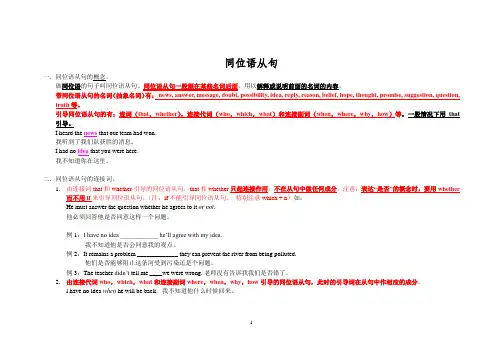
同位语从句——语法专题讲解
- 格式:doc
- 大小:569.50 KB
- 文档页数:6
高中英语语法专题讲解
专题二、同位语从句
一、同位语从句概述
同位语从句是用以解释说明某一名词内容的从句,常见的可以被同位语从句修饰的名词有:belief, chance, doubt, hope, idea, news, opinion, thought, promise等。引导同位语从句的词有连词that, whether和副词how, when, where等。
二、 同位语从句
(1) 同位语从句是意义完整的陈述句时,用连词that引导。注:that在从句中不充当任何成分,只起连接作用,通常不省略。
eg:I got the news that he would come to see me the next week.
(2) 同位语从句是疑问句时,应根据语境选用who, when ,where, how, whether(不能用if)等词来引导。
eg:The question who is the best for the job requires consideration.
(3) 分隔式同位语从句:当主句的谓语较短,而同位语从句较长时,为了使句子保持平衡,常把同位语从句后置。
eg:An idea came to him that he could buy her a diamond ring.
(4) 后面常跟同位语的词有:doubt, fact, hope, idea, message, news, possibility,
promise, question, suggestion,truth,thought,warning,wish等。
● 注:advice, order, suggestion等词表示建议、命令的词后的同位语从句中的谓语动词须用(should) +动词原形
eg:He made the suggestion that the meeting(should) be put off.
三、 同位语从句与定语从句的区别
(1) 所表达的内容不同:同位语从句和定语从句一般是放在某一名词后面,但同位语从句是对该名词的解释和说明,而定语从句是对该名词的修饰,说明它的性质特征。
eg:The fact that he presented was a strong proof.
The fact that she hadn’t said anything surprised us all.
(2) 在句中所起的语法作用不同:引导定语从句的that是关系代词,它的作用是连接主句和从句,并代表先行词在从句中充当句子成分,而且that作宾语时可省略,指物时,可以用which代替。引导同位语从句的that是连词,只起连接主句和从句的作用,它不充当任何成分,不能省略,也不可被which代替
eg:We expressed the hope that Mr and Mrs Smith would come to visit China the
next year.
The news that we heard spread all over the city.
(3) 所修饰的词不尽相同:同位语从句所修饰的名词数量有限,往往是含有某种信息的词,如:message,news,fact,hope,desire,problem,idea,suggestion,advice,questtion,
order, belief, doubt, fear, truth, throught等,而定语从句修饰的先行词无此限制。
(4) wh-引导词引导同位语从句时,有其本身的疑问含义;引导定语从句时则没有疑问的意思。
eg:I have no idea where the meeting will be held.
He is the only one of these boys who can speak Franch.
◆ 跟踪练习:
1、There is no obvious evidence_____ there is life on any other planet in the
solar system.
A. which B. that C. how D. where
2、My friend showed me round the town, _____was very kind of him.
A. which B. that C. where D. it
3、Many children, _____parents are away working in big cities,are taken good care
of in the village.
A. their B. whose C. of them D. with whom
4、Many young people in the West are expected to leave _____ could be life’s
most important decision—marriage---almost entirely up to luck.
A. as B. that C. which D. what
定 语 从 句 及 同 位 语 从 句 专 项 训 练
[ ] 1. That is _____ he said.
A. all what B. all which C. all that D. all
which
[ ] 2. These are things and persons ___I’ve heard of.
A. who B. whom C. which D.
that
[ ] 3. Please tell me everything ___you know. A. what B. that C. which D. all
what
[ ]4. We know the fact ___he has gone to college.
A. that B. which C. what D. why
[ ] received the news ____Xiao Ping had passed away.
A. what B. that C. which D. in
which
[ ] 6. This is the thing ___he referred to.
A. who B. whom C./ D. what
[ ] 7. This is the building, in front of ____there is a dog lying on
the ground.
A. that B. which C. it D./
[ ] 8. Those are the students, most of ____are very active.
A. that B. them C. which D. whom.
[ ] 9. The girl ___father lives in Beijing won the first prize in maths.
A. who B. whose C. whom D that
[ ] 10. The factory ___we work is very big..
A. that B. which C. where D. who
[ ] 11. The factory ___we visited is very big.
A. that B. where C. in which D. on
which
[ ] 12. This is the day ___we joined the army.
A. which B. that C. when D. in
which
[ ] 13. The days ___we spent last year will not be forgotten.
A. that B. on which C. in which D.
when
[ ] 14. He has such a book ___I borrowed from the library.
A. which B. that C. as D. what
[ ] 15. He made the same progress ___I did in my entrance examination..
A. what B. that C. on which D.
as
[ ] 16. The reason ___he gave me was not reasonable.
A. that B. why C. for D. for which
[ ] 17. September 18, 1913 is the day _____we’ll never forget.
A. that B. when C. on which D. on
that
[ ] 18. I remember the day ___I first came to the college.
A. on which B. in which C. which D.
that
[ ] 19. Is this factory ___we visited last year
A. where B. in which C. the one D. at
which
[ ] 20. Is this the factory ___your father worked
A. where B. which C. of which D. in
that
[ ] 21. This is the factory ___we visited the day before yesterday.