
Review of Chapter1-2
- 格式:ppt
- 大小:367.50 KB
- 文档页数:26

基于TMS320C5416 DSK的DSP实验课程书本书框架结构⏹第一章DSP概述⏹第二章TMS320C5416结构及其开发环境⏹第三章DSP软件开发详解⏹第四章DSP算法实现之一FFT⏹第五章DSP算法实现之二FIR⏹第六章外设和DSK⏹第七章DSP系统设计第一章DSP概述DSP的含义狭义理解可为Digital Signal Processor 数字信号处理器。
广义理解可为Digital Signal Processing 译为数字信号处理技术。
前者是指用于数字信号处理的可编程微处理器,后者则是指数字信号处理的理论和方法。
DSPDSP的结构特点⏹哈佛结构⏹多总线结构⏹指令系统的流水线(pipeline)操作⏹专用的硬件乘法器⏹特殊的DSP指令⏹快速的指令周期⏹硬件配置强DSP的结构特点⏹哈佛结构⏹多总线结构⏹指令系统的流水线(pipeline)操作⏹专用的硬件乘法器⏹特殊的DSP指令⏹快速的指令周期⏹硬件配置强DSP的结构特点⏹哈佛结构⏹多总线结构⏹指令系统的流水线操作⏹专用的硬件乘法器⏹特殊的DSP指令⏹快速的指令周期⏹硬件配置强指令系统的流水线(DSP的结构特点⏹哈佛结构⏹多总线结构⏹指令系统的流水线(pipeline)操作⏹专用的硬件乘法器⏹特殊的DSP指令⏹快速的指令周期⏹硬件配置强专用的硬件乘法器∑-()()A kB n kDSP的结构特点⏹哈佛结构⏹多总线结构⏹指令系统的流水线(pipeline)操作⏹专用的硬件乘法器⏹特殊的DSP指令⏹快速的指令周期⏹硬件配置强快速的指令周期随着集成电路工艺的发展,DSP广泛的采用微米CMOS制造工艺,其运算速度越来越快。
以TMS320C54x为例,其运算速度可达100MIPS以上。
DSP的结构特点⏹哈佛结构⏹多总线结构⏹指令系统的流水线(pipeline)操作⏹专用的硬件乘法器⏹特殊的DSP指令⏹快速的指令周期⏹硬件配置强硬件配置强新一代的DSP芯片的接口功能越来越强,片内具有串口、主机(HPI)、DMA控制器等等。

一.概论Chapter 1. Introducing SLA1.Second language acquisition (SLA)2.Second language (L2)(也可能是第三四五外语) also commonly called a target language (TL)3.Basic questions:1). What exactly does the L2 learner come to know?2). How does the learner acquire this knowledge?3). Why are some learners more successful than others?4.linguistic; psychological; social.Only one (x) Combine (√)Chapter 2. Foundations of SLAⅠ. The world of second languages1.Multi-; bi-; mono- lingualism1)Multilingualism: the ability to use 2 or more languages.(bilingualism: 2 languages; multilingualism: >2)2)Monolingualism: the ability to use only one language.3)Multilingual competence (Vivian Cook, Multicompetence)Refers to: the compound state of a mind with 2 or more grammars.4)Monolingual competence (Vivian Cook, Monocompetence)Refers to: knowledge of only one language.2.People with multicompetence (a unique combination) ≠ 2 monolingualsWorld demographic shows:3.Acquisition4.The number of L1 and L2 speakers of different languages can only beestimated.1)Linguistic information is often not officially collected.2)Answers to questions seeking linguistic information may not bereliable.3) A lack of agreement on definition of terms and on criteria foridentification.Ⅱ. The nature of language learning1.L1 acquisition1). L1 acquisition was completed before you came to school and thedevelopment normally takes place without any conscious effort.2). Complex grammatical patterns continue to develop through the1) Refers to: Humans are born with an innate capacity to learnlanguage.2) Reasons:♦Children began to learn L1 at the same age and in much the same way.♦…master the basic phonological and grammatical operations in L1 at 5/ 6.♦…can understand and create novel utterances; and are not limited to repeating what they have heard; the utterances they produce are often systematically different from those of the adults around them.♦There is a cut-off age for L1 acquisition.♦L1 acquisition is not simply a facet of general intelligence.3)The natural ability, in terms of innate capacity, is that part oflanguage structure is genetically “given” to every human child.3. The role of social experience1) A necessary condition for acquisition: appropriate socialexperience (including L1 input and interaction) is2) Intentional L1 teaching to children is not necessary and may havelittle effect.3) Sources of L1 input and interaction vary for cultural and socialfactors.4) Children get adequate L1 input and interaction→sources has littleeffect on the rate and sequence of phonological and grammatical development.The regional and social varieties (sources) of the input→pronunciationⅢ. L1 vs. L2 learningⅣ. The logical problem of language learning1.Noam Chomsky:1)innate linguistic knowledge must underlie language acquisition2)Universal Grammar2.The theory of Universal Grammar:Reasons:1)Children’s knowledge of language > what could be learned from theinput.2)Constraints and principles cannot be learned.3)Universal patterns of development cannot be explained bylanguage-specific input.Children often say things that adults do not.♦Children use language in accordance with general universal rules of language though they have not developed the cognitive ability to understand these rules. Not learned from deduction or imitation.♦Patterns of children’s language development are not directly determined by the input they receive.。
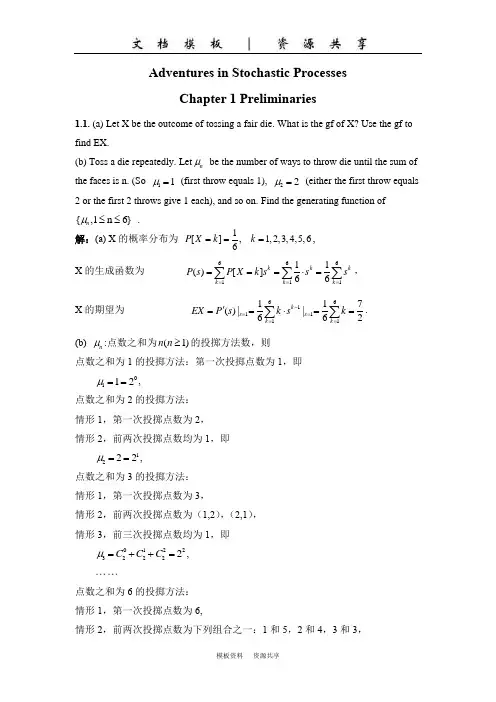
Adventures in Stochastic ProcessesChapter 1 Preliminaries1.1. (a) Let X be the outcome of tossing a fair die. What is the gf of X? Use the gf to find EX.(b) Toss a die repeatedly. Let n μ be the number of ways to throw die until the sum of the faces is n. (So 11μ= (first throw equals 1), 22μ= (either the first throw equals 2 or the first 2 throws give 1 each), and so on. Find the generating function of{,1n 6}n μ≤≤ .解:(a) X 的概率分布为 1[],1,2,3,4,5,66P X k k ===,X 的生成函数为 66611111()[]66kk kk k k P s P X k s s s ======⋅=∑∑∑,X 的期望为 6611111117()||662k s s k k EX P s k s k -===='==⋅==∑∑.(b) n μ:点数之和为(1)n n ≥的投掷方法数,则 点数之和为1的投掷方法:第一次投掷点数为1,即0112μ==,点数之和为2的投掷方法: 情形1,第一次投掷点数为2, 情形2,前两次投掷点数均为1,即1222μ==,点数之和为3的投掷方法: 情形1,第一次投掷点数为3,情形2,前两次投掷点数为(1,2),(2,1), 情形3,前三次投掷点数均为1,即012232222C C Cμ=++=,点数之和为6的投掷方法: 情形1,第一次投掷点数为6,情形2,前两次投掷点数为下列组合之一:1和5,2和4,3和3,情形3,前三次投掷点数为下列组合之一:1,1和4,1,2和3,2,2和2, 情形4,前四次投掷点数为下列组合之一:1,1,1和3,1,1,2和2, 情形5,前五次投掷点数为下列组合之一:1,1,1,1和2, 情形6,前六次投掷点数均为1,即015565552C C C μ=+++=,于是,n μ(6)n ≤的生成函数为66111()2nn n n n n P s s s μ-===⋅=⋅∑∑1.2. Let {},1n X n ≥ be iid Bernoulli random variables with 11[1]1[0]P X p P X ===-=and let 1nn i i S X ==∑ be the number of successes in n trials. Show n S has a binomial distribution by the following method: (1) Prove for 0,11n k n ≥≤≤+1[][][1 ] n n n P S k pP S k qP S k +===-+=.(2) Solve the recursion using generating functions. 解:(1) 由全概率公式,得1111111[][1][|1][0][|0]n n n n n n n P S k P X P S k X P X P S k X +++++++=====+===[1][]n n pP S k qP S k ==-+=(2) 1110()[]n k n n k P s P S k s +++===∑10([1][])n k n n k pP S k qP S k s +===-+=∑1110[1][]n nk kn n k k ps P S k sq P S k s +-====-+=∑∑11[][]n nlkn n l k ps P S l s q P S k s ====+=∑∑211()()()()()n n n ps q P s ps q P s ps q +-=+=+=+所以 1~(;1,)n S b k n p ++1.3 Let {,1}n X n ≥ be iid non-negative integer valued random variables independent of the non-negative integer valued random variable N and suppose()()11(), Var , , Var E X X EN N <∞<∞<∞<∞.Set 1nn i i S X ==∑. Use generating functions to check211Var()Var()()Var()N S EN X EX N =+ 证明:由1()(())N S N X P s P P s =所以 11111()()|(())()|()()N N S s N X X s E S P s P Ps P s E N E X =='''===,1111211()|[(())(())(())()]|N S s N X X N X X s P s P Ps P s P P s P s ==''''''''=+ 11112((1))((1))((1))(1)NX X N X X P P P P P P ''''''=+ (1(1)1X P =) 222111()()()()EN EN EX E N EX EX =-+- 22111Var()()EN X EN EX ENEX =+-又 2211()|()()N S s N N N P s E S ES E S ENEX =''=-=- 所以 22211()Var()()N E S EN X EN EX =+ 因此 22Var()()()N N N S E S ES =-2222111Var()()-()()EN X EN EX EN EX =+211Var()()Var()EN X EX N =+.1.4. What are the range and index set for the following stochastic processes : (a) Let i X be the quantity of beer ordered by the th i customer at Happy Harry's and let ()N t be the number of customers to arrive by time t . The process is(){}()10,N t i i X t X t ==≥∑ where ()X t is the quantity ordered by time t .(b) Thirty-six points are chosen randomly in Alaska according to some probability distribution. A circle of random radius is drawn about each point yielding a random set S . Let ()X A be the value of the oil in the ground under region A S ⋂. The process is () {,}X B B Alaska ⊂.(c) Sleeping Beauty sleeps in one of three positions: (1) On her back looking radiant. (2) Curled up in the fetal position.(3) In the fetal position, sucking her thumb and looking radiant only to an orthodontist.Let ()X t be Sleeping Beauty's position at time t. The process is (){} ,0X t t ≥. (d) For 0,1,n =, let n X be the value in dollars of property damage to West PalmBeach, Florida and Charleston, South Carolina by the th n hurricane to hit the coast of the United States.解:(a) The range is {0,1,2,,}S =∞,the index is {|0}T t t =≥;(b) The range is [0,)S =∞,the index is {1,2,,36}T =;(c) The range is {1,2,3}S =,the index is {|0}T t t =≥; (d) The range is [0,)S =∞,the index is {0,1,2,}T =.1.5. If X is a non-negative integer valued random variable with~{},()X k X p P s Es =express the generating functions if possible, in terms of () P s , of (a) []P X n ≤, (b)[]P X n <, (c) []P X n ≥. 解:0()[]k k P s P X k s ∞===∑1000()[]k kki k k i P s P X k s p s ∞∞===⎛⎫=≤= ⎪⎝⎭∑∑∑001i k i i i k i i s s p p s ∞∞∞===⎛⎫== ⎪-⎝⎭∑∑∑ 011()11i i i s p P s s s ∞===--∑; 12000()[]k kki k k i P s P X k s p s ∞∞-===⎛⎫=<= ⎪⎝⎭∑∑∑10101i k i i i k i i s s p p s +∞∞∞==+=⎛⎫== ⎪-⎝⎭∑∑∑0()11i i i s ss p P s s s∞===--∑; 300()[]kki k k i k P s P X k s p s ∞∞∞===⎛⎫=≥= ⎪⎝⎭∑∑∑100011i i k i i i k i s s p p s +∞∞===-⎛⎫== ⎪-⎝⎭∑∑∑ 0011()111ii ii i s sP s p p s s s s ∞∞==-=-=---∑∑. 1.8 In a branching process 2()P s as bs c =++, where 0,0,0,(1)1a b c P >>>=. Compuct π. Give a condition for sure extinction. 解:由(1)1P a b c =++=,可得 1()b a c -=-+,2()s P s as bs c ==++ 2(1)0as b s c +-+=2(+)0as a c s c -+=,1cs s a== (1)21m P a b '==+≤.1.10. Harry lets his health habits slip during a depressed period and discovers spots growing between his toes according to a branching process with generating function23456()0.150 .050.030.070.40.250.05P s s s s s s s =++++++Will the spots survive? With what probability?解:由 2345()0 .050.060.21 1.6 1.250.3P s s s s s s '=+++++, 可得 (1)0 .050.060.21 1.6 1.250.3 3.471m P '==+++++=>, 又由 23456()0.150 .050.030.070.40.250.05s P s s s s s s s ==++++++, 依据1π<,可得=0.16π.1.23. For a branching process with offspring distribution,0,1,01,n n p pq n p q p =≥+=<<解: ()1pP s qs=- ()1ps P s qs==- 210qs s q -+-=1s = 或 p s q=1(1)1k k qm P p kq p∞='===≤∑, 112p p p -≤⇒≥.Chapter 2 Markov Chains2.1. Consider a Markov chain on states {0, 1, 2} with transition matrix0.30.30.4=0.20.70.10.20.30.5P ⎛⎫⎪⎪ ⎪⎝⎭.Compute 20[2|0]P X X == and 210[2,2|0]P X X X ===.解:由题意得 20.230.420.350.220.580.20.220.420.36P ⎛⎫⎪= ⎪ ⎪⎝⎭,(2)202[2|0]0.35P X X p ====, 120[2,2|0]P X X X === 2110[2|2][2|0]P X X P X X =====(1)(1)22020.50.40.2p p =⋅=⨯=2.8. Consider a Markov chain on {1, 2, 3} with transition matrix1001112631313515P ⎛⎫ ⎪ ⎪⎪= ⎪ ⎪ ⎪⎝⎭. Find ()3n i f for 1,2,3,n =.解:当1i =时,对任意1n ≥,()1313[(1)]0n f P n τ===;当2i =时,对于1n ≥,()112323222311[(1)]()63n n n f P n p p τ--====⋅; 当3i =时,对于1n =,(1)3333331[(1)1]15f P p τ====, 对于2n ≥,()222333332222331111[(1)]()()56356n n n n f P n p p p τ---===⋅⋅=⋅⋅=⋅. Exercise. Consider a Markov chain on states {1,2,3,4,5} with transition matrix1000001000120012000120120120120P ⎛⎫ ⎪ ⎪ ⎪= ⎪ ⎪ ⎪⎝⎭,(1) What are the equivalence classes ?(2) Which states are transient and which states are recurrent ?(3) What are the periods of each state? (详细过程自己完成!)解:(1) 分为三类:{1},{2}和{3,4,5}.(2) 1,2为正常返状态,3,4,5为瞬过状态.(3) 状态1,2的周期为1,状态3,4,5的周期为2.。

研究生英语——多维教程——熟谙第一册原文TypescriptChapter 1 Learning to Listen1. Using What You Already KnowExercise 1Student: Excuse me.Counselor: Yes?Student: Do I need to make an appointment to register for an ESL class?Counselor: No, but you first have to take a placement test.Student: A test?Counselor: We need to find out what your ESL level is.Student: Oh, Okay. Where do I go to take the test?Counselor: We will be giving the test tomorrow at 3 o’clock in room 303. Can you come then? Student: Yes.Counselor: Good. Now, let me give you some forms to fill out so we can begin the registration process. Please write your name and address here, and your ID number here.Student: Okay. What do I write under teacher and section?Counselor: You can leave those blan k. We’ll fill it in tomorrow.Exercise 2Student A: I didn’t really understand what Ms. Smith was saying about the id, the superego and the ego.Student B: Oh, that’s easy. Look here on page 53. The id is the part of our personality that wants instant gratification. The ego tries to help the id get what it wants, but in a logical and practical way. The superego is like the personality’s police force. It monitors the id and the ego.Student A: Oh, I think I’m getting it. You mean the id, ego and superego are all part of our personality?Student B: Right. They are all interacting.Student A: Do you think we’ll need to give definitions?Student B: I don’t know. We may just have to match the names with the definitions. But we’d better study this some more just to be safe.2. Scanning for the Main IdeaExercise:A: I can’t believe it’s closed. I’ve got a class from 7 o’clock to 10 o’clock. What am I going to do? B: Well, there are some food machines in the Student Union. You could always go there.A: No way! I tried that once last semester and I got as s ick as a dog. There’s got to be something better.B: Well, we can go down to Main Street. There are a couple of places that I’m sure are open.A: We’d never make it back in time. It’s already 6:40. I think I’ll pass out if I don’t get something.I came her e right from work. I didn’t have time to stop by my apartment.B: I think there’s a stand in front of Smith Hall. You can at least get something warm there.A: Well, I guess we don’t have any other choice.B: Yeah, it’s either the canteen or three hours of listening to your stomach growl.3. Scanning for the Important PointsExercise:●Teacher: Good evening class. Before we begin tonight’s lesson. I want to remind you aboutnext Thursday’s midterm. Remember to review chapters one through eight in the book. You will be responsible for knowing all of the information in the chapters plus all of the other topics we have discussed in class. This test will include multiple choice, True/False, and essay questions. You will not be able to use any books, notes or dictionaries.●Now, last week, I spoke about the importance of using note cards and visual aids to prepareyour speeches. Tonight I’m going to talk about specific things that will help you with your speech delivery. Please take careful notes so you can use those techniques to improve your speech delivery.The first and perhaps the most important element of good speech delivery is eye contact. It is extremely important, especially in the English-speaking world, to make eye contact with your entire audience. This may be very difficult for you if you come from a culture where making direct eye contact is a sign of disrespect. But, you really need to practice this skill until you are comfortable looking directly at all of your audience members when you are speaking to them. Please note that you need to look at the entire audience. Please don’t direct your attention to just one person or one side of the room, and really be sure not to stare into the eyes of anyone for too long of a period.●Next, you need to make sure that when you talk to your audience, you are enthusiastic aboutyour topic and excited to share it with your audience. Vitality is a way of maintaining the audience’s attention and indicating to them that you firmly believe in what you are saying.V olume, intonation, facial expressions, and gestures all add to the vitality of your speech.Think abut a speaker you really liked. Did he or she just stand there and read words from a piece of paper? No, of course not. Probably the speaker was full of life and his or her energy forced you into becoming involved in caring about the topic of the speech.4. Inferencing (Making Intelligent Guesses)Exercise:Dr. Stevens: Ted, can I speak to you a minute?Ted: Yes, Doctor Stevens?Dr. Stevens: I finished reading your essay and before I return it to you, I was hoping you might be able to come in and speak with me about it.Ted: Oh, uh, okay, sure.Dr. Stevens: Can you come during my office hours?Ted: I think so. When are they again?Dr. Stevens: Tuesdays and Thursdays from 3 o’clock until 4:30.Ted: That’s no problem. Oh, wait a minute, I have football practice every day from 2 o’clock until 5 o’clock.Dr. Stevens: Hmm. Well, how about if we get together tomorrow right before class?Ted: Sure.5. Scanning for Specific Pieces of InformationExercise:You have reached the Student Union Activity Hotline. The following is a list of information and events for Thursday, September 18.The Student Union is open from 7:00 a.m. until 11:30 p.m. The cafeteria will be serving breakfast from 7 o’clock until 8:30, lunch from 11 o’clock until 1 o’clock, and dinner from 5 o’clock until 7 o’clock, The snack bar will be open from 9:00 a.m.—8:00 p.m.Assembly member Carole Berg will be speaking on the topic: “Parity pay for Women: It’s St ill Not Here.” Assembly woman Berg will speak in the Oak Room from 9 o’clock. Admission is free, and a question/answer period will follow.The Student Council will meet in room 27 from noon until 1:30. Elections will be held for all major offices. All students are welcome.The campus folk dance club meets in the Green Room from 2 o’clock until 5 o’clock today. All are welcome to attend; dance experience is not necessary.Bette Milder will be performing live in the Campus Corner Cabaret. The show begins at 8 o’clock. Tickets are available at the Ticket Office. All seats are $7.00.Tonight’s movie, the experimental “Dial Tones,” will be shown in the Union theater at 7:00 and 9:00 p.m. Tickets for both shows are $5.00 and are available at the ticket office.If you have missed anything on this recording, please press the pound key for the message to repeat. Thank you for calling the Student Union.6. Using Context CluesExercise 1A: Let’s exchange phone numbers. That way, if one of us is absent, we can call eac h other for the homework assignments.B: That’s a great idea. My number is 555---A: Wait a second, this pen just died. Let me get another one.B: Here, take my pencilA: Thanks. Okay, what was it?Exercise 21. Sentence: H e’s a real stickler.A: Who’s you r history professor?B: I’m in Dr. Leydorf’s class.A: Oh, How is he?B: The class is interesting and I really like him, but he’s a real stickler. If you’re more than fifteen minutes late, he marks you absent, and you have to hand in every assignment on time or he lowers your grade.A: Ooh! He sounds really tough.2. Sentence: you could have knocked me over with a feather!A: How did you do on your composition?B: Oh, you won’t believe it. I hadn’t worked on it very long and I didn’t have time to check it o ver. When the teacher returned it to me with an “A” on it, you could have knocked me over with a feather!A: Wow. That’s great. You must be really smart.B: Or else just lucky.3. Sentence: I’ve got to cram for a test.A: Let’s go to a movie tonight.B: So rry, I’ve got to cram for a test tonight. I haven’t had a chance to study before now.A: Well, how about going to the late show?B: No, I’m going to need a good night’s sleep. I want to make sure that I’m ready for the test.4. Sentence: Let’s get cracking.A: All right. We promised each other we’d get this report done today. Let’s get cracking.B: Aw, it’s such a beautiful day. Can’t we go for a walk and do this later?A: No, we’ll need to return these books to the library by five o’clock. We really have t o do this now.5. Sentence: Fat chance.A: Gee. It’s already a quarter after ten. Maybe Ms. Hughes is absent today.B: Fat chance. She’s never been absent a day in her life. I was in her class last year and she even came in when she had the flu.A: Well I guess she really loves teaching. Oh, here she comes now.7. Using Structure and Intonation CluesUsing StructureExercise 11. I’m taking Biology 101 this semester.2. I’m going to the Student Union at 7:00.3. We’re discussing parapsychological phenomena.4. When are you returning to the computer lab?5. We’re meeting with Dr. Stevens at the end of the lesson.Exercise 21.I am transcribing my sociology notes.2.John is defending his dissertation on Tuesday.3.We are forming a study group on the first day of class.4.I’m applying for financial aid to help pay my tuition and expenses.5.Ms. Wilson is correcting our essays over the weekend.Exercise 31.The professor is coming.2.The professor is coming in a little while.3.The Shakespeare Theater Group is performing Romeo and Juliet on the 17th.4.The Shakespeare Theater Group is performing Romeo and Juliet.5.The campus bookstore is having a big sale on all college sweatshirts.6.The campus bookstore is having a big sale on all college sweatshirts during Spring Break.Using Intonation CluesExercise1.I really wanted the new David Sedaris book. The professor in my contemporary lit classpraised it all last semester. The bookstore hasn’t been able to get a single copy for the last month. Oh, well. Maybe I can find a copy on .2.I used the new computer registration system to charge my tuition on my credit card, and theytotally messed it up. They were supposed to charge me $500 for the two art classes, and instead, it says that I’m enrolled in three history classes to the tun e of $900. This is ridiculous!3.Today is my graduation day. I am done! Now, I can finally spend my weekends doingsomething other than cramming for exams and writing term papers. Yippee!4.This schedule is baffling. It says that English 90 is offered at both the midtown and downtowncampuses, but the times are vague. Look here; does this nine mean AM or PM? Hmm, I’m stumped.5.Oh yeah. I absolutely recommend professor Ponz. She’s a real dilly, let me tell you. If youenjoy writing endless term papers on meaningless subjects, participating in class activities that have zero relevance to the topic of the course, she’s the teacher for you!Chapter TwoPart Two Main DialogueDenise: Excuse me, miss, how much does it cost to ride BART?Stranger: Well, that depends on your destination. From here to Glen Park it’s only a dollar ten, but if you go as far as Fremont, it costs a lot more.Tom: We’re going to Berkeley. Do you know what the fare is?Stranger: There are two stations in Berkeley. Which one are you interested in?Denise: Oh, gee, I’m not sure. We’re from out of town. We’re visiting my sister. She told me her house is just a stone’s throw from the UC Berkeley campus. Which station is that?Stranger: The downtown Berkeley station is really close to the university. I’m sure that’s the one you want.Denise: Tom, are you going to remember this, or should I be jotting this down?Tom: What is there to write down, Denise? The woman is giving us very simple directions. So, how much is the fare to downtown Berkeley?Strang er: Let’s go take a look at the map over there. You see, the map shows you how much it costs to go from one station to another. Ah, there it is: two dollars and sixty-five cents.Tom: Two sixty-five? That’s highway robbery for such a short distance!Denise: You think that’s expensive? Tom from our house to Amherst it costs twice as much as that. Tom: Yeah, but that’s an hour ride. You really get your money’s worth.Stranger: Yeah…Uh…Well, did your sister explain which train to take?Tom: Berkeley. We take the Berkeley train to Berkeley, right?Stranger: Well, no actually. That’s just one stop on the Richmond line. Here, let me show you on this map. Here we are a t Powell Street in San Francisco, and it’s basically a straight shot on the Richnond line to the downtown Berkeley station.Denise: Yes, my sister said we wouldn’t have to change trains.Stranger: Uh-oh, what time is it?Denise: It’s 8:15.Stranger: You can’t go directly to Berkeley from San Francisco after 8:04.Tom: Uh-oh. Is there another train we can catch?Stranger: Don’t worry. You can take the Pittsburg line. Look here, take the Pittsburg line to the 12th Street Station in Oakland, and then transfer to the Richmond train. The Richmond train willstop in Berkeley. Get off at the downtown station. From there you can walk to your sister’s house. Denise: We want to be there by 9 o’clock. If we have to transfer, we might be late. Do you think we’ll make it in time?Stranger: It doesn’t take that long. Let’s see; there’s a train from here at 8:18. It arrives at the 12th Street Oakland station at 8:34. You can get a Richmond train right away at 8:34, and you’ll arrive in Berkeley at 8:46.Tom: Let’s see if I’ve go t this right: We take the 8:18 Pittsburg train and arrive in Oakland at 8:34. Then we take the 8:34 Richmond train to Berkeley. That should be a snap.Stranger: Yeah, you’ll have no trouble.Tom: Thank you very much for your help, Miss. You’re a very kind young lady.Denise: And so pretty and smart, too! Tell me dear, I notice you’re not wearin g a ring. Stranger: Well, no, uh…Denise; You know, my sister’s son is very handsome. I think you two would like each other…Stranger: Uh, well; oh! I think I hear your train coming! You’d better hurry so you don’t miss it!Part ThreeExercise 3AThe BART system is a modern metro that links thirty-nine stations throughout Northern California’s San Francisco Bay Area. The trains are operated by computers and the BART station platforms have electronic signs that light up with information about trains that will be arriving.Exercise 3C1.How long does it take to get from JFK Boulevard to Town Plaza? That’s JFK Boulevard toTown Plaza.2.What is the fare from Oxford Avenue to College Avenue? That’s Oxford Avenue to CollegeAvenue.3.How much does it cost an dhow long does it take to go from Fifth Street/Florida to GroveStreet? Again, that’s both the fare and time from Fifth Street/Florida to Grove Street.4.How much is a round-trip ticket from 75th Street to Kentucky Street? That’s a round-tripticket from 75th Street to Kentucky.5.How much time does it take to travel from Kansas Street to 20th Street? Again, how muchtime does it take to travel from Kansas Street to 20th Street?6.You are at the Alabama Street station. It’s twelve noon and you just got on the train. Wha ttime will you arrive at the Madrid Avenue station? Again, it’s twelve noon and you’re going from Alabama Street to Madrid Avenue. What time will you arrive at the Madrid Avenue station?7.What time does the 4:07 PM train from Yonkers arrive at Grand Central Terminal? Again,what time does the 4:07 PM train from Yonkers arrive at Grand Central Terminal?8.What time does the 6:20 AM train from Grand Central Terminal arrive in Yonkers? That’sthe 6:20 AM train from Grand Central Terminal arrive in Yonkers.9.9. How many trains are there from Grand Central Terminal to Yonkers from 4:20PM until7:53 Pm? Again, how many trains are there from Grand Central Terminal to Yonkers from 4:20PM until 7:53 PM?10.How long is the trip from Yonkers to Grand Central Terminal? Again, that’s the time fromYonkers to Grand Central Terminal.11.Which trains from Yonkers to Grand Central Terminal do not stop at 125th Street? Again,which trains do no stop at 125th Street going from Yonkers to Grand Central Terminal? 12.Look at your watch. What time is it right now? What time will the next train from GrandCentral Terminal arrive at 125th Street? Again, using the time now, when will the next train from Grand Central Terminal arrive at 125th Street?Part FourExercise 11.Was her flight from New York on time?2.Did you get the rental car information?3.Which bus do I take to go downtown?4.Is Alice meeting us at the train station?5.Why was the man yelling at the stranger?6.Are you going to call the travel agent today?7.How long do we have to wait for the next bus?8.Where are you going after the meeting?9.What did you do with your extra ticket?10.Were you going to go to the airport alone?Exercise 21.What time did the plane arrive?2.How often do you take the bus?3.Did someone meet them at the airport?4.Why didn’t she tell us she would be late?5.Who will pay for the extra ticket?6.Were you at the bus station yesterday?7.How far is it from here to New Jersey?8.Which bus do you think we should take?9.Whose purse was left on the bus?10.Are you meeting your brother at the bus station?Part FiveExercise 11.How much is the fare to Kansas ST.?2.When is the next Yonkers train?3.Does this bus go to City Hall?4.How long does it take to get to Park Lane?5.Which line do I need to take to get to the Macarthur Station?6.Can you tell me how far the trip from Boston to San Diego is?7.What’s the fastest way to get to Grand Central Terminal from here?8.Do you know where the train for Atlanta stops?9.Exercise 21.The 12:20 train to Seattle will leave in two minutes.2.The next train to Yonkers will leave from Grand Central Terminal in ten minutes.3. A round-trip ticket from JFK Boulevard to Kansas St. is $2.90.4.We’re sorry, but the 12:10 train Riverdale will be six minutes late.5.The bus from Los Angles to Burbank leaves every fifteen minutes at that time of the day.6.The next Fremont train will leave from platform number 4 in half an hour.Exercise 31.Question: Where does this person want to go?A: Pardon me, how much does it cost to go to the Jefferson Auditorium?B: That’s $1.80 one way, but you can’t go directly there after 6:00 PM. You’ll have to take a Lenox train at that hour and then transfer to a Hastings train at the Portsmouth station. 2.Question: What time will the next bus for Chicago leave?A: Excuse me, when does the next bus to downtown Chicago leave?B: Let’s see. One just left at 8:00. The schedule says that that bus leaves every fifteen minutes, so…A: Uh-oh;it’s already 8:10. I’d better hurry.B: Ooh, I hope you make it.2.Question: What is the total round-trip fare for the children?A: May I help you?B: Yeah, we’d like to get tickets from Portland to Long beach.A: When are you planning on going?B: We were thinking of going the week of June 15th.A: Gook. That’s far enough in advance to take advantage of our supersaver fares. If you purchase your tickets thirty days in advance, it will only cost $240 round trip.B: $240. That sounds good.A: How many people are in your party?B: There’s my wife and me, plus our two kids.A: Ooh, we have a special discount available for our young travelers. Let’s see, kids under twelve fly for half price and those under three can go for free.B: Well, Evelynne is six and Renee is two.A: Very good. Let me check the computer to see which flights are open the week of the 15th. Exercise 41.It’s really easy to get to school from my house by bus.2.Greenwich is very close to London.3.I take a 20-minute bus ride from home to work every day.4.I leave my house each day at 8 am.5.We’re going to Hawaii for our next vacation.6.According to this, the train to Vancouver will arrive in ten minutes.7.Do I need a Bakerloo or a Victoria train to get to Picadilly Circus?8.How much is a ticket to Baltimore and then back again?9.You need to take a #5 bus to the Berman Station. Then, catch a #12.10.This bus is too crowded between 7am and 9am.。