新概念英语第二册Lesson 3
- 格式:doc
- 大小:46.00 KB
- 文档页数:2
5 Lesson 3 Please send me a card
Phrase:
1. in public gardends 在公园里 2. on the last day 在最后一天 3. every day 每天
4. make a decision 决定 5. think about 想到,想 6. not a single 连一个都没有
Intensive Reading:
1. but是连词,用来连接两个简单句,表示转折关系,它前面一般要用逗号点开。but决不能与 (al)though连用,注意中英文的区别。 eg. She was tired, but she went to work. (√) Although she was tired, but she went to work. (×)
2. spend 花费,度过,经常与on连用。 eg. Roy spent a lot of money on records.
spend 常用句型为:spend…doing/ on sth. eg. He’s spent half his life writing this book.
3. think about 意为“考虑”,think后不能直接加名词作宾语,而要借助合适的介词。
eg. think about a question 想问题,think of you 想你。但think后加句子时不需介词, eg. I think he will come soon.
4. make a big decision 意为“下大决心”,英语中make和take是两个搭配能力很强的动词,后接名词可组成许多不同的词组,但一般来说make和take不可互换使用,而分别与一定的名词搭配。
eg. make the bed, take a rest .
Key Structure:
1. 一般过去时:
A. 用法:描述已经执行和完成了的行为动作,但与现在的情况没有联系,而且必须跟确切的时间状语连用。
B. 时间状语:yesterday, the day before yesterday,in+确切过去时间,一段时间+ ago,last+确切时间。
C. 构成:主语+P.(动词过去式)
D. 动词过去式的变化规则:
1). 规则动词加ed,以e结尾加d, eg. repeat---repeated, die---died
2). 以辅音字母加y结尾,去y变成i加ed, eg. try---tried, carry---carried
3). 不规则变化, eg. begin---began,
run---ran
Special Difficulty:
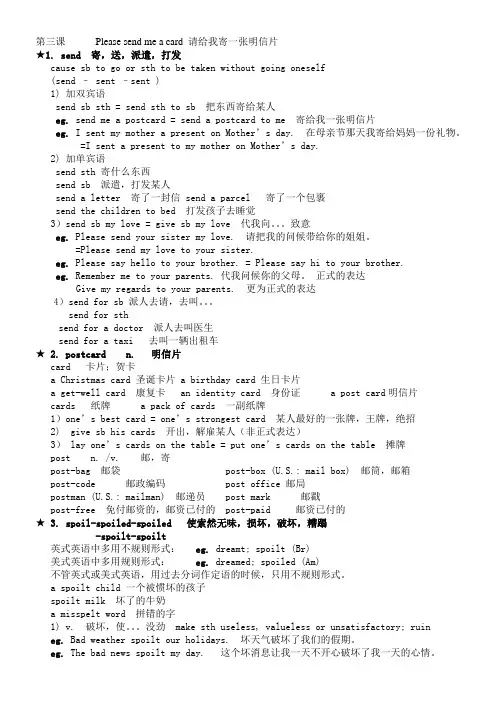
1. 英语中很多动词可带两个宾语,即间接宾语和直接宾语,间接宾语通常是人,直接宾语通常是事物。间接宾语一般在直接宾语之前,但也可以把直接宾语放在间接宾语之前,此时,直接宾语和间接宾语之间需加介词to/ for。
A. 动词+直接宾语+to+间接宾语: eg. he lent me a book→He lent a book to me.
用于这一句型的动词都有give(给予)的含义:
bring(带给), give(给予), grant(同意给), hand(交给), leave(遗留给), lend(借给), offer(提供给), owe(欠), pass(递给), pay(付给), post(寄给), promise(答应给), read(读给), recommend(推荐给), sell(卖给), send(寄给), show(出示给,给…看), sing(唱给), take(带给,拿给), teach(教给), tell(告诉,讲给), throw(扔给), write(写给)
假如这类动词后面使用for,就表示代替某人做某事, for的宾语不是接受物品的那个人。
eg. He wrote a letter to me. 他给我写了一封信(收信人是我)。
He wrote a letter for me. 他替我写了一封信(收信人不是我)。
B. 动词+直接宾语+for+间接宾语: eg. She bought me a dress. → She bought a dress for me. 她给我买了条裙子。
用于这类句型的动词大部分都有“给/为某人干某事”的意思。
buy (给…买),call(给…叫), choose(给…挑选), cook(给…做饭), do(给…干), fetch(给…取来),
find(给…找到), get(给…弄到), keep(替…保存), leave(给…剩/留下), make(给…做/煮), order(给…点菜), save(省去)
在这类句型中,for可以有两种解释,一是接受物品的人,二是代替某人做某事,根据上下文而定。
eg. My dad bought a new watch for me. 爸爸为我买了一块新手表。
I’ll make the bookcase for you. 我来替你做书架。
Discrimination:
1. common/ general/ popular/ public:
这些形容词都指(感染力、用途、影响等的)广泛性,作“普遍的、公认的”解:
common 指共同的,暗示某人或某物为日常的、普遍使用的或周知的;
general 指一般的、全面的,具有普遍性; 6 popular 指大众的,表示在大多数人、物或特定的阶层中流行;
public 表示公共的。
2. spoilt/ spoiled:
两者都是spoil的过去式,但spoilt在语气上听起来比spoiled更强,而且经常可以作定语, eg. a spoilt child 一个被宠坏的孩子。
3. all/ whole:
这两个形容词的意思往往相同,但词序不同。all用于冠词和所有格之前。 eg. all the time
whole 则用于冠词和所有格之后, eg. the whole time
Exercise:
一、动词填空:
1. He (teach) me English in 1987.
2. She (get) a bad cold last week.
3. Tom (not do) his homework the day before yesterday.
4. Yesterday I (think) that you were not in Shanghai.
5. I (lose) my wallet on the way.
6. They (leave) home a moment ago.
7. He (read) the book last month.
8. Alice usually (sit) in the front of the classroom, but she (sit) at the back this morning.
9. She usually (spend) a lot of money on dresses.
10. I (write) a letter to my father this morning.
二、在必要的地方用适当的介词填空:
1. last autumn, I went Beijing and visited the Great Wall.
2. If animals can think , what do yu think they think ?
3. I didn’t go anywhere the last day of my visit.
4. I spent several hours my room writing postcards.
5. She always talks to me a friendly way.
6. Please ask Bill to call a taxi me.
7. He still owes a lot of money me.
8. He offered drinks everyone in the bar.
三、改错:
1. Shall we make a rest after such a long walk?
2. I’m always thinking this question: Why Mary doesn’t like to go to the park.
3. Would you please take the bed yourself before going to bed?
4. My father thinks about you may want to see the film, too.
四、把括号内的词语改换句子:
1. The speaker is very friendly. (speak)
2. It was an early train (arrive)
3. He decided to go to the cinema last night. (make a decision)
4. The old man likes to sit in a park for a while every morning. (garden)
5. The teacher is considering an important questio. (think)
五、用括号内的时间短语改写下列句子:
1. I study English every day. (yesterday)
2. Do you swim after lunch? (just now)
3. My sister doesn’t write to me. (last month)
4. Mr. Smith visits our university. (three days ago)
5. He doesn’t understand modern literature. (when he was a boy)
A man should keep his friendship in constant repair. 只有经常“浇灌”,友谊方能地久天长。