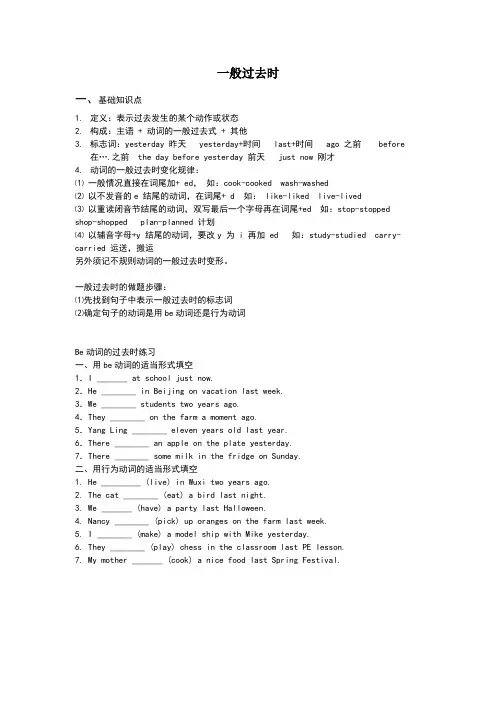
七年级一般过去时知识点
- 格式:docx
- 大小:37.07 KB
- 文档页数:6
七年级一般过去时知识点
一、一般过去时的定义
一般过去时表示在过去发生的动作或存在的状态。在英语中,动词的过去式通常是通过在动词后加“-ed”形成的(有些动词则会有不规则的过去式形式)。
例如,walk的过去式是walked,但是,go的过去式是went。
二、动词的过去式
大部分动词的过去式都可以在动词后面加上“-ed”,如:
play → played
clean → cleaned
hope → hoped
有一些动词是不规则的,如:
go → went
have → had
eat → ate
需要记忆这些不规则形式。
三、一般过去时的肯定句、否定句、疑问句
1. 肯定句
构成:主语 + 动词过去式 + 其他
例如:
I played football yesterday.
She cleaned the house last night.
2. 否定句
构成:主语 + did not + 原形动词 + 其他
例如:
I did not play football yesterday.
She did not clean the house last night.
3. 疑问句
构成:Did + 主语 + 原形动词 + 其他?
例如:
Did you play football yesterday?
Did she clean the house last night?
四、一般过去时的时间状语
在一般过去时中,时间状语可以用来说明动作发生的具体时间。以下是一些常用的时间状语:
yesterday → 昨天
last night → 昨晚
last week → 上个星期
last year → 去年
例句:
I ate breakfast yesterday.
We watched a movie last night.
She visited her grandparents last week.
五、一般过去时的用法
1. 表示过去的某个时间发生的动作。
例如:
We arrived at the station at six o'clock.
He went to the gym every day last week.
2. 表示过去的一段时间内反复发生的动作(过去的习惯)。
例如:
When I was a child, I played football every weekend.
She studied English for two hours every day.
3. 表示过去的状态。
例如:
I was tired after running for an hour.
The sky was dark before the storm.
总的来说,一般过去时在英语中非常常用,因此我们需要尽快学好并且尝试使用。