一般将来时态精讲
- 格式:doc
- 大小:35.00 KB
- 文档页数:5
一般将来时态精讲
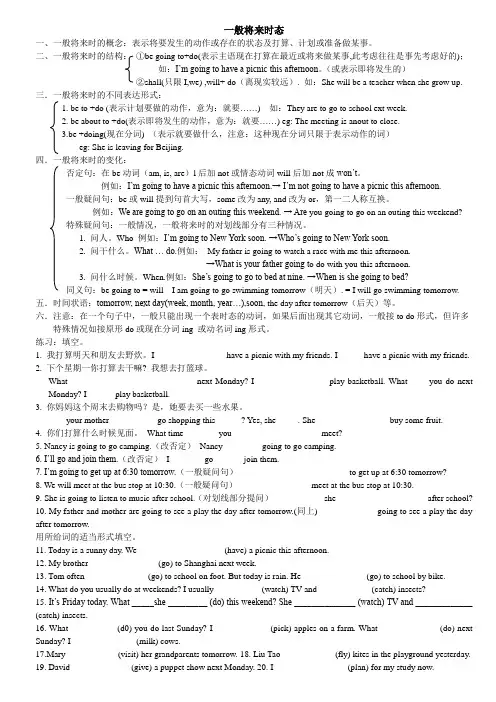
一一般将来时的定义
一般将来时表示将来某个时间所发生动的作或存在的状态,也可表示将来经常或反复发生的动作,经常与表示将来的时间状语连用, 如:soon, tomorrow,next week, in a few days等;例如:Where will you be this time tomorrow 明天这个时候你会在那儿
1. 表示将要发生的动作或存在的状态;例如:
I will return the book in a few days. 我过几天会还这本书;
2. 表示将来经常或反复发生的动作;例如:
They will go to the park every Sunday. 他们将每周日去公园;
二一般将来时的构成
一般将来时由“助动词shall/will+动词原形”构成;系动词am, is, are都用动词原形be;
1. shall用于第一人称后表示一般将来时,一般只限于肯定句和否定句中;shall通常用于第一人称后,由其构成的一般疑问句用来询问对方的意见,这时的shall不含将来含义,也不可被will替代;例如:
There’s no one to answer the phone. What shall we do 没有人接,我们该怎么办
2. 美国英语中,不论什么人称和数,一律用“will+动词原形”;在口语中,will常缩写为’ll,与主语连写在一起;如:I’ll, you’ll, he’ll, she’ll, we’ll, they’ll;而shall not常缩写为shan’t,will not常缩写为won’t;
三一般将来时的结构
1. 肯定句 :主语+shall\will+动词原形;
I shall\will work next year. 明年我将要工作了;
2. 否定句 :主语+shall\ will+not+动词原形;
I won’t tell anyone what you said. 你说的话我不会告诉任何人;
3. 一般疑问句 :Shall\Will+主语+动词原形
—Will you leave for Beijing next week 下周你将前往北京吗
—Yes, I will. 是的,我将要去; No, I won’t. 不,我不去;
4. 特殊疑问句
“特殊疑问词+一般疑问句”的语序,也就是“疑问词+will+主语+动词原形+其他成分 ”;如果是对主语提问,则主语就不在句子中出现;例如:
Who will leave for Beijing next week下周谁将前往北京
四There be 句型的一般将来时
There be 句型的一般将来时There will be表示“将来有……”;
1. 肯定句:There will be+ 物+ 介词短语+其他;例如:
There will be cars in people’s home in the future..将来人们的家里会很多的小汽车;
2. 否定句:There won’t be + 物+介词短语+ 其他;例如:
There won’t be any trees in this place in two years.两年后这个地方就不会有树了;
3. 疑问句:Will there be +物+介词短语+其他 例如:
—Will there be less pollution 将来会有更少的污染吗
—Yes, there will.是的,会的;
—No, there won’t. 不,不会;
五be going to 表示将来
1.用来表示按计划或安排要发生的动作
We are going to have a class meeting this afternoon.今天下午我们打算开班会;
2.表示推测将要或肯定会发生的动作,有“准备;打算”的意思;含有be going to 结构的句子中往往有表示将来的时间状语;例如:
Look at the black clouds. It's going to rain.看那些乌云,快要下雨了;
结构:
肯定句:主语 + beam,is,are + going to do sth.
否定句:主语 + beam,is,are+ not + going to do sth.
疑问句:Beam,is,are+ 主语 + going to do sth
Yes, 主语+ am/is/are. / No, 主语+ isn't/aren't. / No, I'm not.
They are going to see the car factory next week. 肯定句
They are not going to see the car factory next week. 否定句
-Are they going to see the car factory next week
-Yes, they are. No, they aren't. 一般疑问句及其回答
注意:There is / are going to be... 注意句型中going to 后面的be不能改为have; 常用来表示将有某事发生;例如:
There is going to be a football match next Saturday in our school.下周六我们学校将有一场足球比赛;
六 come, go, leave, arrive,take等表示位置移动的动词常用现在进行时表示将要发生的动作,它们很少与be going to 结构连用;例如:
Miss Sun is coming tonight.今晚孙小姐要来;
七be going to 和will的区别
1. will表示说话人认为、相信、希望或假定要发生的事,不含任何具体的时间,可以指遥远的将来;而be going to 指有迹象表明某事即将发生或肯定发生,通常指很快就要发生的事情;
2. 2. be gong to 和will均可表示意图,但事先考虑过的意图用be going to,不是事先考虑过的意图用will;
一般将来时练习
一、单项选择
1. There __________ a meeting tomorrow afternoon.
A. will be going to B. will going to be C. is going to be D. will go to be
2. Charlie ________ here next month.
A. isn’t working B. doesn’t working C. isn’t going to working D. won’t work
3. He ________ very busy this week, he ________ free next week.
A. will be; is B. is; is C. will be; will be D. is; will be
4. There ________ a dolphin show in the zoo tomorrow evening.
A. was B. is going to have C. will have D. is going to be
5. –________ you ________ free tomorrow – No. I ________ free the day after
tomorrow.
A. Are; going to; will B. Are; going to be; will
C. Are; going to; will be D. Are; going to be; will be
6. Mother ________ me a nice present on my next birthday. A. will gives B. will give C. gives D. give
7. – Shall I buy a cup of tea for you –________. 不,不要;
A. No, you won’t. B. No, you aren’t. C. No, please don’t. D. No, please.
8. – Where is the morning paper – I ________ it for you at once.
A. get B. am getting C. to get D. will get
9. ________ a concert next Saturday
A. There will be B. Will there be C. There can be D. There are
10. If they come, we ________ a meeting.
A. have B. will have C. had D. would have
11. He ________ her a beautiful hat on her next birthday.
A. gives B. gave C. will giving D. is going to give
12. He ________ to us as soon as he gets there.
A. writes B. has written C. will write D. wrote
13. He ________ in three days.
A. coming back B. came back C. will come back D. is going to coming back
14. If it ________ tomorrow, we’ll go roller-skating.
A. isn’t rain B. won’t rain C. doesn’t rain D. doesn’t fine