
BSB119 International_Marketing (Case Study - Coca-Cola India)
- 格式:ppt
- 大小:767.00 KB
- 文档页数:10
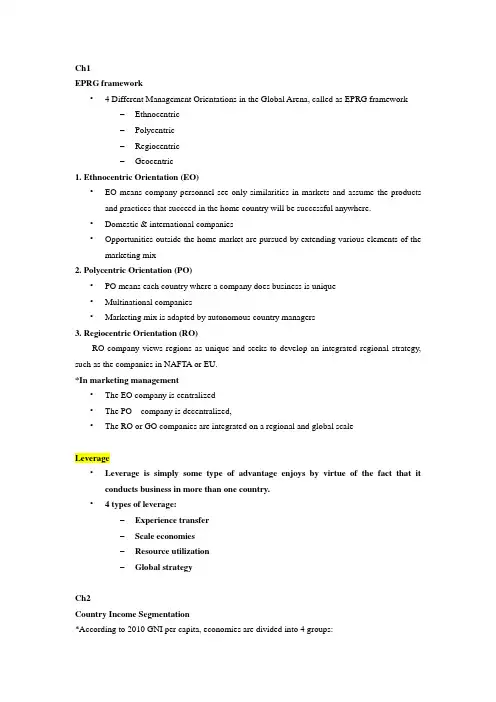
Ch1EPRG framework• 4 Different Management Orientations in the Global Arena, called as EPRG framework –Ethnocentric–Polycentric–Regiocentric–Geocentric1. Ethnocentric Orientation (EO)•EO means company personnel see only similarities in markets and assume the products and practices that succeed in the home country will be successful anywhere.•Domestic & international companies•Opportunities outside the home market are pursued by extending various elements of the marketing mix2. Polycentric Orientation (PO)•PO means each country where a company does business is unique•Multinational companies•Marketing mix is adapted by autonomous country managers3. Regiocentric Orientation (RO)RO company views regions as unique and seeks to develop an integrated regional strategy, such as the companies in NAFTA or EU.*In marketing management•The EO company is centralized•The PO company is decentralized,•The RO or GO companies are integrated on a regional and global scaleLeverage•Leverage is simply some type of advantage enjoys by virtue of the fact that it conducts business in more than one country.• 4 types of leverage:–Experience transfer–Scale economies–Resource utilization–Global strategyCh2Country Income Segmentation*According to 2010 GNI per capita, economies are divided into 4 groups:1.Low Income: $1,005 or less2.Middle Income: $1,006-$12,275•Lower Middle Income: $1,006 - $3,975•Upper Middle Income: $3,976 - $12,2753.High Income: $12,276 or more*How many countries or economies in the world?•World Bank member countries: 184•All other economies with populations of more than 30,000: 215 total1.Low Income: 35 (16%)2.Middle Income: 110 (51%)–Lower Middle Income: 56 (26%)–Upper Middle Income: 54 (25%)3.High Income: 70 (33%)Low-Income Countries1.Pre-industrial countries2.Characteristics:•Limited industrialization•High birth rates•Low literacy rates•Heavy reliance on foreign aid•Political instability•Concentration in Africa, south of the SaharaLower-Middle-Income Countries1.LDCs (Least Developed Countries)2.Characteristics•Early stages of industrialization•Expanding consumer markets3.Major competitive advantage in the production of mature, standardized, labor-intensiveproductsUpper-Middle-Income Countries1.Industrializing (developing) countries2.Population of agriculture is decreasing and the degree of urbanization is increasing.3.Rising wages, high rates of literacy, and advanced education4.Experience rapidly, export-driven economic growth5.Become strong competitorsHigh-Income Countries1.Advanced, industrialized (developed), post-industrial or First World Countries2.Importance of service sector – about 70% of GDP3.Ascendancy of knowledge over capitalCh3High- and Low-Context Cultures1.Low-context culture:•Messages are explicit•Words carry most of the information in communication•United States, Switzerland, Germany2. High-context culture•Less information is contained in the verbal part of the message•More information resides in the context of communication (background, associations, basic values of communicators)•Japan, Saudi Arabia3.In general, high-context cultures function with much less legal paperwork than is deemedessential in low-context ones.Hofstede’s Cultural Typology(P86 T3-2)• 5 dimensions:–Power Distance–Individualism / Collectivism–Masculinity–Uncertainty Avoidance–Long-term Orientation*Power Distance•The extent to which the less powerful members of a society accept -even expect- power to be distributed unequally.•High PD cultures: HK SAR, France•Low: Germany, Austria*Individualism / CollectivismA reflection of the degree to which individuals in a society are integrated into group.*Masculinity•Masculinity: a society in which men are expected to be assertive, competitive, and concerned with material success, and women fulfill the role of nurturer and are concerned with issues such as the welfare of children.•Femininity: a society in which the social roles of men and women overlap, which neither gender exhibiting overly ambitious or competitive behavior.*Uncertainty Avoidance•The extent to which the members of a society are uncomfortable with unclear, ambiguous, or unstructured situations.•Acceptance of uncertainty generally manifests itself in behavior that is more contemplative, relativistic, and tolerant.Self-reference criterion•It means unconscious reference to one’s own cultural values. It may cause culture myopia.•How to solve this problem?:-Define problem in terms of home country norms-Define problem in terms of host country norms-Isolate SRC influence. See how it complicates problem-Redefine problem without SRC influence. Solve for host country market situationCharacteristics of innovations•Relative advantage: the degree to which the innovation appears superior to existing P •Compatibility: the degree to which the innovation fits the values and experiences of potential consumers.•Complexity: the degree to which the innovation is difficult to understand or use.•Divisibility: the degree to which the innovation may be tried on a limited basis.•Communicability: the degree to which the results of using the innovation can be observed or described to others.Ch4CounterfeitingAssociative counterfeitingCh5GCCPFCCPLCCPCh6BSB’ Global Scan•Global Scan is a study that encompasses 18 countries, mostly located in the Triad.•To identify attitudes that could help explain and predict purchase behavior for different product categories, the researchers studied consumer attitudes and values, as well asmedia viewership or readership, buying patterns, and product use.•The survey attempts to identify both country-specific and global attitudinal attributes •Combining all the country data yielded a segmentation study known as TARGET SCAN,a description of 5 global psychographic segments.•BSB has labeled the segments as•Strivers•Achievers•Pressured•Traditionals•Adapters.•Strivers (26%). This segment consists of young people with a median age of 31 who live hectic, on-the-go lives. Driven to achieve success, they are materialistic pleasure seekers for whom time and money are in short supply.•Achievers (22 %). Achievers are status-conscious consumers for whom quality is important.•Pressured (13%).The Pressured segment, largely comprised of women, cuts across age groups and is characterized by constant financial and family pressures. Life's problems overwhelm the members of this segment.•Adapters (18%).This segment is composed of older people who are content with their lives and who manage to maintain their values while keeping open minds when faced with change.•Traditionals (16%). This segment is “rooted to the past” and clings to the country's heritage and cultural values.•Global Scan is a helpful tool for identifying consumer similarities across national boundaries, as well as highlighting differences between segments in different countries.Ch7Global Strategic Partnerships•Linkages between companies from different countries to jointly pursue a common goal,a.k.a.–collaborative agreements–strategic alliances–strategic international alliances–global strategic partnerships*The Nature of GSP• 3 characteristics–Participants remain independent following formation of the alliance–Participants share benefits of alliance as well as control over performance of assigned tasks–Participants make ongoing contributions in technology, products, and other key strategic areas*5 Attributes of True GSP•Two or more companies develop a joint long-term strategy•Relationship is reciprocal•Partners’ vision and efforts are global•Relationship is organized along horizontal lines (not vertical)•When competing in markets not covered by alliance, participants retain national and ideological identitiesCh8Brand Equity•The added value that accrues to a product as a result of investments in the marketing of the brand•An asset that represents the value created by the relationship between the brand and customer over timeGlobal Product PlanningStrategy 1: Dual Extension•Company sells exactly the same product or service with the same advertising as used in the home country•Company assumes that all markets are alike•Does not work in all markets•Often used because it saves costs•Example: KFC to English countriesStrategy 2: P. Extension, C. Adaptation•If the product serves different needs in various countries, only marketing communication may have to be adapted•It may cause product transformation.•Cheap implementation because product does not change•Example: Intel’s chips to ChinaStrategy 3: P. Adaptation, C. Extension•Product is adapted to the new market, but basic home market communication strategy remains unchanged•Product is adapted to the environment and the preferences of the consumers in the newmarket•Example: Exxon gasoline –“Put a Tiger in Your Tank”Strategy 4: Dual Adaptation•Using Dual Adaptation the company must adapt the product or service as well as the marketing communication to the foreign market•Example: P&G’ cosmetics in China MarketStrategy 5: Product Invention•New product with new communicationCh9Parallel importingKnown as Parallel importing, trademarked products are exported from one country to another where they are sold by unauthorized persons or organizations.Environmental Influences on PDGlobal pricing: 3 policy alternativesTransfer Pricing1.It refers the pricing of goods and services bought and sold by operating units or divisionsof a single company.2.The transaction is a intra-corporate not inter-corporate one.3.It is often higher or lower than the market price. more…4. 3 approaches to TP:–Cost-Based Transfer Pricing–Market-Based Transfer Pricing–Negotiated Transfer PricingCh10Piggyback Marketing•In this arrangement, one manufacture obtains product distribution by utilizing another company’s distribution channels.•Both parties can benefit: increase revenue for one party and save money for another party4 Market Entry Expansion Strategies For GR*Organic growthCompany uses its own resources to open a store on a Greenfield site or acquire one or more existing retail facilities*FranchiseAppropriate strategy when barriers to entry are low yet the market is culturally distant in terms of consumer behavior or retailing structures*Chain acquisitionA market entry strategy that entails purchasing a company with multiple existing outlets in a foreign country*Joint ventureThis strategy is advisable when culturally distant, difficult-to-enter markets are targetedCh11Selecting an Advertising Agency: 4 considerations•Company organization–Companies that are decentralized may want to leave the choice to the local subsidiary•National responsiveness–Is the global agency familiar with local culture and buying habits of a particular country?•Area coverage–Does the agency cover all relevant markets?•Buyer perception–What kind of brand awareness does the company want to project?Ch12Industry analysis: forces influencing competitionAccording to Michael E. Porter, there are 5 forces influencing competition in an industry:1.Threat of new entrants2.Threat of substitute products3.Bargaining power of buyers4.Bargaining power of suppliers5.Rivalry among competitorsThreat of now entrant1.New players push prices downward and squeeze margins, resulting in reduced industryprofitability.2.There are 8 major sources of barriers to entry.*8 major entry barriers1.Economies of scale2.Product differentiation3.Capital requirements4.Switching costs5.Distribution channelsernment policy7.Cost advantages independent of the scale economiespetitor responseThreat of substitute products1.The availability of substitute products may place limits on the prices; and2.High prices may induce buyers to switch to the substitute.Bargaining Power of BuyersBuyers can exert power over suppliers when:1.supplier firms depend on the buyers' business for survival.2.supplier's products are viewed as commodities3.suppliers industry's products or services represent a significant portion of the buyingfirms' costs.4.the buyer is willing to achieve backward vertical integration.Bargaining Power of Suppliers4 factors influence supplier bargaining power:•Large or relatively few in number?•Are their products or services important inputs to user firms? highly differentiated, or carry switching costs?•Is their business threatened by alternative products?•Their willingness and ability to develop their own products and brand names.Rivalry among competitors•It refers to all the actions taken by firms in the industry to improve their positions and gain advantage over each other, such as–price competition,–advertising battles,–product positioning, and–attempts at differentiation.•If it forces companies to innovate and/or rationalize costs, it can be a positive force.•If it drives down prices, and therefore profitability, it creates instability and negatively influences the attractiveness of the industry.*Several factors can create intense rivalry:–The industry becomes mature and firms focus on market share–The industry accumulates excess capacity–Lack of differentiation or absence of switching costs–Firms with high strategic stakes in achieving success in an industry generally are destabilizingNational competitive advantage。

创富国际备有技术指标文章与名词解释下载温馨提示:该文档是我店铺精心编制而成,希望大家下载以后,能够帮助大家解决实际的问题。
文档下载后可定制随意修改,请根据实际需要进行相应的调整和使用,谢谢!并且,本店铺为大家提供各种各样类型的实用资料,如教育随笔、日记赏析、句子摘抄、古诗大全、经典美文、话题作文、工作总结、词语解析、文案摘录、其他资料等等,如想了解不同资料格式和写法,敬请关注!Download tips: This document is carefully compiled by the editor. I hope that after you download them, they can help you solve practical problems. The document can be customized and modified after downloading, please adjust and use it according to actual needs, thank you!In addition, our shop provides you with various types of practical materials, suchas educational essays, diary appreciation, sentence excerpts, ancient poems, classic articles, topic composition, work summary, word parsing, copy excerpts, other materials and so on, want to know different data formats and writing methods, please pay attention!创富国际备有技术指标文章与名词解释是现代金融领域中非常重要的概念。


国际市场与营销职业资格认证项目(BMI)国际市场营销职业资格认证体系是由中国国家外国专家局培训中心和美国知名市场营销协会合作成立的中美国际市场营销体系研发中心根据国际市场营销管理发展的最新理念与最新研究成果,结合中国现实商业环境开发出来的一套具有国际领先水平的市场营销知识体系。
美国市场营销协会(American Marketing Association ,简称AMA)于1937年由市场营销企业界及学术界具有远见卓识的人士发起成立。
如今,该协会已发展成为世界上规模最大的市场营销协会之一,拥有30,000多名会员,他们在世界各地从事着市场营销方面的工作、以及营销领域的教学与研究。
作为面向营销人的领先机构,美国市场营销协会被视为市场营销从业者和学术研究人员的可信赖的主要资源平台。
经过多年经验的积累及众多资深专家的潜心研究,该协会推出了专门面向资深市场营销管理专业人士的认证项目一一国际注册高级市场运营官(AMA CMM )”该认证是目前国内市场营销领域的顶级认证,为资深的市场营销高级管理人才提供战略营销与规划,全球视野等最前沿、最先进的营销理念。
美国企业市场营销学会(Business Marketing institute,简称BMI)是由美国企业市场营销协会(Business Marketing Association (BMA)发展而来,是目前美国B2B营销领域中最大的专业协会。
它致力于为来自不同规模企业的市场管理、销售管理和产品管理专业人士提供B2B营销的教育和培训。
通过学习,市场专业人士能够在计划、执行和管理营销方案时掌握关键技能,能够成功运作B2B营销方案,并能够衡量和测评销售反馈的好坏。
同时,美国企业市场营销学会培训项目对很多B2B营销市场专业人士面临的战略性市场的内容和问题:比如为新企业和新产品制定可执行的市场计划、市场转机局面和新市场评估等内容进行解读并提供应对方法。
通过培训,学习者能够快速积累市场营销知识,学到切实可行的营销方法和决策支持工具,显著提高市场执行力和切实有用的市场营销管理技巧。