
unit-3 vocabulary
- 格式:ppt
- 大小:36.50 KB
- 文档页数:12


新视野大学英语1读写教程unit3第三版一、Unit3主要内容Unit 3是《新视野大学英语1读写教程》第三版中的一单元,主要内容涵盖了以下几个方面:1.Unit 3: Pop Music:本单元的主题是流行音乐。
通过本单元的学习,学生将了解流行音乐的发展和演变过程,并能够进行有关流行音乐的讨论和写作。
2.Reading Skills:阅读技巧方面,本单元将重点培养学生阅读理解和分析的能力。
通过阅读不同类型的音乐相关文章,学生将学会提取关键信息,理解作者观点以及进行文章摘要等技巧。
3.Writing Skills:写作技巧方面,本单元将针对流行音乐主题进行训练。
学生将学习音乐评论的写作技巧和表达方式,同时也将学会写作音乐观点陈述和比较对比的文章。
4.Vocabulary:本单元的词汇学习将围绕音乐主题展开。
学生将学习到与音乐相关的词汇,包括音乐类型、乐器、歌曲等。
5.Grammar:语法方面,本单元将重点学习并巩固过去时态的用法。
学生将学会正确运用不同的语态和时态来描述过去发生的事件和事实。
二、Unit 3学习目标完成本单元学习后,学生将能够:1.熟练运用流行音乐相关词汇进行交流,并描写自己对音乐的喜好。
2.通过阅读音乐评论,提取关键信息,理解作者的观点和态度。
3.运用正确的语法结构和句型,描述过去发生的事件和事实。
4.了解流行音乐的发展历程,掌握一些流行音乐的基本知识。
5.能够写出音乐评论和音乐观点陈述的文章。
三、Unit 3学习内容1. Reading Skills在本单元的阅读部分,学生将阅读两篇与流行音乐相关的文章。
•第一篇文章是一则音乐评论,主题是对一首流行歌曲的赞赏和解读。
学生需要通过阅读理解评论的内容,并思考自己对这首歌曲的看法。
•第二篇文章是一则关于流行音乐历史的短文。
学生需要通过阅读了解流行音乐从20世纪初到现在的发展过程,了解不同的音乐类型和风格。
通过阅读这两篇文章,学生将提高阅读理解的能力,并能够理解和分析不同类型的音乐文章。

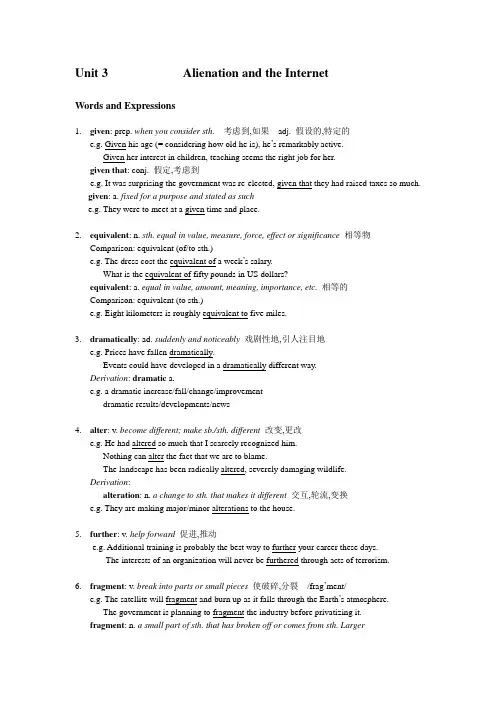
Unit 3 Alienation and the InternetWords and Expressions1.given: prep. when you consider sth. 考虑到,如果adj. 假设的,特定的e.g. Given his age (= considering how old he is), he’s remarkably active.Given her interest in children, teaching seems the right job for her.given that: conj. 假定,考虑到e.g. It was surprising the government was re-elected, given that they had raised taxes so much.given: a. fixed for a purpose and stated as suche.g. They were to meet at a given time and place.2.equivalent: n. sth. equal in value, measure, force, effect or significance 相等物Comparison: equivalent (of/to sth.)e.g. The dress cost the equivalent of a week’s salary.What is the equivalent of fifty pounds in US dollars?equivalent: a. equal in value, amount, meaning, importance, etc. 相等的Comparison: equivalent (to sth.)e.g. Eight kilometers is roughly equivalent to five miles.3.dramatically: ad. suddenly and noticeably 戏剧性地,引人注目地e.g. Prices have fallen dramatically.Events could have developed in a dramatically different way.Derivation: dramatic a.e.g. a dramatic increase/fall/change/improvementdramatic results/developments/news4.alter: v. become different; make sb./sth. different 改变,更改e.g. He had altered so much that I scarcely recognized him.Nothing can alter the fact that we are to blame.The landscape has been radically altered, severely damaging wildlife.Derivation:alteration: n. a change to sth. that makes it different 交互,轮流,变换e.g. They are making major/minor alterations to the house.5.further: v. help forward 促进,推动e.g. Additional training is probably the best way to further your career these days.The interests of an organization will never be furthered through acts of terrorism.6.fragment: v. break into parts or small pieces 使破碎,分裂/frag’ment/e.g. The satellite will fragment and burn up as it falls through the Earth’s atmosphere.The government is planning to fragment the industry before privatizing it.fragment: n. a small part of sth. that has broken off or comes from sth. Largere.g. Police found fragments of glass near the scene.I overheard a fragment of their conversation.Pronunciation:Note that when the same form is used as a noun, the stress shifts to the first syllable.Derivation:fragmentation n. 分裂e.g. the fragmentation of the country into small independent statesfragmented a. 成碎片的,片段的e.g. a fragmented society7.alienate: v. cause sb. to feel very distant from or not welcome to sb. else 使疏远,离间,麻木e.g. She was alienated from her brother by her foolish behavior.All these changes to the newspaper have alienated its traditional readers.Derivations:alien: a. & n. 外国的,陌生的;外星人e.g. In a world that had suddenly become alien and dangerous, he was her only security.aliens from outer space (n.)alienation: n. 疏远,离间,[哲]异化e.g. The new policy resulted in the alienation of many voters.Many immigrants suffer from a sense of alienation.8.addicted: a. being dependent on sth. and wanting to spend as much time doing it as possibleCollocation:be addicted to sth.e.g. Some youngsters are hopelessly addicted to video games.She’s become addicted to love stories.Derivations:addiction: n. 沉溺,上瘾e.g. He is now fighting his addiction to alcohol.addictive: a. 使人上瘾的e.g. Heroin is highly addictive.9.alcoholic: n. sb. who cannot stop drinking large amounts of alcohol, even when this is makinghim/her ill 酗酒者Word Formation:-aholic: (suffix in nouns) liking sth. very much and unable to stop doing or using ite.g. shopaholic; chocaholic; workaholic 购物狂;巧克力迷;工作狂10.in that: conj. (formal) for the reason that; because 因为e.g. She was fortunate in that she had friends to help her.Men differ from brutes in that they can think and speak.The news was all the more reliable in that it was from an official source.11.be given to: (formal) so sth. often or regularlyCollocation:e.g. The evidence against him was overwhelming.She had the almost overwhelming desire to tell him the truth.Derivation:be given to sth. / doing sth.e.g. He is given to heavy drinking.He is given to going for long walk on his own.12.exaggeration: n. continue in a course of action even in the face of difficulty or with little or noindication of success 夸张e.g. He told his story simply and without exaggeration.Derivations:exaggerate: v. make sth. seem larger, better, worse or more important than it really ise.g. The hotel was really filthy and I’m not exaggerating.He tends to exaggerate the difficulties.13.binge: n. an occasion when an activity is done in an extreme way, esp. eating, drinking orspending money 狂欢,作乐e.g. go on a binge / an Internet binge / a chocolate bingeOne of the symptoms of this disease is binge eating.14.skew: v. cause to be not straight or exact; twist 歪斜,扭转e.g. The company’s results for this year are skewed because not all our customers have paidtheir bills.Today’s election will skew the results in favor of the northern end of the country.ment: v. express sadness and regret about sth. 惋惜,哀悼e.g. He lamented the death of his friend.She lamented that she had never been to Paris.Derivation:lamentable: a. very disappointing 可悲的,哀伤的,可怜的e.g. She shows a lamentable lack of understanding.16.… it struck us that …: … it occurred to us that … / … we suddenly realized that …e.g. How does the concert last night strike you?He struck me as an odd, old-fashioned professor of Chinese.17.confront: 面对,遭遇(1)v. deal with a problem or difficult situationSynonym:face up to 大胆面对,勇于正视e.g. She knew that she had to confront her fears.He manifested extraordinary courage when confronted with formidable difficulty.(2) face sb. so that they cannot avoid seeing and hearing you, esp. in an unfriendly ordangerous situatione.g. The lawyer confronted the accused man with the forged check.This was the first time he had confronted an armed robber.18.perceive: v. see, notice, or realize sth., esp. when it is not obvious 注意到,察觉到,认为e.g. I perceived a change in his behavior.She perceived that all was not well.The patient was perceived to have difficulty in breathing.Derivations:perception: n. 观念,洞察力,认识能力perceptive: a. having or showing the ability to see or understand things quickly, esp.things that are not obvious 敏感的,有洞察力的,感知的e.g. It was very perceptive of you to notice that.perceptible: a. great enough for you to notice it (Synonym: noticeable) 可察觉的,能感觉到的e.g. Her foreign accent was barely perceptible.19.converse: n. the opposite 相反的e.g. In the U.S., cars are driven on the right side of the road, but in Britain the converseapplies.It is possible, of course, that the converse of this theory may also be true.20.maximize:(1) v. increase sth. as much as possiblee.g. maximize efficiency/fitness/profits[computing] Maximize the window to full screen.(2)v. make the best use of sth.e.g. maximize opportunities/resourcesAntonym: minimizeVocabulary ExercisesIII. Word Derivation1.alienation n. → alienate v.(1)制造业的工作又枯燥又单调,使许多工人产生了一种疏离感。
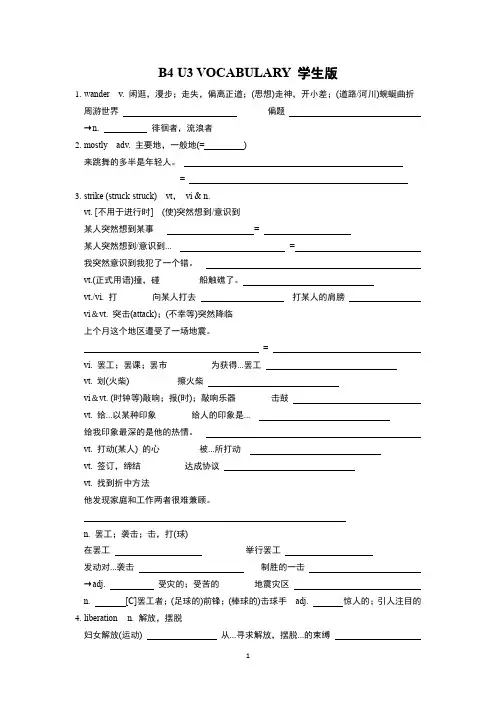
B4 U3 VOCABULARY 学生版1.wander v. 闲逛,漫步;走失,偏离正道;(思想)走神,开小差;(道路/河川)蜿蜒曲折周游世界偏题→n. 徘徊者,流浪者2.mostly adv. 主要地,一般地(= )来跳舞的多半是年轻人。
=3.strike (struck-struck) vt,vi & n.vt. [不用于进行时] (使)突然想到/意识到某人突然想到某事=某人突然想到/意识到... =我突然意识到我犯了一个错。
vt.(正式用语)撞,碰船触礁了。
vt./vi. 打向某人打去打某人的肩膀vi&vt. 突击(attack);(不幸等)突然降临上个月这个地区遭受了一场地震。
=vi. 罢工;罢课;罢市为获得...罢工vt. 划(火柴) 擦火柴vi&vt. (时钟等)敲响;报(时);敲响乐器击鼓vt. 给...以某种印象给人的印象是...给我印象最深的是他的热情。
vt. 打动(某人) 的心被...所打动vt. 签订,缔结达成协议vt. 找到折中方法他发现家庭和工作两者很难兼顾。
n. 罢工;袭击;击,打(球)在罢工举行罢工发动对...袭击制胜的一击→adj. 受灾的;受苦的地震灾区n. [C]罢工者;(足球的)前锋;(棒球的)击球手adj. 惊人的;引人注目的4.liberation n. 解放,摆脱妇女解放(运动) 从...寻求解放,摆脱...的束缚→v. 解脱,解放n. 解放者,释放者使A摆脱B的约束整个国家是在1949年解放的。
5.opposed adj. 截然不同的;强烈反对的反对做某事===我在这里出差而不是度假。
→n. 反对,敌对n. 对手,竞争者vt. 对抗;与...竞争我们强烈反对暴力与战争。
6.dominate v.在...中具有最重要的(或明显的特色;支配,控制;左右;(在比赛中等)占有优势;占据主动;(山、塔等)高出于;俯视(= )他否认他的国家想称霸欧洲。