6 chapter phenols
- 格式:ppt
- 大小:130.00 KB
- 文档页数:29
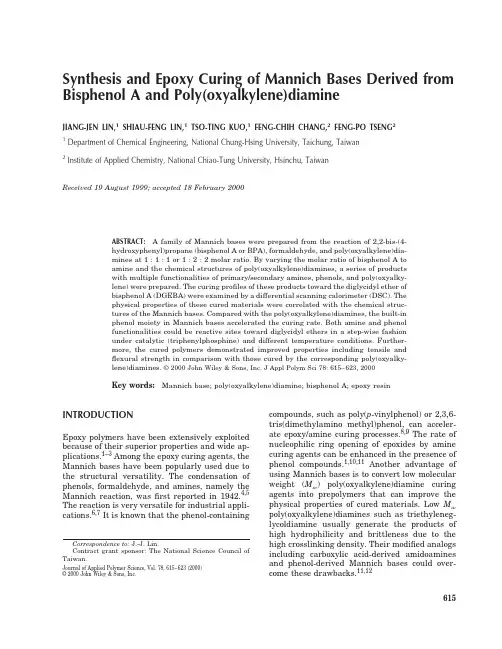
Synthesis and Epoxy Curing of Mannich Bases Derived from Bisphenol A and Poly(oxyalkylene)diamineJIANG-JEN LIN,1SHIAU-FENG LIN,1TSO-TING KUO,1FENG-CHIH CHANG,2FENG-PO TSENG21Department of Chemical Engineering,National Chung-Hsing University,Taichung,Taiwan2Institute of Applied Chemistry,National Chiao-Tung University,Hsinchu,TaiwanReceived19August1999;accepted18February2000ABSTRACT:A family of Mannich bases were prepared from the reaction of2,2-bis-(4-hydroxyphenyl)propane(bisphenol A or BPA),formaldehyde,and poly(oxyalkylene)dia-mines at1:1:1or1:2:2molar ratio.By varying the molar ratio of bisphenol A toamine and the chemical structures of poly(oxyalkylene)diamines,a series of productswith multiple functionalities of primary/secondary amines,phenols,and poly(oxyalky-lene)were prepared.The curing profiles of these products toward the diglycidyl ether ofbisphenol A(DGEBA)were examined by a differential scanning calorimeter(DSC).Thephysical properties of these cured materials were correlated with the chemical struc-tures of the Mannich pared with the poly(oxyalkylene)diamines,the built-inphenol moiety in Mannich bases accelerated the curing rate.Both amine and phenolfunctionalities could be reactive sites toward diglycidyl ethers in a step-wise fashionunder catalytic(triphenylphosphine)and different temperature conditions.Further-more,the cured polymers demonstrated improved properties including tensile andflexural strength in comparison with those cured by the corresponding poly(oxyalky-lene)diamines.©2000John Wiley&Sons,Inc.J Appl Polym Sci78:615–623,2000Key words:Mannich base;poly(oxyalkylene)diamine;bisphenol A;epoxy resinINTRODUCTIONEpoxy polymers have been extensively exploited because of their superior properties and wide ap-plications.1–3Among the epoxy curing agents,the Mannich bases have been popularly used due to the structural versatility.The condensation of phenols,formaldehyde,and amines,namely the Mannich reaction,wasfirst reported in1942.4,5 The reaction is very versatile for industrial appli-cations.6,7It is known that the phenol-containing compounds,such as poly(p-vinylphenol)or2,3,6-tris(dimethylamino methyl)phenol,can acceler-ate epoxy/amine curing processes.8,9The rate of nucleophilic ring opening of epoxides by amine curing agents can be enhanced in the presence of phenol compounds.1,10,11Another advantage of using Mannich bases is to convert low molecular weight(M w)poly(oxyalkylene)diamine curing agents into prepolymers that can improve the physical properties of cured materials.Low M w poly(oxyalkylene)diamines such as triethyleneg-lycoldiamine usually generate the products of high hydrophilicity and brittleness due to the high crosslinking density.Their modified analogs including carboxylic acid-derived amidoamines and phenol-derived Mannich bases could over-come these drawbacks.11,12Correspondence to:J.-J.Lin.Contract grant sponsor:The National Science Council ofTaiwan.Journal of Applied Polymer Science,Vol.78,615–623(2000)©2000John Wiley&Sons,Inc.615Recently,we have explored the Mannich bases prepared from simple phenols and dicyclopenta-diene (DCPD).13The flexibility of the cured ep-oxies was enhanced by the introduction of the tricyclodecane moieties.In this article,we report the preparation of the Mannich bases from bis-phenol A and poly(oxyalkylene)diamines.The products are composed of various functionalities including phenols,primary/secondary amines,and poly(oxyalkylene)segments at different com-positions.The methodology of preparing these bisphenol A-derived Mannich bases allows us to tailor a family of desired prepolymers as epoxy curing agents because BPA can provide four re-active sites for the variation.The curing process towards DGEBA was characterized by using a differential scanning calorimeter (DSC),and the mechanical properties of cured materials were tested.The relationship between the physical properties and the chemical structures is pur-posely addressed.EXPERIMENTALMaterialsThe poly(oxyalkylene)diamines including poly-(propylene glycol)bis(2-aminopropyl ether)at an average M w of 230(i.e.,Jeffamine D-230),and 400(i.e.,Jeffamine D-400),and triethylenegly-coldiamine at an M w of 148(i.e.,Jeffamine EDR-148)were obtained from Huntsman Chemical Company.Their chemical structures are shown in Figure 1.Liquid epoxy resin,diglycyidyl ether ofbisphenol A (DGEBA)with an epoxide equivalent weight of 188(trade name BE-188)was pur-chased from Nan-Ya Chemicals of Taiwan,and 2,2-bis-(4-hydroxyphenyl)propane (bisphenol A or BPA)from Showa Chemical Company,and for-malin from the TEDIA Company.Preparation of Mannich BasesThe typical experimental procedures for prepar-ing Mannich bases are described:to a 1-L four-necked round-bottom flask,equipped with a me-chanical stirrer,a thermometer,a heating man-tle,and a Dean-Stark trap,were added bisphenol A (228.0g,1.0mol),poly(propylene glycol)bis(2-aminopropyl ether)at an average M w of 230(230.0g,1.0mol)and toluene (100mL).The mix-ture was heated to 50°C while stirring,until it reached homogeneity.The mixture was allowed to cool down to an ambient temperature and was followed by adding formalin (81.0g,1.0mol)drop-wisely through a dropping funnel.After complet-ing the formalin addition,the reactor was heated to 80–90°C for 3h and was further increased to 100–110°C.At this temperature,the generated water was removed slowly through a Dean-Stark trap.Finally,the temperature was raised to 120–130°C for an additional 2h.The reactor was then cooled to 90°C,and subjected to low vacuum pres-sure to reduce water and toluene solvent.The recovered product was a sticky,yellow liquid (ad-duct 1a ).Using a similar procedure but different starting materials and stoichiometric ratios such as bisphenol A/CH 2O/diamine ϭ1/1/1or 1/2/2,adducts involving three different poly(oxypro-pylene)-and poly(oxyethylene)-diamineswereFigure 2The representative structures of Mannich bases prepared from various poly(oxyalkylene)dia-mines.Figure 1Chemical structures of starting poly(oxyal-kylene)diamines.616LIN ET AL.prepared.Six theoretical structures with mono-and di-substituted BPA Mannich compounds(x ϭ0and xϭ1,respectively)are illustrated in Figure2.Epoxy Curing in DSCEquivalent amounts of adducts1a,2a,2b,3a,or 3b and epoxy resin BE-188(DGEBA with average epoxide equivalent weight of188)were mixed at an ambient temperature and agitated until homo-geneity.The homogenized mixture was quickly placed in a differential scanning calorimeter (DSC)instrument to measure its maximum exo-thermic temperature(T P)and the glass transition temperature(T g).Triphenylphosphine(Ph3P)as an accelerator(2wt%based on epoxy)was added to the curing mixture in some cases.In a set of control experiments,a series of phys-ical mixtures of starting materials were used as curing agents.As an example,the stoichiometric amounts of bisphenol A and BE-188were mixed at100°C until becoming homogeneous.The mix-ture was allowed to cool,and the calculated amount of the starting diamine was then added at either ambient temperature or lower.The pre-pared samples were quickly placed in DSC for the measurement.In the specific case of highly reac-tive diamine such as triethyleneglycoldiamine, the samples were prepared near the freezing point to minimize the reaction before measure-ment.Preparation of Specimens for Mechanical Tests The mixtures of the prepared Mannich bases and epoxy resin BE-188were physically agitated and degassed at50°C in a vacuum oven for about5 min.The mixtures were then poured immediately into a preheated steel mold with caves.These caves were dogbone shaped for tensile tests and rectangular of different size forflexural or Izod impact tests.When the phenoxyl groups(—OH) were considered as reactive sites in addition to amines(—NH)in the calculation of equivalent weight towards epoxide,triphenylphosphine (Ph3P)was added as catalyst(2wt%based on epoxy).The curing temperature cycle was50°C 1h,100°C2h,and150°C2h.In the case of poly(propylene glycol)bis(2-aminopropyl ether)of 230M w(JeffamineD-230),the mixing and de-gassing process were carried out at room temper-ature.The resin mixture was cured under a sim-ilar heating cycle to that described above.The mixture of triethyleneglycoldiamine(JeffamineEDR-148)and epoxy had partly cured during ag-itation and before degassing.The bubbles remain-ing in the mixtures occasionally induced failure in preparing the test specimens.InstrumentationThe1H-NMR characterization was carried out by a Varian Unity Inova FT-NMR(600MHz)spec-trometer using CDCl3as solvent.FTIR spectra were obtained using a Perkin-Elmer Paragon500 FTIR spectrometer.The measurements using a differential scanning calorimeter(DSC)were car-ried out on a Seiko DSC5200at a heating rate of 10°C/min under nitrogen.Gel permeation chro-matography(GPC)analyses were performed in a HP1090M HPLC using THF as the eluent,cali-brated by polystyrene standards.Tensile proper-ties were measured according to ASTM D638-86 at a testing rate of5mm/min,andflexural prop-erties were measured according to ASTM D790at a testing rate of2.6mm/min using an Instron machine.Notched Izod impact tests were carried out at ambient conditions according to the test method of ASTM D256.Amine contents were es-timated by using the ASTM D2073-92titration method.RESULTS AND DISCUSSIONSyntheses of Mannich BasesThe Mannich reaction of bisphenol A,formalde-hyde(CH2O),and diamines including triethyl-eneglycoldiamine(EDR-148)and poly(propylene glycol)bis(2-aminopropyl ether)of230(D-230) and400M w(D-400)produced a series of Mannich bases,according to the reaction described in Fig-ure2.The bisphenol A molecule has four reactive sites towards formaldehyde addition,providing many possibilities for the structural variation in this reaction.By varying the starting diamines and BPA,the products can be structurally diver-sified.The Mannich bases prepared from bisphe-nol A/CH2O/diamineϭ1/1/1(adduct1a,2a,3a) and1/2/2(adduct1b,2b,3b)are listed in Table I. Attempts to prepare the products of bisphenol A/CH2O/diamineϭ1/3/3failed,due to the forma-tion of unworkable crosslinked gel materials.The analyses of amine contents in the prepared prod-SYNTHESIS AND EPOXY CURING OF MANNICH BASES617ucts were generally in good agreement with thetheoretical values,as shown in Table I.The GPCanalyses revealed the distribution of the weight-averaged molecular weight(M w)of these productsand residual starting materials or byproducts(Fig.3).The main peaks corresponded to theproducts of the calculated M w based on the stoi-chiometric molar ratios in Table I.These productsare considered to be the mixtures of analogousMannich bases.The typical IR spectrum of adduct1a indicatesthe characteristic absorption at3200–3400cmϪ1(—NH stretch),2800–3000cmϪ1(alkyl group),1600cmϪ1and1500cmϪ1(aromatic CϭCstretch),1103cmϪ1(C—O stretch,vs),1258cmϪ1(aliphatic C—N stretch).Two representative1H-NMR spectra of products1a and1b are given inFigures4and5,respectively.The following chem-ical shifts are assigned:␦0.95–1.2ppm(O—C—C—CH3),␦1.5–1.6ppm(Ph—C—CH3),␦3.0–3.7 ppm(—NH—NH2and OCH2CH),␦6.6–7.1ppm (aromatic).The observed␦3.7–4.0ppm is the characteristic chemical shift for the methylenelinkages(Ph—CH2—N)in the Mannich struc-tures.14,15The ratio of area integration forpeaks(Ph—CH2—N/aromatic protons/Ph—C—CH3ϭ0.07/0.11/0.09)is in good agreement with the theoretical structure of adduct1b at4/6/6.Foradduct1a(Ph—CH2—N/aromatic protons/Ph—C—CH3ϭ0.05/0.18/0.14)the integration ratio is also in agreement with2/7/6according to itsstructure.Similar IR and NMR spectrums wereobserved in other adducts(1b–3b).In general,adducts of molar ratio1/1/1(1a,2a,3a)have apparently higher viscosity than thecorresponding1/2/2(1b,2b,3b)analogs.Thismay be due to the presence of higher relative content of the rigid bisphenol A moiety in the molecular structures of1/1/1adducts.Epoxy CuringThe prepared Mannich bases were allowed to re-act with the epoxy BE-188in DSC to determine the curing profiles.Mannich bases cured epoxy with different stoichiometric amount of amine (denoted as—NH stoichiometry in Table II)or amineϩphenol(denoted as—NHϩ—OH stoi-chiometry in Table II).The peaks of maximum exothermic temperature(T P)and glass transition temperature(T g)of the cured polymers are im-portant indications for the nature of these curing agents.These features of curing behavior are summarized in Table II.The differences in molecular weights of the Mannich bases affected the curing kinetics.For example,the adducts derived from D-230exhib-ited a lower T P than the D-400analogs.Particu-Figure3The Mwdistribution of Mannich bases:ad-dict1a(BPA/CH2O/D-230ϭ1/1/1);adduct1b(BPA/CH2O/D-230ϭ1/2/2);adduct2a(BPA/CH2O/D-400ϭ1/1/1);adduct2b(BPA/CH2O/D-230ϭ1/2/2);adduct3a(BPA/CH2O/EDR-148ϭ1/1/1);adduct3b(BPA/CH2O/EDR-148ϭ1/2/2).Table I The Mannich Products of Bisphenol A, Formaldehyde,and Poly(oxyalkylene)diaminesAdductAmine Contents(mEq/g)Molecular WeightDistribution Calculated Found Calculated GPC1a 4.3 4.4470640 1b 5.6 5.8712893 2a 3.1 3.0640832 2b 3.8 4.310501500 3a 5.2 5.4388612 3b7.37.7548770 618LIN ET AL.Figure 4The 1H-NMR spectra of adduct 1a.Figure 5The 1H-NMR spectra of adduct lb .SYNTHESIS AND EPOXY CURING OF MANNICH BASES 619larly,the mixtures of triethyleneglycoldiamine (EDR-148)based adducts and epoxy cured at very low temperatures.It appears that the curing tem-perature is related to the structure.The curing profiles of adducts1a and1b,prepared from D-230,with epoxy in stoichiometric amounts of amine(—NH)to epoxide were shown in Figure 6.The T P s of the epoxy curing with adduct1a and 1b are both lower than that of curing with the starting material D-230.This can be explained by the accelerating effect of the phenoxyl groups (from bisphenol A)on the amine/epoxide reaction. The relative content of phenol moieties in adduct 1a is higher than in adduct1b in leading to lower T P in the curing profile.Similar results were also observed for paired adducts2a/2b and3a/3b.The polymers derived from adducts1a and1b have a higher T g(89.7and80.1°C)than that from D-230 (77.6°C).This is attributed to the existence of rigid bisphenol A structures in adducts1a and 1b.The same trend was observed in adducts2a and2b.But for EDR-148,the extremely high crosslinking densities of cured polymer had a higher T g(92.7°C)than those obtained from the corresponding Mannich bases(85.7°C for3a and 82.3°C for3b).Furthermore,epoxies cured from the Mannich bases of bisphenol A/amineϭ1/1(1a, 2a)generally showed higher T g than the analogs at bisphenol A/amine1/2(1b,2b),due to the higher content of bisphenol A moieties.The adducts1a and1b cured epoxy with stoi-chiometric amount of amineϩphenol(—NHϩ—OH)were shown in Figure7.The exotherms of more complicated patterns were observed,pre-sumably due to the additional phenol curing with epoxide in the existence of catalyst.It was found that the T g of cured polymers from—NHϩ—OH stoichiometry was higher than those from—NH stoichiometry.This imputes to the increase of the bisphenol A weight fraction in the network.Table II The Maximum Exothermic Temperature(TP )and Glass Transition Temperature(Tg)ofEpoxy Process in a Differential Scanning CalorimeterCuring Agent Stoichiometry Bisphenol A wt%TP (°C)Tg(°C)D-230O NH013077.6 D-400O NH013942.7 EDR-148O NH010592.7 1a O NH58.39720689.7 1b O NH53.111321880.1 2a O NH50.110420850.1 2b O NH44.912022348.4 3a O NH63.47824185.7 3b O NH58.49124282.3 1a O NHϩO OH60.59613293.5 1b O NHϩO OH55.411222092.1 2a O NHϩO OH53.912322768.7 2b O NHϩO OH48.113023161.2 3a O NHϩO OH64.38521586.5 3b O NHϩO OH59.89323385.3Control experiment(physical mixture of BPAϩdiamine)1aO NH18.89081.7 1bO NH12.69866.6 2aO NH16.59550.3 2bO NH10.610537.9 3aO NH24.37460.6 3bO NH13.88336.2 1aO NHϩO OH12.39413892.2 1bO NHϩO OH10.410476.0 2aO NHϩO OH13.09713560.6 2bO NHϩO OH9.010649.5 3aO NHϩO OH17.38293.8 3bO NHϩO OH11.28779.9 620LIN ET AL.Therefore,the phenoxyl group contributes to the curing process not only as an accelerator but also as a crosslinking site for epoxies.In the control experiment,the physical mixtures (BPA ϩdia-mine)of control experiments had apparently low viscosity compared to the analogous Mannich ed as curing agents,the physical mix-tures showed lower T P than the corresponding Mannich adducts,as demonstrated in Figures 6–7as well as Table II.This phenomenon was observed repeatedly in different curing systems including D-230,D-400,and EDR-148.It can be explained by the better mobility for the physicalmixture as a curing agent during the curing pro-cess in relation to the Mannich bases.The phys-ical mixtures cured polymers generally have lower T g than those from Mannich bases.The epoxy materials cured with the Mannich bases had a generally higher thermal stability than those cured with the corresponding physical mix-tures.A higher crosslinking density caused by the use of the Mannich bases as curing agents is as-sumed.The thermal stability of several representa-tive epoxies by TGA in air are shown in Figure 8.Overall,the Mannich bases prepared from bis-phenol A and poly(oxyalkylene)diamine had a generally higher curing reactivity than the corre-sponding poly(oxyalkylene)diamines.The curing rate was accelerated due to the presence of phe-noxyl group in the Mannich base.In all cases,the Mannich bases had more than one curing exo-therm because of the structural complexity.The nature of functionalities in chemical struc-tures contributes differently to the physicalprop-Figure 6The curing profiles of D-230derivatives with epoxy by stoichiometric amine inDSC.Figure 9Structures and nature of Mannich bases and epoxyresin.Figure 7The curing profiles of D-230derivatives with epoxy by stoichiometric amine plus phenol inDSC.Figure 8Thermal gravimetry analysis of epoxies cured by D-230derivatives in air.SYNTHESIS AND EPOXY CURING OF MANNICH BASES 621erties.The poly(oxyalkylene)segment isflexible in comparison with the bisphenol A backbone in nature(Fig.9).The bisphenol A is a rigid struc-ture,which also exists in the epoxy structure (DGEBA).It seems the relative contents of poly(oxyalkylene)vs.BPA determine the proper-ties of the epoxy products.Mechanical PropertiesThe factors contributing to the mechanical prop-erties can be also explained by the structural versatility as shown in Figure9.The hard and soft segments in the Mannich base structure gen-erated different epoxy polymer networks.The comparison of mechanical properties between the poly(oxyalkylene)diamines and the Mannich bases is summarized in Table pared to the starting material D-230(or D-400),the Man-nich base-cured materials exhibited an improve-ment in tensile strength andflexural modulus. This is credited to the bisphenol A in the Mannich base structure.Bisphenol A in the Mannich base structures had contributions as a hard segment and also good compatibility with epoxy.Similarly, the epoxies cured with—NHϩ—OH stoichiom-etry had higher tensile strength than those cured with—NH stoichiometry,due to the higher weight fraction of bisphenol A(Table II).With the incorporation of soft segments of poly(oxyalky-lene)diamines,the D-400derivatives are more flexible than those from D-230.Therefore,the epoxies cured from D-400derivatives exhibited lower tensile strength and lower T g than those from D-230derivatives.In the Izod impact strength,the Mannich bases at1/2molar ratio (adducts1b,2b)performed better than the ana-logs of1/1molar ratio(adducts1a,2a),similarly due to higher relative amount of poly(oxypro-pylene)structure in adducts1b and2b.When the physical mixtures were used as curing agents in control experiments,there were no significant changes in composition compared to the Mannich bases,and hence,no apparent changes on me-chanical properties.CONCLUSIONSThe Mannich reactions of bisphenol A,formalde-hyde,and poly(oxyalkylene)diamines at1:1:1or 1:2:2molar ratios afforded a series of Mannich bases.These products consisted of multiple func-tionalities of primary/secondary amines,phenols, andflexible poly(oxyalkylene)segments.Three types of reactive sites(primary amine,secondary amine,and phenol)in the Mannich base structure showed off in the complexity of curing profiles in pared with the starting poly(oxyalky-lene)diamines,the Mannich bases had a faster curing profile or cured at lower temperatures,due to the accelerating effect by the phenoxies.The tailored Mannich structures had a diversity ofTable III The Mechanical Properties of Epoxies Cured by the Mannich BasesCuringAgent EquivalentsTensile Flexural Izod TensileStrength(MPa)Strain atBreak(%)FlexuralStrength(MPa)Notch IzodImpact Strength(J/M)D-230O NH60.4(5.7)10.3(2.7)108.1(1.4)59 1a O NHϩO OH64.1(2.5)8.9(0.4)116.4(1.2)48 1b O NHϩO OH77.8(0.9)13.8(0.8)120.2(3.7)50 D-400O NH51.9(1.1)7.9(0.1)81.4(0.3)47 2a O NH52.6(10.5)7.1(2.2)96.2(4.7)37 2b O NH54.2(3.4)9.9(0.7)87.4(1.2)56 2a O NHϩO OH61.8(1.1)10.3(0.9)91.9(0.8)46 2b O NHϩO OH59.3(0.4)10.8(0.6)93.1(0.3)53Control experiment(physical mixture of BPAϩdiamine)2aO NH53.1(4.0)7.0(0.9)92.6(2.5)39 2bO NH56.0(1.1)10.0(0.3)86.4(0.1)38 2aO NHϩO OH59.8(0.5)11.0(0.9)90.8(1.8)42 2bO NHϩO OH56.4(0.9)10.6(0.6)84.6(0.1)40 622LIN ET AL.functionalities,which has curing properties in a stepwise manner.Furthermore,the cured poly-mers from Mannich bases had improved mechan-ical properties.The curing profiles and the me-chanical properties can be correlated with the Mannich structures.Thefinancial support from the National Science Coun-cil of Taiwan is acknowledged.REFERENCES1.May,C.A.Epoxy Resin:Chemistry and Technol-ogy;Marcel Dekker Inc.:New York,1988.2.Lee,H.;Neville,K.Epoxy Resins;McGraw-Hill:New York,1959.3.Lee,H.;Neville,K.Handbook of Epoxy Resins;McGraw-Hill:New York,1982.4.Blicke,anic Reactions;J.Wiley&Sons:New York,1942,p.303,vol.11.5.Tramontini,M.;Angiolini,L.Mannich Bases:Chem-istry and Uses;CRC Press:Boca Raton,FL,1994.6.Tramontini,M.;Angiolini,L.;Ghedini,N.Polymer1988,29,771.7.Leigh,D.A.;Linnae,P.;Jackson,G.TetrahedronLett1993,34,5639.8.Bagga,M.M.;Bull,C.H.U.S.Pat.4,659,779,1986.9.Grigsby,R.A.,Jr.;Speranza,G.P.U.S.Pat.4,714,750,1986.10.Suzuki,H.;Matsui,A.;Inoue,T.U.S.Pat.3,950,451,1973.11.Lin,J.J.;Speranza,G.P.;Waddill,H.G.J ApplPolym Sci1997,66,2339.12.Lin,J.J.;Speranza,G.P.;Waddill,H.G.J PolymRes1996,3,97.13.Tseng,F.P.;Chang,F.C.;Lin,S.F.;Lin,J.J.J Appl Polym Sci1999,71,2129.14.Jamois,D.;Tessier,M.;Marechal,E.J Polym SciPart A Polym Chem1993,31,1923.15.Jamois,D.;Tessier,M.;Marechal,E.J Polym SciPart A Polym Chem1993,31,1959.SYNTHESIS AND EPOXY CURING OF MANNICH BASES623。