
货币银行学Chapter19
- 格式:ppt
- 大小:526.50 KB
- 文档页数:16


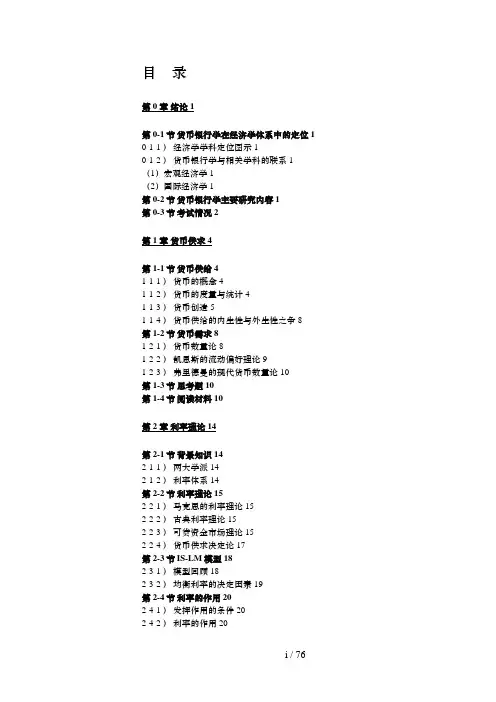
目录第 0 章绪论1第0-1节货币银行学在经济学体系中的定位1 0-1-1)经济学学科定位图示10-1-2)货币银行学与相关学科的联系1 (1)宏观经济学1(2)国际经济学1第0-2节货币银行学主要研究内容1第0-3节考试情况2第 1 章货币供求4第1-1节货币供给41-1-1)货币的概念41-1-2)货币的度量与统计41-1-3)货币创造51-1-4)货币供给的内生性与外生性之争8 第1-2节货币需求81-2-1)货币数量论81-2-2)凯恩斯的流动偏好理论91-2-3)弗里德曼的现代货币数量论10第1-3节思考题10第1-4节阅读材料10第 2 章利率理论14第2-1节背景知识142-1-1)两大学派142-1-2)利率体系14第2-2节利率理论152-2-1)马克思的利率理论152-2-2)古典利率理论152-2-3)可贷资金市场理论152-2-4)货币供求决定论17第2-3节IS-LM模型182-3-1)模型回顾182-3-2)均衡利率的决定因素19第2-4节利率的作用202-4-1)发挥作用的条件202-4-2)利率的作用20第2-5节中国的利率市场化改革20第2-6节思考题21第 3 章通货膨胀理论22第3-1节定义与类型223-1-1)定义223-1-2)主要类型223-1-3)阅读材料23第3-2节通货膨胀运行过程的AS-AD模型分析24 3-2-1)需求拉上型253-2-2)成本推动型263-2-3)供求混合型273-2-4)本节阅读材料28第3-3节通货膨胀的经济效应293-3-1)通货膨胀与短期经济增长293-3-2)通货膨胀与长期经济增长303-3-3)通货膨胀预期的经济效应31第3-4节思考题目31第 4 章金融体系32第4-1节金融机构体系324-1-1)金融机构体系的构成324-1-2)金融体系的功能324-1-3)中国金融体系存在的问题32第4-2节融资方式与融资结构324-2-1)融资方式334-2-2)中国融资格局的变动趋势334-2-3)资产证券化334-2-4)本节阅读材料34第4-3节金融监管体系354-3-1)金融风险与金融监管354-3-2)中国的金融监管组织体系354-3-3)金融监管的一般内容354-3-4)金融监管体系364-3-5)本节阅读材料36第4-4节思考题40第 5 章金融市场41第5-1节金融市场体系及其功能415-1-1)金融市场体系415-1-2)金融市场的功能41第5-2节金融工具的发展415-2-1)金融工具的类型415-2-2)金融工程42第5-3节金融市场理论的发展425-3-1)风险与收益425-3-2)投资组合理论425-3-3)资本资产定价模型(CAPM)435-3-4)套利定价模型(APT)43第5-4节思考题43第 6 章金融创新44第6-1节金融创新理论446-1-1)金融创新的概念446-1-2)金融创新动因的理论解释446-1-3)金融创新相关关系44第6-2节金融创新的内容456-2-1)金融业务的创新456-2-2)金融市场的创新456-2-3)金融制度的创新45第6-3节金融创新的货币政策效应456-3-1)金融创新与货币供给456-3-2)金融创新与货币需求456-3-3)金融创新与中央银行的宏观调控46第6-4节思考题46第 7 章货币政策47第7-1节货币政策目标477-1-1)货币政策诸目标的统一与冲突477-1-2)货币政策目标的选择477-1-3)货币政策规则47第7-2节货币政策的传导机制和指标选择487-2-1)货币政策传导机制理论487-2-2)货币政策指标的选择48第7-3节货币政策与财政政策、收入政策的配合49 7-3-1)三大政策与社会总需求的关系497-3-2)三大政策的配合形式及时机选择49第7-4节货币政策效应497-4-1)影响货币政策效应的主要因素497-4-2)货币政策效应的衡量49第7-5节思考题目49第7-6节阅读材料49第 8 章汇率理论51第8-1节汇率理论的历史脉络518-1-1)汇率理论的研究内容518-1-2)汇率理论的产生与发展51第8-2节汇率制度安排518-2-1)汇率制度的概念和内容518-2-2)汇率制度的种类518-2-3)各种汇率安排的优劣528-2-4)汇率制度选择的理论依据528-2-5)汇率制度的新发展53第8-3节人民币汇率制度538-3-1)人民币汇率制度的含义538-3-2)人民币汇率制度的演变538-3-3)现行人民币汇率制度概述538-3-4)人民币升值的影响53第8-4节思考题53第 9 章国际金融体系57第9-1节国际金融体系概述579-1-1)国际金融体系的含义与构成579-1-2)国际金融体系的作用57第9-2节国际金本位体系579-2-1)国际金本位的特点579-2-2)国际金本位体系的历史地位58第9-3节布雷顿森林体系589-3-1)布雷顿森林体系的主要内容589-3-2)布雷顿森林体系的崩溃及其原因58 9-3-3)布雷顿森林体系的评价59第9-4节牙买加体系599-4-1)牙买加体系的主要内容599-4-2)牙买加体系的运行599-4-3)对牙买加体系的评价59第9-5节欧洲货币一体化599-5-1)欧洲货币一体化的进程599-5-2)欧元问世后的表现599-5-3)欧元的重大意义59第9-6节国际金融体系改革599-6-1)现在国际金融体系的脆弱性599-6-2)国际金融体系改革的进展599-6-3)国际金融体系改革的前景59第9-7节思考题目59第 10 章内外均衡理论60第10-1节内外均衡理论的基本思想6010-1-1)M德内外均衡理论的基本内容6010-1-2)实践中各国追求内外均衡的做法与原因60 第10-2节内外均衡理论的数学描述6110-2-1)斯旺图示6110-2-2)蒙代尔的政策配合说6210-2-3)IS-LM-FE模型63第10-3节中国的内外均衡政策6710-3-1)内部均衡与外部均衡的关系6710-3-2)政策协调67第10-4节思考题67第 0 章绪论第0-1节货币银行学在经济学体系中的定位0-1-1 ) 经济学学科定位图示0-1-2 ) 货币银行学与相关学科的联系(1)宏观经济学IS-LM模型(图形分析)宏观经济政策(简要了解财政政策和汇率政策、重点掌握货币政策)AS-AD模型(图形分析)(2)国际经济学BOP汇率理论(重复)宏观经济内外均衡(重复)第0-2节货币银行学主要研究内容理论:货币供求理论、利率及汇率理论、通胀理论、内外均衡理论应用:金融创新、金融市场与金融体系、货币政策、国际金融体系第0-3节考试情况统考分值:20分题型:名词解释、简答、论述2007年新增选择题,请注意平时授课提示。

货币银行学课件word第一章货币与货币制度货币购买力Currency purchasing power单位货币购买商品或换取劳务的能力。
其大小决定于货币价值与商品价值的对比关系第一节货币的起源与本质一、货币的起源(一)中国古代的货币起源学说先王制币说司马迁的货币起源说(二)西方货币起源学说创造发明说便于交换说保存财富说(三)马克思的货币起源说从商品和商品交换入手“货币根源于商品”货币是一种商品。
商品:为了交换而产生的劳动产品,具有价值和使用价值两种属性。
使用价值:是商品的自然属性。
价值:凝结在商品中的无差别的人类劳动,是商品的社会属性,只有通过与其他商品的交换才能证明其存在。
价值形式的四个发展阶段逻辑推理过程二、货币的本质货币是商品,根源于商品本身,但货币不是普通的商品,而是固定地充当一般等价物的特殊商品,并体现一定的社会生产关系。
三、货币的形态划分依据:币材(一)实物货币以自然物商品来充当货币。
贝、布帛(二)金属货币金、银、铜金属做币材的两种形式:称量货币;铸币我国封建社会主要货币是铜钱。
为什么我国封建社会贵金属很少作为货币?1 )商业活动受到过多限制(重农轻商)2 )政治制度的特殊性(中央集权 vs.西方硬通货)3 )货币制度的特殊性(铜钱、泥膜浇筑;当时人均日消费大约10文)硬通货:信用好、币值稳定的货币eg:与中国接壤的一些国家中,人民币是硬通货(三)信用货币币材的价值低于其作为货币所代表的价值甚至没有价值,只凭借发行者的信用得以流通。
典型形式:银行券、政府纸币1973年国际货币基金组织正式宣布黄金非货币化我国宋朝初年(公元960年)“交子”,褚树皮纸可兑现;不可兑现(四)电子货币通过电子信息的交换完成结算功能。
英国Swindon市,Midland Bank和National Westminster Bank共同出资开办了“Mondex UK”企业,进行了电子货币实验。
(17万市民中有4万人参加,全市80%的商店约1000个参加,免费发放Mondex卡)卡式:储值卡eg大润发购物卡、IC卡;贷记卡(信用卡)软件式:网上银行、支付宝【瑞典或成世界第一个无现金国家银行劫犯将失业】瑞典目前正努力摆脱纸币现金,努力成为世界上第一个无现金国家。

⼴外货币银⾏学期末重点全英⽶什⾦考试题型以及分数分布:⼀、选择题:1’*20=20’⼆、名词解释:4’*5=20’三、简答题:8’*5=40’四、论述题:20’*1=20’重点制作思路:1.考虑到时间关系,抓⼤放⼩2.结合⽼师提及复习内容进⾏预测3.以理顺书本架构为主,看到⼀个知识点猜⼀下可能会出什么题The economics of money,banking and financial markets----by Kyle Chapter1:Why Study Money, Banking, and Financial Markets?(本章了解⼀下这个问题即可,最多考⼀下选择)Answer:To examine how financial markets such as bond and stock markets workTo examine how financial institutions such as banks workTo examine the role of money in the economyChapter2:An Overview of the Financial System1.Function of Financial MarketsPerform the essential function of channeling funds from economic players that have saved surplus funds to those that have a shortage of fundsDirect finance: borrowers borrow funds directly from lenders in financial markets by selling them securities.Promotes economic efficiency by producing an efficient allocation(分配)of capital(资⾦), which increases production Directly improve the well-being of consumers by allowing them to time purchases better 2.Structure of Financial Markets Debt and Equity (普通股)MarketsPrimary and Secondary MarketsExchanges and Over-the-Counter (OTC不通过交易所⽽直接售给顾客的) MarketsMoney and Capital Markets(货币和资本市场)3. Financial Market Instruments(要能举出例⼦,很可能考选择)Money markets deal in short-term debt instrumentsCapital markets deal in longer-term debt and equity instruments.4.Internationalization of Financial Markets(重点,选择、名词解释都有可能)Foreign Bonds & EurobondEurocurrencies & EurodollarsWorld Stock Markets5.Function of Financial Intermediaries: Indirect Finance(记⼀下⾦融中介机构的功能,交易成本很可能考名词解释)Lower transaction costs (time and money spent in carrying out financial transactions).Reduce the exposure of investors to riskDeal with asymmetric 不对称information problemsConclusion:Financial intermediaries allow “small” savers and borrowers to benefit from the existence of financial markets.6. Types of Financial Intermediaries(会分类即可)Depository institutionsContractual saving institutionsInvestment intermediaries7.Regulation of the Financial SystemTo increase the information available to investors:To ensure the soundness 健康稳固of financial intermediariesChapter3:What Is Money?1.Meaning of Money(即definition,必考名词解释!!)Money (or the “money supply”): anything that is generally accepted in payment for goods or services or in the repayment of debts.2.Functions of Money(重点)Medium of Exchange:A medium of exchange mustUnit of Account:Store 储藏of Value:3.Evolution of the Payments SystemCommodity 商品MoneyFiat 法定MoneyChecks ⽀票Electronic Payment (e.g. online bill pay).E-Money (electronic money):4.Measuring Money (重中之重,M1/M2都很有可能考名词解释)Construct monetary aggregates using the concept of liquidity:(构建货币总量使⽤流动性的概念)M1 (most liquid assets)= currency + traveler’s checks + demand deposits + other checkable deposits.M2 (adds to M1 other assets that are not so liquid) = M1 + small denomination time deposits + savings deposits and money market deposit accounts + money marketmutual fund shares.Chapter 4:Understanding Interest Rates1.measuring interest rates:Present Value(很可能考察名词解释)A dollar paid to you one year from now is less valuable than a dollar paid to you todaySimple Present Value:PV=CF/(1+i)n次⽅2.Four Types of Credit Market InstrumentsSimple LoanFixed Payment LoanCoupon Bond 附票债券Discount Bond 贴现债券3.Yield to Maturity(重点,很可能名词解释)The interest rate that equates the present value of cash flow payments received from a debt instrument with its value today 计算4种不同信⽤⼯具外加Consol or Perpetuity(⾦边债券或永久债券)的YM4. Yield on a Discount Basis(了解即可)Current Yield当期收益率Yield on a Discount Basis 折价收益率Rate of Return 收益率5.Rate of Return and Interest Rates(收益率与利息率的distinction)The return equals the yield to maturity only if the holding period equals the time to maturityA rise in interest rates is associated with a fall in bond prices, resulting in a capital loss if time to maturity is longer than the holding periodThe more distant a bond’s maturity, the greater the size o f the percentage price change associated with an interest-rate changeThe more distant a bond’s maturity, the lower the rate of return the occurs as a result of an increase in the interest rate Even if a bond has a substantial initial interest rate, its return can be negative if interest rates rise6.Interest-Rate RiskPrices and returns for long-term bonds are more volatile than those for shorter-term bondsThere is no interest-rate risk for any bond whose time to maturity matches the holding period7.Real and Nominal Interest Rates(重点,很可能考察简答题)Nominal interest rate makes no allowance for inflationReal interest rate is adjusted for changes in price level so it more accurately reflects the cost of borrowingEx ante real interest rate is adjusted for expected changes in the price levelEx post real interest rate is adjusted for actual changes in the price level8.Fisher Equation(重点考察)Chapter5:The Behavior of Interest Rates1.Determining the Quantity Demanded of an AssetWealth: the total resources owned by the individual, including all assetsExpected Return: the return expected over the next period on one asset relative to alternative assetsRisk: the degree of uncertainty associated with the return on one asset relative to alternative assetsLiquidity: the ease and speed with which an asset can be turned into cash relative to alternative assets(流动性很有可能考名词解释)2.Theory of Asset Demand(必考,死活都得背下来)Holding all other factors constant:1.The quantity demanded of an asset is positively related to wealth2.The quantity demanded of an asset is positively related to its expected returnrelative to alternative assets3.The quantity demanded of an asset is negatively related to the risk of its returnsrelative to alternative assets4.The quantity demanded of an asset is positively related to its liquidity relative toalternative assets3.Supply and Demand for Bonds(见到看⼀下图)Market Equilibrium4.Shifts in the Demand for BondsWealth: in an expansion with growing wealth, the demand curve for bonds shifts to the rightExpected Returns: higher expected interest rates in the future lower the expected return for long-term bonds, shifting the demand curve to the leftExpected Inflation: an increase in the expected rate of inflations lowers the expected return for bonds, causing the demand curve to shift to the leftRisk: an increase in the riskiness of bonds causes the demand curve to shift to the left Liquidity: increased liquidity of bonds results in the demand curve shifting right 5.Shifts in the Supply of BondsExpected profitability of investment opportunities: in an expansion, the supply curve shifts to the rightExpected inflation: an increase in expected inflation shifts the supply curve for bonds to the rightGovernment budget: increased budget deficits shift the supply curve to the right6.The Liquidity Preference Framework(重中之重)7.Demand for Money in the Liquidity Preference FrameworkAs the interest rate increases:–The opportunity cost of holding money increases…–The relative expected return of money decreases……and therefore the quantity demanded of money decreases.8.Shifts in the Demand for Money(都很重要)Income Effect:a higher level of income causes the demand for money at each interest rate to increase and the demand curve to shift to the rightPrice-Level Effect: a rise in the price level causes the demand for money at each interest rate to increase and the demand curve to shift to the rightLiquidity preference framework leads to the conclusion that an increase in the money supply will lower interest rates: the liquidity effect.Income effect finds interest rates rising because increasing the money supply is an expansionary influence on the economy (the demand curve shifts to the right). Chapter9:Banking1.The Bank Balance SheetLiabilities–Checkable deposits–Nontransaction deposits–Borrowings–Bank capitalAssets–Reserves(准备⾦)–Cash items in process of collection–Deposits at other banks–Securities–Loans–Other assets2.Basic Banking:Cash Deposit:Opening of a checking account leads to an increase in the bank’s reserves equal to the increase in checkable depositsCheck Deposit3.Inter-businessBank settlementFinance leaseFiduciary businessSafe deposit box4.Off-Balance-Sheet ActivitiesLoan sales (secondary loan participation)Generation of fee income. Examples:Chapter12:Central Banks and the Federal Reserve System(此章省略很多)1.Structure of the Fed(了解即可)12 FRBs(9⼈)Member BanksFOMC (7+1+4⼈)Federal Advisory Council (12⼈)2.Federal Reserve Bank(3+3+3⼈)Functions:Clear checksIssue new currencyWithdraw damaged currency from circulationAdminister and make discount loans to banks in their districtsEvaluate proposed mergers and applications for banks to expand their activitiesAct as liaisons between the business community and the Federal Reserve SystemExamine bank holding companies and state-chartered member banksCollect data on local business conditionsUse staffs of professional economists to research topics related to the conduct of monetary policyChapter13&14:The Money Supply Process:1.Players in the Money Supply ProcessCentral bank (Federal Reserve System)Banks (depository institutions; financial intermediaries)Depositors (individuals and institutions)2.Fed’s Balance Sheet4.Open Market PurchaseThe effect of an open market purchase on reserves depends on whether the seller of the bonds keeps the proceeds from the sale in currency or in depositsThe effect of an open market purchase on the monetary base always increases the monetary base by the amount of the purchaseOpen Market SaleReduces the monetary base by the amount of the saleReserves remain unchangedThe effect of open market operations on the monetary base is much more certain than the effect on reserves5.Fed’s Ability to Control the Monetary BaseSplit the monetary base into two components :MBn= MB - BRthe non-borrowed monetary base :MBnborrowed reserves:BR6.The Formula for Multiple Deposit Creation(很重要!必考,记住公式)7.Factors that Determine the Money SupplyChanges in the nonborrowed monetary base MBnChanges in borrowed reserves from the FedChanges in the required reserves ratioChanges in currency holdingsChanges in excess reserves8.The Money Multiplier(重点)Assume that the desired holdings of currency C and excess reserves ER grow proportionally with checkable deposits D. Then,c = {C/D} = currency ratioe = {ER/D} = excess reserves ratioThe monetary base MB equals currency (C) plus reserves (R):MB = C + R = C + (r x D) + ERM=m*MB=m*(MBn+BR)M=1+c/r+e+cChapter 15:Tools of Monetary Policy1. Tools of Monetary PolicyOpen market operationsChanges in borrowed reservesChanges in reserve requirementsFederal funds rate: the interest rate on overnight loans of reserves from one bank to another 2.Demand in the Market for ReservesSupply in the Market for Reserves3.Affecting the Federal Funds Rate4.Open Market Operations(超级重点)Advantages:The Fed has complete control over the volumeFlexible and preciseEasily reversedQuickly implemented5.Discount Policy(超级重点)Advantages:Used to perform role of lender of last resortdisadvantages:Cannot be controlled by the Fed; the decision maker is the bank6.Reserve Requirements(超级重点)Advantages:No longer binding for most banksdisadvantages:Can cause liquidity problemsIncreases uncertainty for banks7.Monetary Policy Tools of the European Central BankOpen market operationsLending to banksReserve RequirementsChapter16:The Conduct of Monetary Policy: Strategy and Tactics1. Goals of Monetary Policy(1)The Price Stability GoalLow and stable inflationInflationNominal anchor to contain inflation expectationsTime-inconsistency problem(2)Other Goals of Monetary PolicyHigh employmentEconomic growthStability of financial marketsInterest-rate stabilityForeign exchange market stability2.Monetary TargetingAdvantages–Almost immediate signals help fix inflation expectations and produce less inflation –Almost immediate accountability Disadvantages–Must be a strong and reliable relationship between the goal variable and the targeted monetary aggregat e3.Inflation TargetingPublic announcement of medium-term numerical target for inflationInstitutional commitment to price stability as the primary, long-run goal of monetary policy and a commitment to achieve the inflation goalInformation-inclusive approach in which many variables are used in making decisions AdvantagesDoes not rely on one variable to achieve targetEasily understoodReduces potential of falling in time-inconsistency trapStresses transparency and accountabilityDisadvantagesDelayed signalingToo much rigidityPotential for increased output fluctuationsLow economic growth during disinflation4.Monetary Policy with an Implicit Nominal AnchorThere is no explicit nominal anchor in the form of an overriding concern for the Fed.Forward looking behavior and periodic “preemptive strikes”The goal is to prevent inflation from getting started.Advantages–Uses many sources of information–Avoids time-inconsistency problemDisadvantages–Lack of transparency and accountability–Strong dependence on the preferences, skills, and trustworthiness of individuals in charge–Inconsistent with democratic principles5.Tactics: Choosing the Policy InstrumentTools–Open market operation–Reserve requirements–Discount ratePolicy instrument (operating instrument)–Reserve aggregates–Interest rates–May be linked to an intermediate targetInterest-rate and aggregate targets are incompatible (must chose one or the other).6.Linkages Between Central Bank Tools, Policy Instruments, Intermediate Targets, and Goals of Monetary Policy(中间⽬标是超级重点,死活都要背下来)Chapter19:The Demand for Money1.Velocity of Money and The Equation ofExchangeV=P*Y/MM*V=P*Y2.Quantity Theory of Money DemandSO: Demand for money is determined by:The level of transactions generated by the level of nominal income PYThe institutions in the economy that affect the way people conduct transactions and thus determine velocity and hence k 3.Keynes’s Liquidity Preference TheoryTransactions motivePrecautionary motiveSpeculative motiveVelocity is not constant:4.Friedman’s Modern Quantity Theory of Money(记住该公式及其含义)5.Differences between Keynes’s and Friedman’s Model (cont’d)Friedman–Includes alternative assets to money–Viewed money and goods as substitutes–The expected return on money is not constant; however, r b – r m does stay constant as interest rates rise–Interest rates have little effect on the demand for moneyFriedman (cont’d)–The demand for money is stable–velocity is predictable–Money is the primary determinant of aggregate spendingChapter23:Transmission Mechanisms of Monetary Policy: The Evidence1.Framework(1)Structural Modelwhether one variable affects anotherTransmission mechanism–The change in the money supply affects interest rates–Interest rates affect investment spending–Investment spending is a component of aggregate spending (output) Advantages and Disadvantages(2)Reduced-FormAnalyzes the effect of changes in money supply on aggregate output (spending) to see if there is a high correlation Advantages and Disadvantages2.Transmission Mechanisms of Monetary Policy(1)Asset Price EffectsTraditional interest rate effectsExchange rate effects on net exports...(2)Credit ViewChapter24:Money and Inflation1.meaning of inflation(死活背下来)extremely high for a sustained period of time, its rate of money supply growth is also extremely highMoney Growth–High money growth produces high inflationFiscal Policy–Persistent high inflation cannot be driven by fiscal policy aloneSupply Shocks–Supply-side phenomena cannot be the source of persistent high inflation ?Conclusion: always a monetary phenomenon 2.Origins of Inflationary Monetary PolicyCost-push inflation–Cannot occur without monetary authorities pursuing an accommodating policy ?Demand-pull inflationBudget deficits–Can be the source only if the deficit is persistent and is financed by creating money rather than by issuing bondsTwo underlying reasons–Adherence of policymakers to a high employment target–Presence of persistent government budget deficits3.The Discretionary (Activist)/ Nondiscretionary (Nonactivist) Policy Debate(1)Advocates of discretionary policy:regard the self-correcting mechanism as slowPolicy lags slow activist policy(2)Advocates of nondiscretionary policy:believe government should not get involvedDiscretionary policy produces volatility in both the price level and output。