现在完成时及现在完成进行时讲解
- 格式:doc
- 大小:77.50 KB
- 文档页数:8
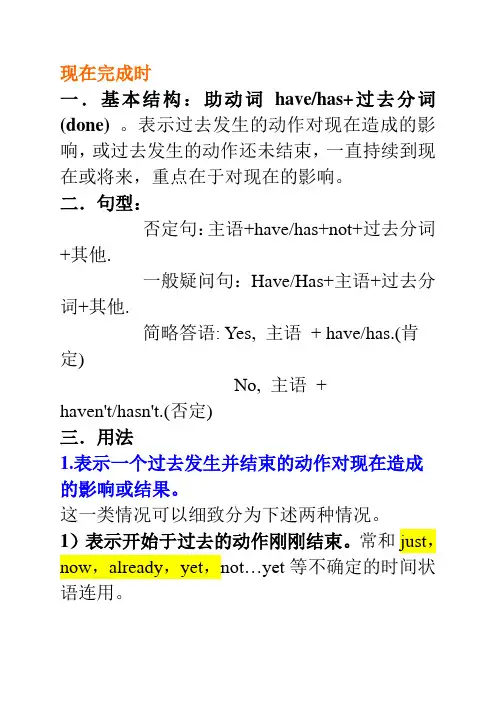
1 一.现在完成时的构成:
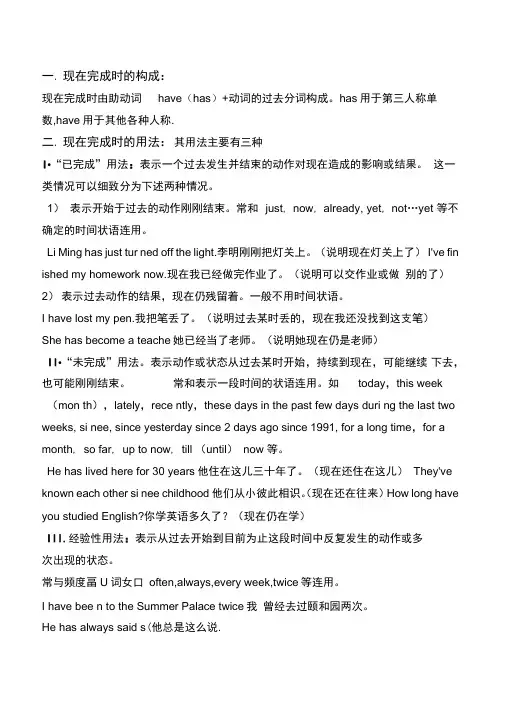
现在完成时由助动词 have(has)+动词的过去分词构成。has用于第三人称单数,have用于其他各种人称.
二.现在完成时的用法:其用法主要有三种
I.“已完成”用法 :表示一个过去发生并结束的动作对现在造成的影响或结果。
这一类情况可以细致分为下述两种情况。
1)表示开始于过去的动作刚刚结束。常和just,now,already,yet,not…yet等不确定的时间状语连用。
2)表示过去动作的结果,现在仍残留着。一般不用时间状语。
II.“未完成”用法。表示动作或状态从过去某时开始,持续到现在,可能继续下去,也可能刚刚结束。常和表示一段时间的状语连用。如today,this week(month),lately,recently,these days,in the past few days,during the last two
weeks,since,since yesterday,since 2 days ago,since 1991,for a long time,for
a month,so far,up to now,till(until) now等。
III.经验性用法:表示从过去开始到目前为止这段时间中反复发生的动作或多次出现的状态。
常与频度副词如often,always,every week,twice等连用。
三.现在完成时的时间状语
I现在完成时属于现在时范围,故不能和过去的时间状语连用。如:yesterday,last
Sunday,in1990,three years ago等。但是,在强调动作产生的后果和影响时,可以和一些表示不确定的时间状语连用。
a. 用副词already和yet。already一般用于肯定句中,yet一般用于否定句和疑 2 问句中。
b. 用ever和never.多用于否定或疑问句中,表示“曾经”或“从未“等。
c. 用表示到说话为止的过去时间状语,如just, before, up to now, the past few
years等。
d.用包括“现在”在内的时间状语,如now,today,this morning(month,year,term)等
II短暂性动词不能和表一段时间的时间状语连用。如:come, go, arrive, reach,
hear, close, leave, begin, start, lose, buy, fall, join, die, get up等。但如果要保留表一段时间的时间状语,必须将动词改为延续性动词。
现归纳总结一下由非延续性动词到延续性动词的转换
如: fall asleep (ill) →be asleep (ill)
get to know→ know begin,(start)→ be on
open →be open buy→ have
get up→ be up die→ be dead
go out→ be out come→ be in
close→be closed arrive→be here
join→be in, be a +名词 finish( end )→be over
leave, move →be away, borrow →keep
go to school→be a student catch(a cold)→ have(a cold)
begin to study→study come back→be back
put on→wear 或be on
如:He has been a soldier for three years.他参军三年了。
His father has been dead for two years.他父亲去世二年了。
The film has been on for 5 minutes.电影已开始五分钟了。
We have studied English for three years. 我们(开始)学英语已三年了。
四.几点注意事项
I. have been(to)与have gone( to)的区别: 3 have been(to)表示“去过某地(现在已经回来了)”,可用于各人称;
have gone(to)表示“去某地了(说话时某人不在当地)”,常用于第三人称,
前者可与once ,never,several times等连用,后者则不能。
II.不可延续性动词现在完成时的否定式,已变成一种可以延续的状态,因此可以和表示一段时间的状语连用。
4 练习
一.用since和for填空
1.______two years 2.____two years ago
3.___last month 4.______ 1999
5._______yesterday 6._______ 4 o’clock
7 4 hours 8._____an hour ago
9.___we were children 10._____ lunch time
11.____ she left here12. He has lived in Nanjing ___ the year before last.
13. I’ve known him ______ we were children.
14. Our teacher has studied Japanese ______ three years.
15. She has been away from the city ______ about ten years.
16. It’s about ten years __________ she left the city.
二.单项选择。
1、Both his parents look sad . Maybe they ______what's happened to him .
A. knew B. have known C. must know D.will know
2、He has _______ been to Shanghai , has he ?
A. already B.never C.ever D.still
3、Have you met Mr Li ______?
A. just B. ago C.before D. a moment ago
4、The famous writer _____ one new book in the past two year .
A. is writing B.was writing C.wrote D.has written
5、—Our country ______ a lot so far .
—Yes . I hope it will be even ______ .
A.has changed ; well B.changed ; good C.has changed ; better D.changed ; better
6、Zhao Lan ______already ______in this school for two years .
A. was ; studying B. will ; study C. has ; studied D. are ; studying
7、We ______ Xiao Li since she was a little girl .
A. know B. had known C. have known D. knew
8、Harry Potter is a very nice film .I______ it twice .
A.will see B.have seen C.saw D.see
9、—These farmers have been to the United States .
—Really ? When _____ there ? 5 A. will they go B. did they go C. do they go D. have they gone
10、—______ you ___ your homework yet ?
—Yes . I _____ it a moment ago .
A.Did ; do ; finished B.Have ; done ; finished
C.Have ; done ; have finished D.will ; do ; finish
11、His father ______ the Party since 1978 .
A. joined B. has joined C. was in D. has been in
12、—Do you know him well ?
— Sure .We _________ friends since ten years ago .
A. were B. have been C. have become D. have made
13、—How long have you ____ here ?
—About two months .
A. been B. gone C. come D. arrived
14、Hurry up! The play __________ for ten minutes .
A. has begun B. had begun C. has been on D. began
15、It _____ ten years since he left the army .