
新概念第二册Lesson-84课件
- 格式:ppt
- 大小:4.23 MB
- 文档页数:26
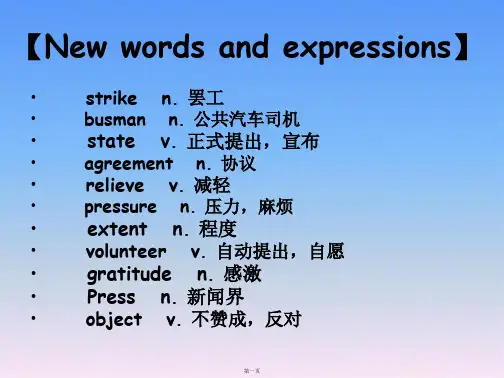
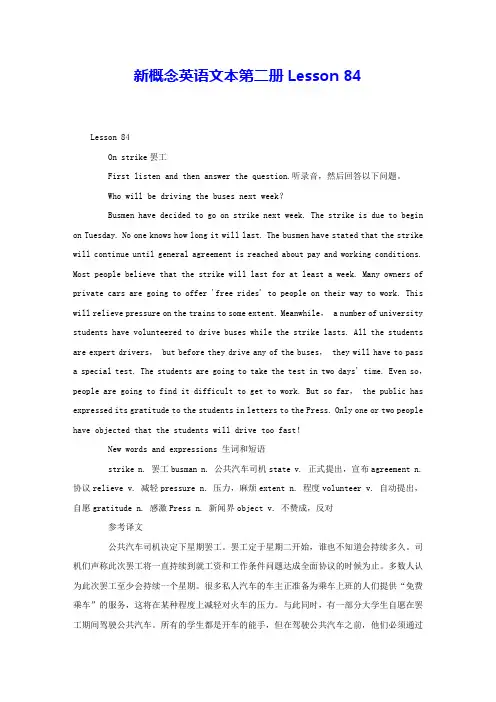
新概念英语文本第二册Lesson 84
Lesson 84
On strike罢工
First listen and then answer the question.听录音,然后回答以下问题。
Who will be driving the buses next week?
Busmen have decided to go on strike next week. The strike is due to begin
on Tuesday. No one knows how long it will last. The busmen have stated that the strike
will continue until general agreement is reached about pay and working conditions.
Most people believe that the strike will last for at least a week. Many owners of
private cars are going to offer 'free rides' to people on their way to work. This
will relieve pressure on the trains to some extent. Meanwhile, a number of university
students have volunteered to drive buses while the strike lasts. All the students
are expert drivers, but before they drive any of the buses, they will have to pass
a special test. The students are going to take the test in two days' time. Even so,
Lesson 47 A thirsty ghost
【New words and expressions】(9)
★thirsty adj. 贪杯的;adj. 渴的
be thirsty for = be hungry for 渴望得到(如饥似渴)
★ghost n. 鬼魂
ghost强调魂,并不是邪恶的象征
★haunt v. (鬼)来访, 闹鬼
haunt=visit 但不能应用于人的拜访,只能用在ghost
the ghost haunt 闹鬼
The ghost haunted the house. 这个房子闹鬼
★block v. 堵The pipe was blocked.
★furniture n. 家具, 设备, 储藏物(不可数名词)
a piece/ set of furniture 一件家具 一套家具
★whisky n. 威士忌酒
Scotch n. 一种上等的威士忌wine n. 果酒,如葡萄酒,石榴酒beer n. 啤酒brandy n. 白兰地
★suggest ① vt. 暗示,(间接地)表明
② vt. 建议,提议suggest +that从句
suggest +doing sth.
★shake(shook,shaken)① vt.&vi. 摇,摇动,抖动Mr. Thompson shook his head.
② vt. 同……握手Dan shook hands with him.
★accept v. 接受accept = receive sth.with pleasure)
【课文讲解】
1、A public house which was recently bought by Mr. Ian Thompson is up for sale.
a public house 酒吧、酒店,口语缩略为pub

Lesson 78 The last one?
【New words and expressions】(12)
★entitle vt. 以……为名,取名,给……题名, 给……称号;v. 授权, 授权
entitle + 宾语 + sth. 给……题名为……
The writer hasn’t entitled his new book yet.
The book was entitled The Sun Also Rises.
call sb. sth. name sb. sth.
★ calm v. 使镇定 calm down 镇定下来
★nerve n. 神经mental disorder 神经病
lose one's nerve 失去勇气
nervous adj. 神经紧张的
★concentration n. 集中,专心
concentrate v. 专心
concentrate on doing sth. 集中精力做某事
★suffer ① vi. 受痛苦,爱苦难;患病
During this time, my wife suffered terribly.
What is the patient suffering from?
② vt. 遭受(痛苦、损害等)
The village suffered serious damage from the floods.
★temper n. 脾气
keep one's temper 别发火 lose one's temper 发火
名词 + ed 为形容词:
hot-tempered 脾气火爆 ;good-tempered 好脾气的 ;bad-tempered 坏脾气的
★appetite n. 胃口,食欲
Lesson 18 He often does this!
【New words and expressions】(3)
pub n. 小酒店landlord n. 店主bill n. 帐单
【课文讲解】
1、After I had had lunch at a village pub, I looked for my bag.Pub是public house(酒店,酒店)的缩写
2、I had left it on a chair beside the door and now it wasn't there!leave除了“离去,离开,出发”的意思,还可以表示“把(人、物)留下,遗留,丢下”等。
Have you left anything in the car?
3、'I'm very sorry,' he said. 'My dog had taken in into the garden. He often does this!'
he指店主的狗,英语国家人士常用人称代词he或she指自己喂养的宠物。
【Key structures】
have的用法
1、have作为助动词构成各种完成时和完成进行时
2、have还可以作完全动词,当作“具有、拥有”讲时,它和have got通常可以互换。have做 “有,
患病” 概念时, 可作为实义动词, 也可作为非实义动词。在英国英语中的疑问句和否定句中have(具有)的用法与be相同,即可以不用助动词do或did;在美国英语中,常用do助动词和have一起构成疑问句和否定句。
I don’t have a pen/a headache.
I haven’t a pen /a headache.
三种情况have 可以用 have got取代
have to== have got to
have作“具有,拥有”讲时是状态动词,不能用于进行时态或被动语态,通常用于一般现在时。在其它时态中,一般用have而不用have got。