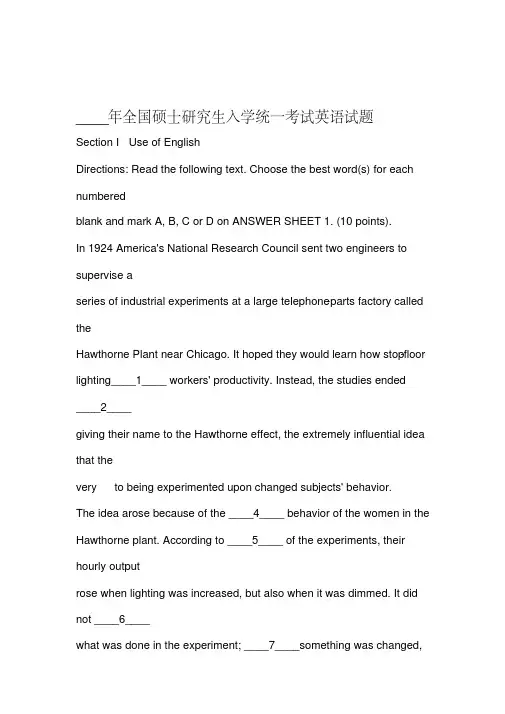
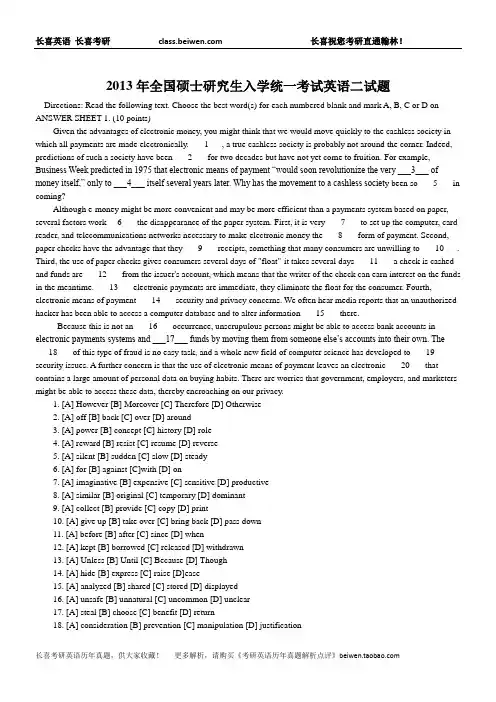
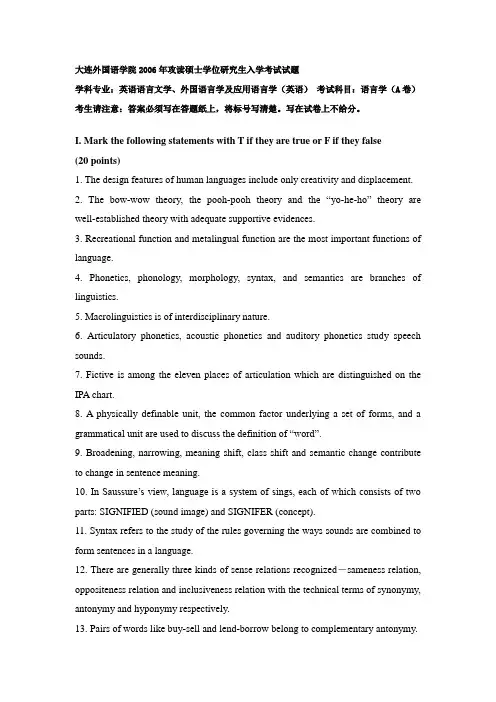
全国硕士研究生入学统一考试考研英语真题
- 格式:docx
- 大小:37.41 KB
- 文档页数:4
全国硕士研究生入学统一考试考研英语真题
Introduction
The National Postgraduate Entrance Examination, commonly known as
the "考研" in China, is a nationwide standardized test that evaluates the
academic abilities and potential of students who wish to pursue a master's
degree in China. One of the crucial subjects in this examination is the
English test, which assesses the students' language proficiency. In this article,
we will analyze and discuss some genuine English questions from previous
years' exams.
Section 1: Reading Comprehension
The Reading Comprehension section is designed to assess the
candidates' ability to understand and analyze various written texts. It consists
of multiple passages, each followed by a set of questions. Let's take a look at
an example passage and discuss its questions.
Passage:
(Here, the passage from a previous year's exam should be included)
Analysis:
In this passage, the topic revolves around a specific theme, such as
technology, education, or social issues. The questions following the passage
may test the candidate's understanding of the main idea, supporting details,
and overall comprehension of the text. It is essential to carefully read the
passage and pay attention to key information to answer the questions
accurately. Section 2: Sentence Completion
The Sentence Completion section evaluates the candidates' lexical and
grammatical knowledge. It requires them to fill in the blanks with the correct
words or phrases based on the context. Let's examine an example sentence
and discuss its completion.
Sentence:
(Here, a sentence from a previous year's exam should be included)
Analysis:
The sentence usually contains one or more blanks, and the candidates
must choose the most appropriate word or phrase to fill in the gaps. It tests
their understanding of vocabulary, grammar rules, and contextual usage. To
do well in this section, candidates need to have a wide range of vocabulary
and a solid grasp of English grammar.
Section 3: Translation
The Translation section assesses the candidates' ability to translate
sentences or paragraphs from Chinese to English. It evaluates their mastery
of both languages and their understanding of idiomatic expressions. Let's
take a look at a translation example.
Translation:
(Here, a sentence or paragraph in Chinese should be included)
Analysis: Candidates are required to accurately translate the given Chinese text
into English, considering the meaning, grammar, and style. This section tests
their language proficiency and translation skills. It is crucial to pay attention
to the original meaning and convey it effectively in English.
Section 4: Error Correction
The Error Correction section aims to assess the candidates' ability to
identify and correct grammatical errors in a given sentence. It tests their
understanding of various grammar rules and their accuracy in sentence
structure. Let's explore an error correction question.
Error Correction:
(Here, a sentence with an error should be included)
Analysis:
Candidates are given a sentence with an underlined segment, which
contains a grammatical error. They must identify and correct the error to
make the sentence grammatically correct. This section examines their
knowledge of grammar rules, such as subject-verb agreement, verb tense,
and word choice.
Conclusion
The National Postgraduate Entrance Examination English test is an
essential component of the overall exam. It evaluates the candidates'
language proficiency and their ability to comprehend and analyze English
texts. By practicing and familiarizing themselves with previous years' genuine exam questions, students can enhance their performance and
increase their chances of success in the examination.