2013年全国硕士研究生入学统一考试英语考研英语一真题
- 格式:docx
- 大小:38.45 KB
- 文档页数:26
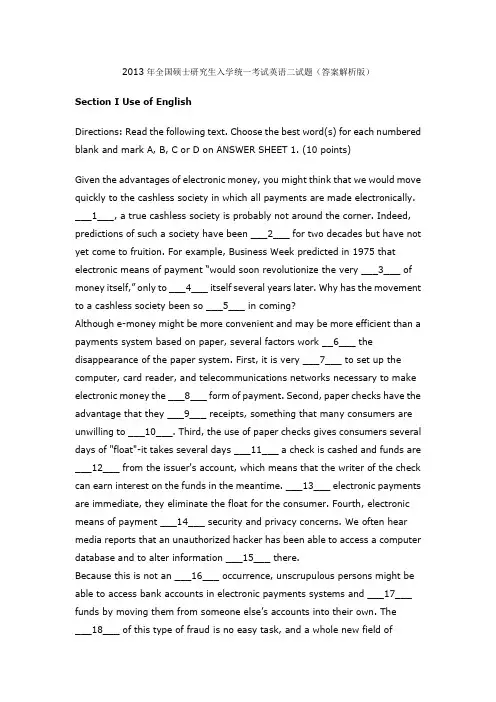
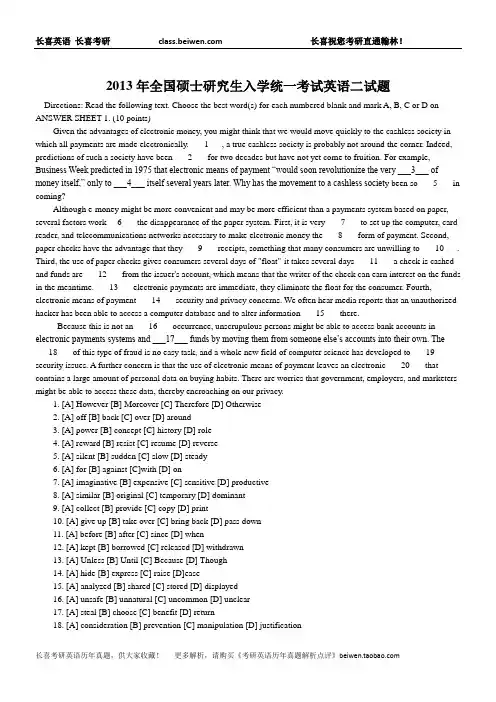
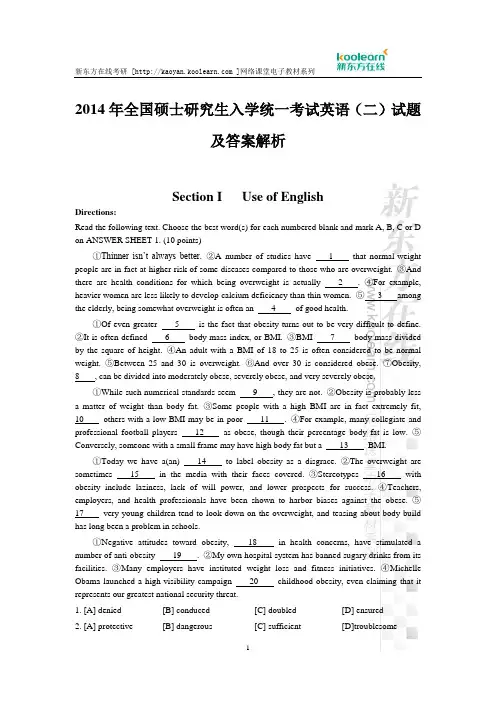
2013 年考研英语一真题解析【完整版】
Section I Use of English
Directions:
Read the following text. Choose the best word(s) for each numbered blank
and mark A, B, C or D on ANSWER SHEET 1. (10 points)
People are, on the whole, poor at considering background information
when making individual decisions. At first glance this might seem like a
strength that 1 the ability to make judgments which are unbiased by 2 factors.
But Dr. Uri Simonsohn speculated that an inability to consider the big 3 was
leading decision-makers to be biased by the daily samles of information they
were working with. 4 , he theorised that a judge 5 of apperaring too soft 6
crime might be more likely to send someone to prison 7 he had already
sentenced five or six other defendants only to forced community service on
that day.
To 8 this idea, he turned to the university-admissions process. In theory,
the 9 of an applicant should not depend on the few others 10 randomly for
interview during the same day, but Dr. Simonsoho suspected the truth was 11 .
He studied the results of 9,323 MBA interviews 12 by 31 admissions
officers. The interviewers had 13 applicants on a scale of one to five. This scale
14 numerous factors into consideration. The scores were 15 used in
conjunction with an applicant’s score on the Granduate Managent Adimssion
Test, or GMAT, a standardized exam which is 16 out of 800 points, to make a
decision on whether to accept him or her.
Dr. Simonsoho found if the score of the previous candidate in a daily
series of interviewees was 0.75 points or more higher than that of the one 17
that, then the score for the next applicant would 18 by an average of 0.075
points. This might sound small, but to 19 the effects of such a decrease a
candidate could need 30 more GMAT points than would otherwise have been
20 .
1. [A] grants [B]submits [C]transmits [D]delivers
2. [A] minor [B]objective [C]crucial [D] external
3. [A] issue [B]vision [C]picture [D]external
4. [A] For example [B] On average [C]In principle [D]Above all
5. [A] fond [B] fearful [C]capable [D] thoughtless
6. [A] in [B] on [C] to [D] for
7. [A] if [B] until [C] though [D] unless
8. [A] promote [B] emphasize [C] share [D]success
9. [A] decision [B] quality [C] status [D] success
10. [A] chosen [B] studied [C] found [D] identified
11. [A] exceptional [B] defensible [C] replaceable [D] otherwise
12. [A] inspired [B] expressed [C] conducted [D] secured
13. [A] assigned [B] rated [C] matched [D] arranged
14. [A] put [B] got [C] gave [D] took
15. [A] instead [B] then [C] ever [D] rather
16. [A] selected [B] passed [C] marked [D] introduced
17. [A] before [B] after [C] above [D] below
18. [A] jump [B] float [C] drop [D] fluctuate
19. [A] achieve [B] undo [C] maintain [D] disregard
20. [A] promising [B] possible [C] necessary [D] helpful
Section II Reading Comprehension
Part A
Directions:
Read the following four texts. Answer the questions below each text by
choosing A, B, C or D. Mark your answers on ANSWER SHEET 1. (40 points)
Text 1
In the 2006 film version of The Devil Wears Prada ,Miranda Priestly,
played by Meryl Streep, scolds her unattractive assistant for imagining that
high fashion doesn’t affect her, Priestly explains how the deep blue color of the
assistant’s sweater descended over the years from fashion shows to
departments stores and to the bargain bin in which the poor girl doubtless
found her garment.
This top-down conception of the fashion business couldn’t be more out of
date or at odds with the feverish would described in Overdressed, Eliazabeth
Cline’s three-year indictment of “fast fashion”. In the last decade or
so ,advances in technology have allowed mass-market labels such as
Zara ,H&M, and Uniqlo to react to trends more quickly and anticipate demand
more precisely. Quicker turnarounds mean less wasted inventory, more
frequent release, and more profit. These labels encourage style-conscious
consumers to see clothes as disposable-meant to last only a wash or two,
although they don’t advertise that –and to renew their wardrobe every few
weeks. By offering on-trend items at dirt-cheap prices, Cline argues, these
brands have hijacked fashion cycles, shaking an industry long accustomed to a
seasonal pace.