
Unit 2第三课时
- 格式:pptx
- 大小:92.50 KB
- 文档页数:5
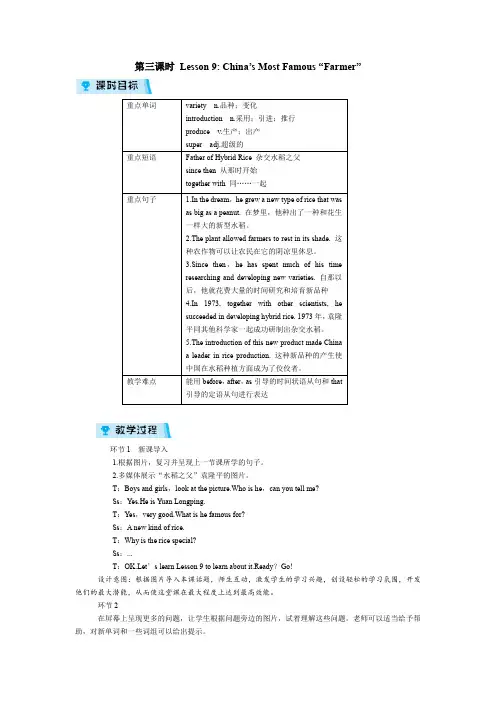
第三课时Lesson 9: China’s Most Famous “Farmer”环节1 新课导入1.根据图片,复习并呈现上一节课所学的句子。
2.多媒体展示“水稻之父”袁隆平的图片。
T:Boys and girls,look at the picture.Who is he,can you tell me?Ss:Yes.He is Yuan Longping.T:Yes,very good.What is he famous for?Ss:A new kind of rice.T:Why is the rice special?Ss:...T:OK.Let’s learn Lesson 9 to learn about it.Ready?Go!设计意图:根据图片导入本课话题,师生互动,激发学生的学习兴趣,创设轻松的学习氛围,开发他们的最大潜能,从而使这堂课在最大程度上达到最高效能。
环节2在屏幕上呈现更多的问题,让学生根据问题旁边的图片,试着理解这些问题。
老师可以适当给予帮助,对新单词和一些词组可以给出提示。
1.Read and do Exercise 1 on Page 23.2.Let the students listen to the tape of the article and repeat it sentence by sentence,then read it aloud by themselves.3.Work in group of 8 to find out the key words,phrases and sentences in the article.4.The teacher explain the whole article sentence by sentence.5.Let students finish Exercise 2 and check the answer.6.Work in groups. Think of an invention of a good way to make life better. Then talk about it with your group members.7.要点点拨(1)In the dream,he grew a new type of rice that was as big as a peanut.在梦里,他种出了一种和花生一样大的新型水稻。
Period III: Grammar (第三课时)第一部分教案设计教学内容Grammar(第23~24页)重点学习行为动词的一般现在时的用法。
教材分析本课时是语法课,在第一单元学习了be动词的一般现在时的基础上,进一步行为动词的一般现在时的用法,并学会灵活运用,能够与be动词的一般现在时加以区分。
主要内容包括:理解行为动词的一般现在时的两种形式,掌握其肯定句、否定句、疑问句及其肯定、否定回答的基本用法;理解行为动词在一般现在时中的变化,掌握其变化规则;能用一般现在时在日常生活中进行相关的表达。
教学目标:基础知识掌握词汇:drawing , weekend , shop词组:at/on weekends =at/on the weekend of course句型:Millie gets up at 6:30 every morning. Cats eat fish. Simon likes playing football.基本技能:1. 理解行为动词一般现在时的用法;2. 掌握行为动词一般现在时的肯定句、否定句、疑问句及其肯定和否定回答的基本用法;3. 学会用一般现在时进行交际综合素质:结合本单元的话题用一般现在时进行交流。
教学重难点及突破重点:掌握基本的四会单词、词组及句型。
难点:行为动词的一般现在时的肯定句、否定句、疑问句及其肯定、否定回答。
教学突破:在行为动词的一般现在时中,要特别注意注意是第三人称单数的情况,可以借助口诀帮助学生记忆。
教学准备教师准备:多媒体课件及关于本课时语法的实例及习题学生准备:复习第一课用法,预习本课时语法,比较不同教学设计Step I Lead-in (导入部分)1.Learn the new words by ask some questions about Li Hua .Where does Li Hua from ? How does he look ? What does he do every day ?What does he do in his free time ?2. Look ,who are these men in the picture? They are basketball players. They play basket very well. This is Kobe .He looks very strong. Kobe plays basketball very well. Many students like him. They often watch his game on TV in their free time. I like watching TV too. But my cousin likes reading .He often reads storybooks.Look at these sentences pay attention to the verbs. We use the Verb” to be” in the these three sentences while we use the verb” to do in these ones. Today we’ll learn the simple present tense of the verb to do.Step ⅡPresentation(新授)1. Complete the sentences using the simple present tense of the verb to do .He often _________(play) football after school .She __________(like) playing volleyball .It ________(look) like a cat .We ___________(enjoy) reading very much .They usually ___________(get) up at 6:00 in the morning .You _________(like) sports .2. Explain the use of the simple present tense of the verb to do. Open your books at page 23 and read the sample sentences .3. Can you find the different forms of the verb to do in these sentences ?When the subject is he/ she / it , we need to add an “s” to the verb .Do you want to know how to add an “s” to the verb ? Let’s read the table on page 23 together . How many ways are there to add an “s” ? What are they ?写出动词的第三人称单数形式put __________ enjoy_________ write ______ fly __________play___________ have_____________ guess _________ match ________go_________ do _________________ study _______ stay ____________4. Millie is writing about herself and her classmates. Please help her complete the sentences in part A with the words in the box.Now who can read the sentences to us ?other listen carefully and check the answers. Finish Part A .Step ⅢPractice(操练)1. Do you know how to make negative sentences and ask and answer questions using the verb to do in the simple present tense ? OK , change the sentences on the board into negative sentences and ask and answer questions .2. Now let’s read the tables on page 23 together .3. Finish Part B on page 24 .4. Look at the table on page 24 and work in pairs, look at this table .It tells us the activities Millie and herclassmates like. Please complete the questions in Part B and then use the information in the table to answer them. Does Daniel like walking ? Yes , he does .Do Amy and Sandy enjoy reading ?Yes ,they do .Does Daniel like drawing ? No , he doesn’t .Do Millie and Kitty enjoy swimming ? No , they don’t .5. Finish Part C6. Explain some language points : at/ on weekends = at/on the weekend of course .7. Work in pairs .教材习题英语书第24页,Part A : 1 like 2 dances 3 goes 4 plays 5 watchesPart B :1 Do; Yes, they do. 2 Does; No she doesn’t.3Does; Yes, she does.4 Does; No, he doesn’t. 5 Do; No, they don’t.Part C Keys: 1 Do, play 2 play 3 Do, go 4 watches 5 reads 6 shops 7 stay 8 go随堂小练习I.用所给动词的适当形式填空。

PEP三年级上英语Unit 2 第3课时Part ALetters and sounds优质课说课稿一. 教材分析PEP三年级上英语Unit 2 第3课时Part A Letters and sounds是本单元的重点内容。
本节课主要介绍了五个元音字母:a, e, i, o, u的发音及单词。
通过学习,学生能够掌握元音字母的发音规则,提高他们的发音准确性。
教材通过图片、单词和句子等形式,让学生在轻松愉快的氛围中学习英语。
二. 学情分析考虑到学生的年龄特点和认知水平,他们对语音有一定的敏感度,但发音准确性有待提高。
在学习过程中,部分学生可能对元音字母的发音规则掌握不够扎实,需要教师加强引导和练习。
此外,学生的学习兴趣和积极性是影响教学效果的重要因素。
三. 说教学目标1.知识目标:学生能够正确发音五个元音字母a, e, i, o, u,并认识相关单词。
2.能力目标:学生能够通过听、说、读、写等方式,运用所学元音字母进行简单的交流。
3.情感目标:激发学生学习英语的兴趣,提高他们的自信心和自主学习能力。
四. 说教学重难点1.重点:五个元音字母的正确发音及单词的学习。
2.难点:元音字母在单词中的运用,以及发音规则的掌握。
五. 说教学方法与手段1.情境教学法:通过图片、实物等创设情境,让学生在真实的环境中学习英语。
2.游戏教学法:设计趣味性强的游戏,激发学生的学习兴趣,提高他们的参与度。
3.互动式教学法:教师与学生、学生与学生之间的互动,提高学生的口语表达能力。
4.信息技术辅助教学:利用多媒体课件、在线资源等,丰富教学手段,提高教学效果。
六. 说教学过程1.热身(5分钟)利用歌曲、简单的口语交流等方式,调动学生的积极性,营造轻松愉快的课堂氛围。
2.引入(10分钟)通过展示图片、实物等,引导学生谈论元音字母,为新课的学习做好铺垫。
3.呈现(15分钟)教师生动讲解五个元音字母的发音规则,并用单词和句子进行展示。
