
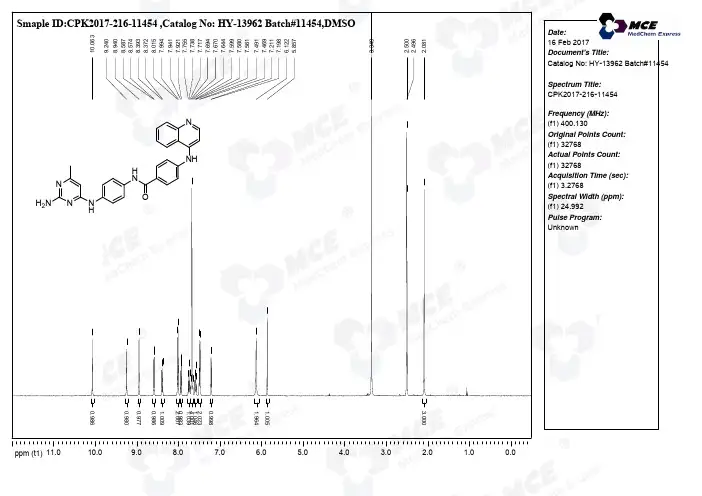
SGI-1027_HNMR_11454_MedChemExpress
- 格式:pdf
- 大小:521.51 KB
- 文档页数:1

苯海拉明软膏微生物限度检查方法的验证余晓霞;朱桦;区杰彬【摘要】目的:建立苯海拉明软膏微生物限度检查方法。
方法采用常规法进行细菌、霉菌及酵母菌计数方法的验证和控制菌检查的验证。
结果采用常规法,细菌、霉菌及酵母菌的回收率均>70%,并可检出铜绿假单胞菌和金黄色葡萄球菌。
结论经方法学验证,结果符合现行《中国药典》2010年版的要求。
%Objective To establish a method to test microbial limit in diphenhydramine ointment. Methods Conventional method was adopted to verify bacteria, mold and yeast count method and control bacteria check.Results By conventional method, all of the recoveries of bacteria, mold and yeast were above 70%, pseudomonas aeruginosa and staphylococcus aureus weredetected.Conclusion Through the technological validation, the result is consistent with the requirement of “Chinese Pharmacopoeia”(edition 2010) in force.【期刊名称】《中国实用医药》【年(卷),期】2014(000)023【总页数】2页(P32-33)【关键词】苯海拉明软膏;微生物限度;验证【作者】余晓霞;朱桦;区杰彬【作者单位】510120 中山大学孙逸仙纪念医院药学部;510120 中山大学孙逸仙纪念医院药学部;510120 中山大学孙逸仙纪念医院药学部【正文语种】中文苯海拉明软膏为中山大学孙逸仙纪念医院的外用制剂,其主要成分为盐酸苯海拉明和黄凡士林,具有抗过敏、止痒、消炎、消肿作用。
Interlaboratory T est …Microbial barrier testing of packa ging materials for medical devices which are tobe ster ili ze d“according to DIN 58953-6:2010Test re portJanuary 2013Author: Daniel ZahnISEGA Forschungs- und Untersuchungsgesellschaft mbHTest report Page 2 / 15Table of contentsSeite1.General information on the Interlaboratory Test (3)1.1 Organization (3)1.2 Occasion and Objective (3)1.3 Time Schedule (3)1.4 Participants (4)2.Sample material (4)2.1 Sample Description and Execution of the Test (4)2.1.1 Materials for the Analysis of the Germ Proofness under Humidityaccording to DIN 58953-6, section 3 (5)2.1.2 Materials for the Analysis of the Germ Proofness with Air Permeanceaccording to DIN 58953-6, section 4 (5)2.2 Sample Preparation and Despatch (5)2.3 Additional Sample and Re-examination (6)3.Results (6)3.1 Preliminary Remark (6)3.2 Note on the Record of Test Results (6)3.3 Comment on the Statistical Evaluation (6)3.4 Outlier tests (7)3.5 Record of Test Results (7)3.5.1 Record of Test Results Sample F1 (8)3.5.2 Record of Test Results Sample F2 (9)3.5.3 Record of Test Results Sample F3 (10)3.5.4 Record of Test Results Sample L1 (11)3.5.5 Record of Test Results Sample L2 (12)3.5.6 Record of Test Results Sample L3 (13)3.5.7 Record of Test Results Sample L4 (14)4.Overview and Summary (15)Test report Page 3 / 15 1. General Information on the Interlaboratory Test1.1 OrganizationOrganizer of the Interlaboratory Test:Sterile Barrier Association (SBA)Mr. David Harding (director.general@)Pennygate House, St WeonardsHerfordshire HR2 8PT / Great BritainRealization of the Interlaboratory Test:Verein zur Förderung der Forschung und Ausbildung fürFaserstoff- und Verpackungschemie e. V. (VFV)vfv@isega.dePostfach 10 11 0963707 Aschaffenburg / GermanyTechnical support:ISEGA Forschungs- u. Untersuchungsgesellschaft mbHDr. Julia Riedlinger / Mr. Daniel Zahn (info@isega.de)Zeppelinstraße 3 – 563741 Aschaffenburg / Germany1.2 Occasion and ObjectiveIn order to demonstrate compliance with the requirements of the ISO 11607-1:2006 …Packaging for terminally sterilized medical devices -- Part 1: Requirements for materials, sterile barrier systems and packaging systems“ validated test methods are to be preferably utilized.For the confirmation of the microbial barrier properties of porous materials demanded in the ISO 11607-1, the DIN 58953-6:2010 …Sterilization – Sterile supply – Part 6: Microbial barrier testing of packaging materials for medical devices which are to be sterilized“ represents a conclusive method which can be performed without the need for extensive equipment.However, since momentarily no validation data on DIN 58953-6 is at hand concerns emerged that the method may lose importance against validated methods in a revision of the ISO 11607-1 or may even not be considered at all.Within the framework of this interlaboratory test, data on the reproducibility of the results obtained by means of the analysis according to DIN 58953-6 shall be gathered.1.3 Time ScheduleSeptember 2010:The Sterile Barrier Association queried ISEGA Forschungs- und Unter-suchungsgesellschaft about the technical support for the interlaboratory test.For the realization, the Verein zur Förderung der Forschung und Ausbildungfür Faserstoff- und Verpackungschemie e. V. (VFV) was won over.November 2010: Preliminary announcement of the interlaboratory test / Seach for interested laboratoriesTest report Page 4 / 15 January toDecember 2011: Search for suitable sample material / Carrying out of numerous pre-trials on various materialsJanuary 2012:Renewed contact or search for additional interested laboratories, respectively February 2012: Sending out of registration forms / preparation of sample materialMarch 2012: Registration deadline / sample despatchMay / June 2012: Results come in / statistical evaluationJuly 2012: Despatch of samples for the re-examinationSeptember 2012: Results of the re-examination come in / statistical evaluationNovember 2012: Results are sent to the participantsDecember 2012/January 2013: Compilation of the test report1.4 ParticipantsFive different German laboratories participated in the interlaboratory test. In one laboratory, the analyses were performed by two testers working independently so that six valid results overall were received which can be taken into consideration in the evaluation.To ensure an anonymous evaluation of the results, each participant was assigned a laboratory number (laboratory 1 to laboratory 6) in random order, which was disclosed only to the laboratory in question. The complete laboratory number breakdown was known solely by the ISEGA staff supporting the proficiency test.2. Sample Material2.1 Sample Description and Execution of the TestUtmost care in the selection of suitable sample material was taken to include different materials used in the manufacture of packaging for terminally sterilized medical devices.With the help of numerous pre-trials the materials were chosen covering a wide range of results from mostly germ-proof samples to germ permeable materials.Test report Page 5 / 15 2.1.1 Materials for the Analysis of Germ Proofness under Humidity according to DIN 58953-6, section 3:The participants were advised to perform the analysis on the samples according to DIN 58953-6, section 3, and to protocol their findings on the provided result sheets.The only deviation from the norm was that in case of the growth of 1 -5 colony-forming units (in the following abbreviated as CFU) per sample, no re-examination 20 test pieces was performed.2.1.2 Materials for the Analysis of Germ Proofness with Air Permeance according to DIN 58953-6, section 4:The participants were advised to perform the analysis on the samples according to DIN 58953-6, section 4, and to protocol their findings on the provided result sheets.2.2 Sample Preparation and DespatchFor the analysis of the germ proofness under humidity, 10 test pieces in the size of 50 x 50 mm were cut out of each sample and heat-sealed into a sterilization pouch with the side to be tested up.Out of the 10 test pieces, 5 were intended for the testing and one each for the two controls according to DIN 58953-6, sections 3.6.2 and 3.6.3. The rest should remain as replacements (e.g. in case of the dropping of a test piece on the floor etc.).For the analysis of the germ proofness with air permeance, 15 circular test pieces with a diameter of 40 mm were punched out of each sample and heat-sealed into a sterilization pouch with the side to be tested up.Test report Page 6 / 15 Out of the 15 test pieces, 10 were intended for the testing and one each for the two controls according to DIN 58953-6, section 4.9. The rest should remain as replacements (e.g. in case of the dropping of a test piece on the floor etc.).The sterilization pouches with the test pieces were steam-sterilized in an autoclave for 15 minutes at 121 °C and stored in an climatic room at 23 °C and 50 % relative humidity until despatch.2.3 Additional Sample and Re-examinationFor the analysis of the germ proofness under humidity another test round was performed in July / August 2012. For this, an additional sample (sample L4) was sent to the laboratories and analysed (see 2.1.2). The results were considered in the evaluation.For validation or confirmation of non-plausible results, occasional samples for re-examination were sent out to the laboratories. The results of these re-examinations (July / August 2012) were not taken into consideration in the evaluation.3. Results3.1 Preliminary RemarkSince the analysis of germ proofness is designed to be a pass / fail – test, the statistical values and precision data were meant only to serve informative purposes.The evaluation of the materials according to DIN58953-6,sections 3.7and 4.7.6by the laboratories should be the most decisive criterion for the evaluation of reproducibility of the interlaboratory test results. Based on this, the classification of a sample as “sufficiently germ-proof” or “not sufficiently germ-proof” is carried out.3.2 Note on the Record of Test Results:The exact counting of individual CFUs is not possible with the required precision if the values turn out to be very high. Thus, an upper limit of 100 CFU per agar plate or per test pieces, respectively, was defined. Individual values above this limit and values which were stated with “> 100” by the laboratories, are listed as 100 CFU per agar plate or per test piece, respectively, in the evaluation.Test report Page 7 / 153.3 Comment on the Statistical EvaluationThe statistical evaluation was done based on the series of standards DIN ISO 5725-1ff.The arithmetic laboratory mean X i and the laboratory standard deviation s i were calculated from the individual measurement values obtained by the laboratories.The overall mean X of the laboratory means as well as the precision data of the method (reproducibility and repeatability) were determined for each sample3.4 Outlier testsThe Mandel's h-statistics test was utilised as outlier test for differences between the laboratory means of the participants.A laboratory was identified as a “statistical outlier” as soon as an exceedance of Mandel's h test statistic at the 1 % significance level was detected.The respective results of the laboratories identified as outliers were not considered in the statistical evaluation.3.5 Record of Test ResultsOn the following pages, the records of the test results for each interlaboratory test sample with the statistical evaluation and the evaluation according to DIN 58953-6 are compiled.Test report Page 8 / 153.5.1 Record of Test Results Sample F1Individual Measurement values:Statistical Evaluation:Comment:Laboratory 4, as an outlier, has not been taken into consideration in the statistical Evaluation.Outlier criterion: Mandel's h-statistics (1 % level of significance)Overall mean X:91.0CFU / agar plateRepeatability standard deviation s r:17.9CFU / agar plateReproducibility standard deviation s R:19.8CFU / agar plateRepeatability r:50.0CFU / agar plateRepeatability coefficient of variation:19.6%Reproducibility R:55.5CFU / agar plateReproducibility coefficient of variation:21.8%Evaluation according to DIN 58953-6, Section 3.7:Lab. 1 - 6:Number of CFU > 5, i.e. the material is classified as not sufficiently germ-proof.Conclusion:All of the participants, even the Laboratory 4 which was identified as an outlier, came to the same results and would classify the sample material as “not sufficiently germ-proof”Test report Page 9 / 153.5.2 Record of Test Results Sample F2Individual Measurement values:Statistical Evaluation:Comment:Laboratory 4, as an outlier, has not been taken into consideration in the statistical Evaluation.Outlier criterion: Mandel's h-statistics (1 % level of significance)Overall mean X:0CFU / agar plateRepeatability standard deviation s r:0CFU / agar plateReproducibility standard deviation s R:0CFU / agar plateRepeatability r:0CFU / agar plateRepeatability coefficient of variation:0%Reproducibility R:0CFU / agar plateReproducibility coefficient of variation:0%Evaluation according to DIN 58953-6, Section 3.7:Lab. 1 – 3:Number of CFU = 0, i.e. the material is classified as sufficiently germ-proofLab. 4:Number of CFU ≤ 5, i.e. a re-examination on 20 test pieces would have to be done Lab. 5 – 6:Number of CFU = 0, i.e. the material is classified as sufficiently germ-proofConclusion:All of the participants, except for the Laboratory 4 which was identified as an outlier, came to the same results and would classify the sample material as “sufficiently germ-proof”.Test report Page 10 / 153.5.3 Record of Test Results Sample F3Individual Measurement values:Statistical Evaluation:Overall mean X:30.1CFU / agar plateRepeatability standard deviation s r:17.2CFU / agar plateReproducibility standard deviation s R:30.9CFU / agar plateRepeatability r:48.2CFU / agar plateRepeatability coefficient of variation:57.1%Reproducibility R:86.5CFU / agar plateReproducibility coefficient of variation:103%Evaluation according to DIN 58953-6, Section 3.7:Lab. 1 - 4:Number of CFU > 5, i.e. the material is classified as not sufficiently germ-proof. Lab. 5:Number of CFU = 0, i.e. the material is classified as sufficiently germ-proof. Lab. 6:Number of CFU > 5, i.e. the material is classified as not sufficiently germ-proof.Conclusion:Five of the six participants came to the same result and would classify the sample as “not sufficiently germ-proof”. Only laboratory 5 would classify the sample material as “sufficiently germ-proof”.Test report Page 11 / 153.5.4 Record of Test Results Sample L1Individual Measurement values:Statistical Evaluation:Overall mean X:0.09CFU / test pieceRepeatability standard deviation s r:0.32CFU / test pieceReproducibility standard deviation s R:0.33CFU / test pieceRepeatability r:0.91CFU / test pieceRepeatability coefficient of variation:357%Reproducibility R:0.93CFU / test pieceReproducibility coefficient of variation:366%Evaluation according to DIN 58953-6, Section 4.7:Lab. 1 - 6:Number of CFU < 15, i.e. the material is classified as sufficiently germ-proof.Conclusion:All participants came to the same result and would classify the sample as “sufficiently germ-proof”.Test report Page 12 / 153.5.5 Record of Test Results Sample L2Individual Measurement values:Statistical Evaluation:Overall mean X:0.73CFU / test pieceRepeatability standard deviation s r: 1.10CFU / test pieceReproducibility standard deviation s R: 1.18CFU / test pieceRepeatability r: 3.07CFU / test pieceRepeatability coefficient of variation:151%Reproducibility R: 3.32CFU / test pieceReproducibility coefficient of variation:163%Evaluation according to DIN 58953-6, Section 4.7:Lab. 1:Number of CFU > 15, i.e. the material is classified as not sufficiently germ-proof. Lab. 2 - 6:Number of CFU < 15, i.e. the material is classified as sufficiently germ-proof.Conclusion:Five of the six participants came to the same result and would classify the sample as “sufficiently germ-proof”. Only laboratory 1 exceeds the limit value slightly by 1 CFU, so that the sample would be classified as “not sufficiently germ-proof”.Test report Page 13 / 153.5.6 Record of Test Results Sample L3Individual Measurement values:Statistical Evaluation:Overall mean X:0.36CFU / test pieceRepeatability standard deviation s r: 1.00CFU / test pieceReproducibility standard deviation s R: 1.06CFU / test pieceRepeatability r: 2.79CFU / test pieceRepeatability coefficient of variation:274%Reproducibility R: 2.98CFU / test pieceReproducibility coefficient of variation:293%Evaluation according to DIN 58953-6, Section 4.7:Lab. 1 - 6:Number of CFU < 15, i.e. the material is classified as sufficiently germ-proof.Conclusion:All participants came to the same result and would classify the sample as “sufficiently germ-proof”.Test report Page 14 / 153.5.7 Record of Test Results Sample L4Individual Measurement values:Statistical Evaluation:Overall mean X:35.1CFU / test pieceRepeatability standard deviation s r:18.8CFU / test pieceReproducibility standard deviation s R:42.6CFU / test pieceRepeatability r:52.7CFU / test pieceRepeatability coefficient of variation:53.7%Reproducibility R:119CFU / test pieceReproducibility coefficient of variation:122%Evaluation according to DIN 58953-6, Section 4.7:Lab. 1 - 3:Number of CFU > 15, i.e. the material is classified as not sufficiently germ-proof. Lab. 4:Number of CFU < 15, i.e. the material is classified as sufficiently germ-proof. Lab. 5 - 6:Number of CFU > 15, i.e. the material is classified as not sufficiently germ-proof.Conclusion:Five of the six participants came to the same result and would classify the sample as“not sufficiently germ-proof”.Test report Page 15 / 15 4. Overview and SummarySummary:In case of four of the overall seven tested materials, a 100 % consensus was reached regarding the evaluation as“sufficiently germ-proof”and“not sufficiently germ-proof”according to DIN 58 953-6.As for the other three tested materials, there were always 5 concurrent participants out of 6 (83 %). In each case, only one laboratory would have evaluated the sample differently.It is noteworthy that the materials about the evaluation of which a 100 % consensus was reached were the smooth sterilization papers. The differences with one deviating laboratory each occurred with the slightly less homogeneous materials, such as with the creped paper and the nonwoven materials.。

January 2021Vol.41 No.12021 年 1 月 第 41 卷 第 1 期基础医学与临床Basic & Clinical Medicine文章编号:1001-6325 ( 2021 ) 01-0087-06研究论文大动脉炎患者外周血单个核细胞RT-qPCR 内参基因的选择田苡箫,李菁*收稿日期:2019-11-18 修回日期:2020-04-30*通信作者(corresponding author ) :lijing6515@ (中国医学科学院北京协和医学院北京协和医院风湿免疫科风湿免疫病学教育部重点实验室国家皮肤与免疫疾病临床医学研究中心,北京100032)扌摘要:目的筛选适于在大动脉炎(TAK )患者和健康人群(HC )之间比较外周血单个核细胞(PBMC )中mRNA 表达水平的内参基因。
方法提取PBMC 中的总RNA,应用RT-qPCR ,分别采用geNorm 、NormFinder 、BestKeeper 3种软 件程序,分析 3-glucuronidase ,GAPDH ,ACTB ,SDHA ,HPRT1,RPL13A ,B2M , YWHAZ 和 PKG1 9 个基因的 mRNA 表达稳定性。
以T-bet 、GATA3和RORC 作为目的基因,比较不同稳定性的内参基因对mRNA 相对丰度的影响。
结果geNorm 筛选得到的基因组合为B 2M-SDHA , Nor^nFinder 和BestKeeper 筛选出最稳定的内参基因均为HPRT1 ; 3种方法均显示GAPDH 的稳定性较差。
结论自身免疫病患者在接受免疫抑制药物治疗时,原本稳定表达的基因可能会 上调或下调;在样本量较小时,稳定性更好的内参基因可能更有助于检测组间差异。
关键词:大动脉炎;实时定量聚合酶链式反应;RNA 稳定性;内参基因选择中图分类号:R593.2 文献标志码:AValidation of reference genes for the normalization of the RT-qPCRin peripheral blood mononuclear cells of patients with Takayasu arteritisTIAN Yi-xiao , LI Jing *(Department of Rheumatology and Immunology , Key Laboratory of Rheumatology and Clinical Immunology , Ministry of Education ,National Clinical Research Center for Dermatologic and Immunologic Diseases ( NCRC-DID ),Peking Union Medical College Hospital , CAMS & PUMC , Beijing 100032, China)Abstract : Objective To validate proper reference genes for quantitative real-time polymerase chain reaction ( RT-qPCR) used for comparing mRNA expression levels in Takayasu arteritis" (TAK) and healthy controls' ( HC ) pe ripheral blood mononuclear cells ( PBMC ). Methods Total RNA in PBMCs was extracted and used RT-qPCR to determine the profiles of 9 candidate genes , including 0-glucuronidase, GAPDH , ACTB , SDHA , HPRT1, RPL13A , B2M , YWHAZ and PKG1. Then compared their transcription stability by geNorm , NormFinder , and Best Keeper. Afterwards , with T-bet , GATA3 and RORC as the targeted genes , explored the influence of reference genes with different stability on mRNA relative abundance. Results The gene combination of B2M-SDHA was selected bygeNorm , and HPRT1 was the most stable one in analysis results of NormFinder and BestKeeper , while GAPDH was less stable. Conclusions Genes that have been expressed stably may be upregulated or downregulated whenpatients with autoimmune diseases received immunosuppressive drugs. When the sample size is small , the more sta ble internal reference may facilitate the identification of inter-groups difference.Key words : Takayasu arteritis ; real-time polymerase chain reaction ; RNA stability ; selection of reference gene88基础医学与临床Basic&Clinical Medicine2021.41(1)反转录实时荧光定量聚合酶链式反应(reverse quantitative real-time polymerase chain reaction,RT-qPCR)是目前分析基因表达水平的黄金标准,却经常表现出重复性欠佳的问题,选取合适的内参基因有助于改善这一情况[1]。
