初中Therebe句型讲解含练习
- 格式:doc
- 大小:87.00 KB
- 文档页数:4
初中Therebe句型讲解含练习
1 / 4
初中 There be 句型解说及练习
1、 定义: There be 句型表示某处存在某物或某人。
2、构造: (1) There is + 单数可数名词 /不行数名词 + 地址状语 . (2) There are +复数名词 +地址状语 .
注意事项: there 是指引词, 在句中不充任任何成分, 翻译时也不用译出。 句子的主语是某人或某物,谓语动词 be 要与主语(某人或某物)的数保持一致。当主语是两个或两个以上
的名词时,谓语动词要与跟它近来的那个名词一致。如:
① There is a bird in the tree. 树上有一只鸟。
② There is a teacher and many students in our classroom. 我们教室里有一位老师和很多
学生。
③ There are two boys and a girl under the tree. 树下有两个男孩,一个女孩。(二) there be 句型的常考点
考点一: 各样句型转变。
1:变为否认
There be 句型的否认式的组成和含有 be 动词的其余句型同样,在 be 后加上 not 或 no 即可。注意 not 和 no
的不一样: not 是副词, no 为形容词, not a/an/any + n. 相当于 no+ n. 。比如:
There are some pictures on the wall. → There aren't any pictures on the wall. =There are no pictures on the
wall.
There is a bike behind the tree.
→ There isn't a bike behind the tree. =There bikeisnobehind the tree.
2:变为一般疑问句
There be 句型的一般疑问句变化是把 be 动词调整到句首,再在句尾加上问号即可。但同时要注意:当一定句中有 some 时,要将其改为 any(否认变化也同样) 。 There is some water on Mars.
→ Is there any water on Mars? There are some fish in the water.
→ Are there any fish in the water?
3:特别疑问句
对主语发问:当主语是人的时候,则用 who 指引,当主语是物的时候,则用 what 指引。
注意: 不论原句的主语是单数仍是复数, 对之发问时一般都用 be 的单数形式 (回答时却要根
据实质状况来决定 )。如: There are many things over there. → What's over there? There is a little girl in the room. → Who is in the room?
对地址状语发问:则用 where 指引。如: There is a computer on the desk. → Where is the computer? There are four children on the playground. → Where are the four children? 对数目发问: 般有两种句型构造:
How many+ 复数名词 +are there+介词短语?
How much+ 不行数名词 +is there+ 介词短语?
考点二: there be 句型的时态。
be 能够有此刻时( there is/are)、过去时 (there was/were)、未来时 (there is/are going to be
或 there will be) 和达成时 (there have/has been);还可用 there must be ,there can ’t be, there used to be
等。 如: ---There ______ a concert this evening. ---Yeah. Exciting news! A. are going to be B. is going to be C. is going to have D. will have 初中Therebe句型讲解含练习
2 / 4
考点三:
there be
句型反意疑问句的组成:
be (not) there?
如:
There is some milk in the bottle, ____ ?
A . isn't
there
B . aren't
there
C .isn't
it
D . are there
考点四: there be 句型的主谓一致:
There be 构造中的 be 动词要和后边所跟名词保持一致 ,按照就近原则。如:
1.There ___ any rice in the bowl.
A. are B. is C. isn ’t D. aren
2.There ___ many apples on the tree last year.
A. have been B. were C. are D. is
考点五: there be 句型用的其余动词:
’t
there be
句型中有时不用动词
be
,而用
come , live ,stand , lie, seem to be , happen to be ,
等。如:
There ____ a knife and a fork on the table. (2007 黄冈 )
A. seems to be B. seem to be C. is seeming to be D. are
解析:依据就近原则,第一清除 B、 D,而 there be 句型中有时不用动词 be ,而用
live ,stand , lie, seem to be 等,因此答案应从 A 、C 中选。感官动词一般不用进行时,故
come ,
C 也
不正确。
注意事项: there be 句型与 have 句型的差别
(1) There be 句型和 have都表示 “有 ”的含义。差别以下:There be 表示 “某处存在某物或某人 ”;
have 表示 “某人拥有某物 / 某人 ”,它表示全部、拥相关系。 如: He has two sons. 他有两个儿子。 There are two men in the office. 办公室里有两个男人。
(2)当 have 表示 “包含 ”、 “存在 ”的含义时, There be 句型与其可交换。 初中Therebe句型讲解含练习 3 / 4
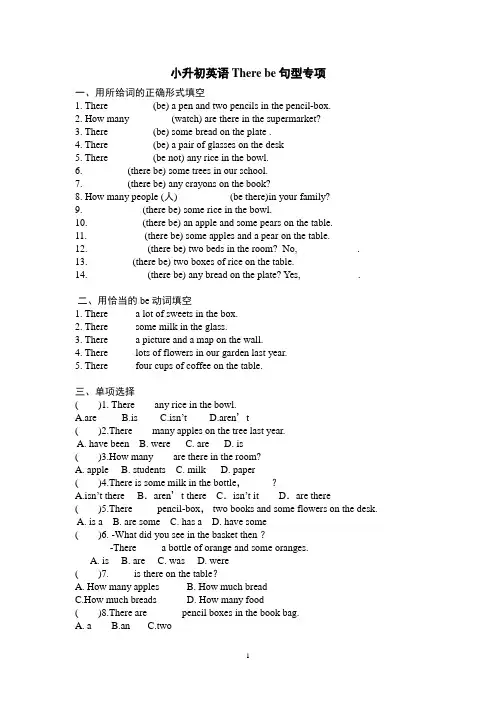
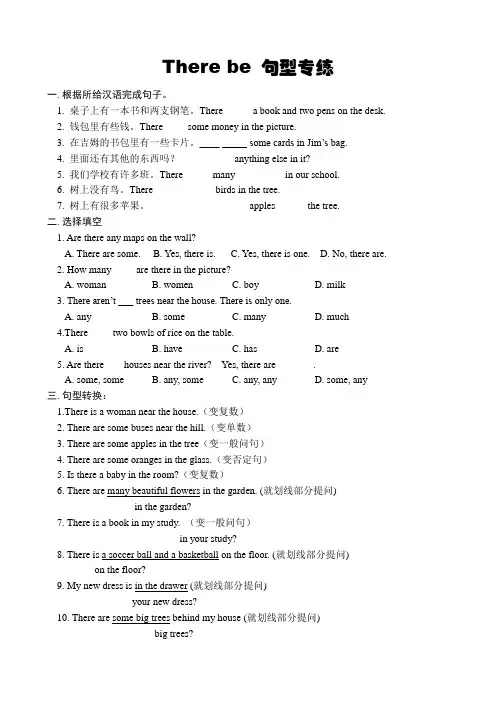
There be 句型练习
I. 将以下句子变为否认句和一般疑问句。
1.There is some water in the bottle.
2.There are many apples in the box.
II. 对句子划线部分发问。
3.There are seven days in a week.
4.There are lots of books in our library.
5.There is a knife over there.
6.There is a little milk in the glass.
Ⅲ. 单项填空。
( )1.
( )2.How many ___ are there in the room ?
A. apple B. students C. milk D. paper
( )3.How many boys ____ there in Class one?
A. be B. is C. are D. am
( )4.There ____ a lot of good news in today's newspaper.
A. is B. are C. was D. were
( )5.There ____ pencil-box, two books and some flowers on the desk.
A. is a B. are some C. has a D. have some
( )6.There ____ an apple and ten bananas in the basket. You can take any of them.
A. are B. is C. has D. have
( )7. ____ any flowers on both sides of the street?
A . Is there B .Are there C.Has D . Have
( )8. There is some ____ on the table.
A. apple B. orange C. cake D. sandwich
( )9.----What did you see in the basket then ?
----There ____ a bottle of orange and some oranges.
A. is B. are C. was D. were
( )10. ____ any flowers on both sides of the street ?
A. Is there B. Are there C. Has D. Have
( )11. ____ is there on the table?
A. How many apples B. How much bread