
第七讲:省略法
- 格式:ppt
- 大小:384.50 KB
- 文档页数:13

三、省略法Omission in English-Chinese Translation省略法也被称为减词法(pruning)。
跟增词法刚好相反,省略法是指把原文中有的词语省掉不译出来,但省掉的都是一些可有可无的或违背译语语言习惯的词,如实词中的代词、动词的省略,虚词中的冠词、介词和连词的省略等,目的是为了在忠实的基础上使译文更加简洁通顺。
一、由于语法差异而需要省略:1.代词的省略:英语中代词的使用频率远远高于汉语,根据实际情况有时需要把代词所指代的人或事物重复出来,而有时则可以直接省掉,有人称代词(主格或宾格),物主代词等。
Order is order. W e cannot complain, we cannot bargain, we cannot question and we cannot suggest changes.命令就是命令,不得抱怨,不得讨价还价,不得置疑,不得建议修改。
One must make painstaking efforts before one can master a foreign language.要掌握一门外语非下苦功夫不可.He put his hands in his pockets and then shrugged his shoulders.他把双手放进衣兜里,耸了耸肩。
A person with nerve damage in the spinal cord can grasp objects when his or her forearms are activated by a device like this one.脊髓神经有损伤的人使用这样的装置后,前臂肌肉被激活,便能抓住东西。
2.Omitting the imp ersonal pronoun “it”This often occurs when “it” is meaningless or empty.It的省略:it作形式主语或宾语,强调句中的it,或表示自然现象、时间、地点、距离等的it 常常可以省略。
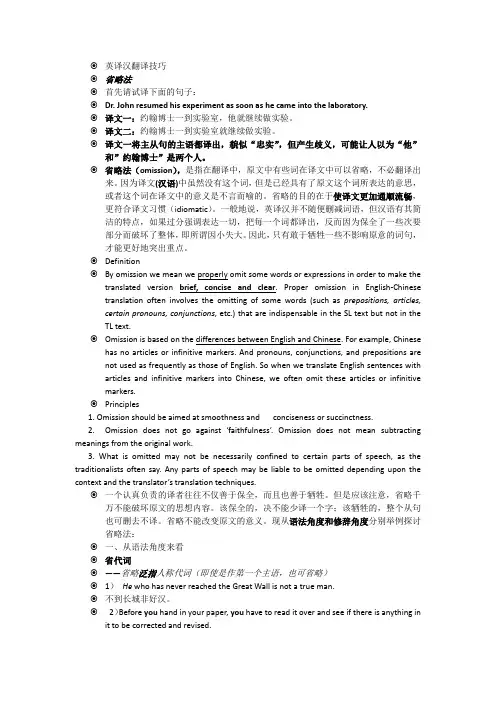
∙英译汉翻译技巧∙省略法∙首先请试译下面的句子:∙Dr. John resumed his experiment as soon as he came into the laboratory.∙译文一:约翰博士一到实验室,他就继续做实验。
∙译文二:约翰博士一到实验室就继续做实验。
∙译文一将主从句的主语都译出,貌似“忠实”,但产生歧义,可能让人以为“他”和”约翰博士”是两个人。
∙省略法(omission),是指在翻译中,原文中有些词在译文中可以省略,不必翻译出来。
因为译文(汉语)中虽然没有这个词,但是已经具有了原文这个词所表达的意思,或者这个词在译文中的意义是不言而喻的。
省略的目的在于使译文更加通顺流畅,更符合译文习惯(idiomatic)。
一般地说,英译汉并不随便删减词语,但汉语有其简洁的特点,如果过分强调表达一切,把每一个词都译出,反而因为保全了一些次要部分而破坏了整体,即所谓因小失大。
因此,只有敢于牺牲一些不影响原意的词句,才能更好地突出重点。
∙Definition∙By omission we mean we properly omit some words or expressions in order to make the translated version brief, concise and clear. Proper omission in English-Chinese translation often involves the omitting of some words (such as prepositions, articles, certain pronouns, conjunctions, etc.) that are indispensable in the SL text but not in the TL text.∙Omission is based on the differences between English and Chinese. For example, Chinese has no articles or infinitive markers. And pronouns, conjunctions, and prepositions are not used as frequently as those of English. So when we translate English sentences with articles and infinitive markers into Chinese, we often omit these articles or infinitive markers.∙Principles1. Omission should be aimed at smoothness and conciseness or succinctness.2. Omission does not go against ‘faithfulness’. Omission does not mean subtracting meanings from the original work.3. What is omitted may not be necessarily confined to certain parts of speech, as the traditionalists often say. Any parts of speech may be liable to be omitted depending upon the context and the translator’s translation techniques.∙一个认真负责的译者往往不仅善于保全,而且也善于牺牲。

