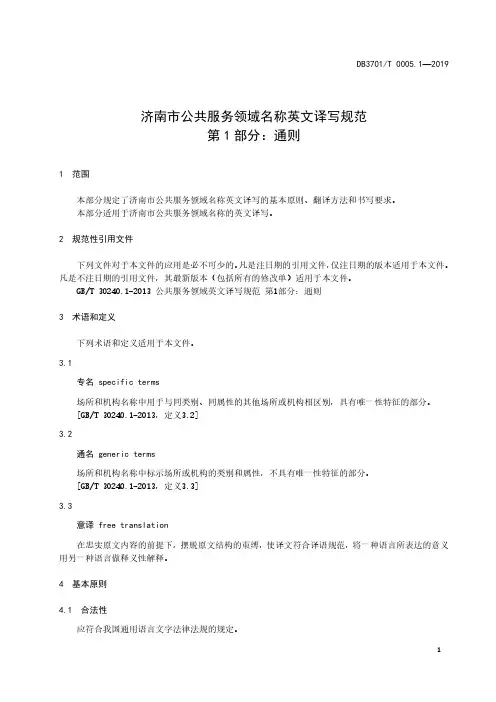
公共服务领域英文译写规
- 格式:doc
- 大小:15.95 KB
- 文档页数:4
公共服务领域英文译写规
英文回答:
Public service translation rules.
In the field of public service, accurate and effective
translation is crucial for effective communication between
service providers and the public. Here are some guidelines
for translating public service materials:
1. Clarity and simplicity: Public service materials
should be translated in a clear and simple manner, using
language that is easily understood by the target audience.
Avoid using complex or technical terms that may confuse or
alienate the readers.
2. Cultural sensitivity: Public service translations
should take into account the cultural nuances and
sensitivities of the target audience. It is important to
adapt the translation to the local culture, customs, and values to ensure that the message is well-received and
understood.
3. Accuracy and consistency: Public service
translations should be accurate and consistent with the
original source text. It is important to convey the
intended meaning of the original message without distorting
or misinterpreting the information.
4. Plain language: Public service translations should
use plain language, avoiding jargon, acronyms, and overly
formal or legalistic terms. The goal is to make the
information accessible and easy to understand for all
members of the public.
5. Accessibility: Public service translations should be
accessible to all individuals, including those with
disabilities. Consideration should be given to providing
alternative formats, such as braille or audio versions, to
ensure equal access to information.
6. Proofreading and editing: Public service translations should undergo thorough proofreading and
editing to eliminate errors, inconsistencies, and
ambiguities. It is important to review the translated text
carefully before finalizing and publishing it.
中文回答:
公共服务领域英文译写规则。
在公共服务领域,准确有效的翻译对于服务提供者和公众之间的有效沟通至关重要。以下是一些公共服务材料翻译的准则:
1. 清晰简明,公共服务材料应以清晰简明的方式进行翻译,使用易于目标受众理解的语言。避免使用复杂或技术性术语,以免混淆或疏远读者。
2. 文化敏感性,公共服务翻译应考虑到目标受众的文化细微差别和敏感性。重要的是要根据当地的文化、习俗和价值观来调整翻译,以确保信息得到良好的接受和理解。
3. 准确性和一致性,公共服务翻译应准确并与原文一致。重要的是传达原始信息的意思,而不扭曲或误解信息。
4. 简明语言,公共服务翻译应使用简明语言,避免使用行话、缩写词和过于正式或法律性的术语。目标是使信息对所有公众成员都易于理解和获取。
5. 可访问性,公共服务翻译应对所有人包括残障人士提供可访问性。应考虑提供替代格式,如盲文或音频版本,以确保信息的平等获取。
6. 校对和编辑,公共服务翻译在最终确定和发布之前应经过仔细的校对和编辑,以消除错误、不一致和歧义。在最终确定和发布之前,应仔细审查翻译文本。
通过遵循这些公共服务翻译规则,可以确保公众能够准确理解和获取重要的公共服务信息。