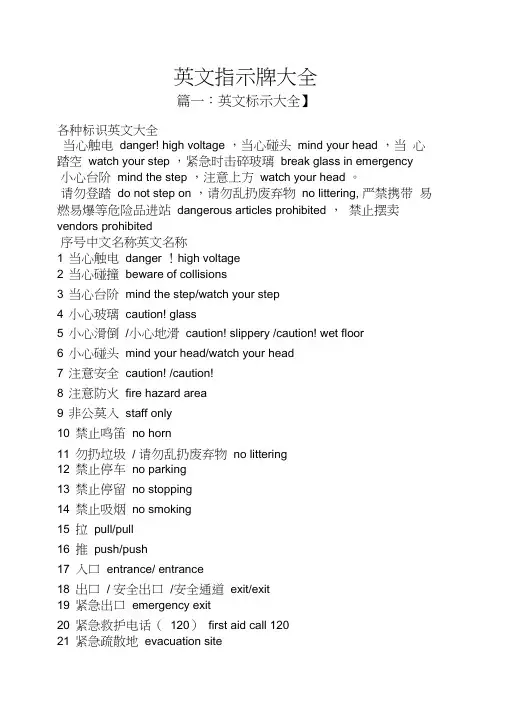
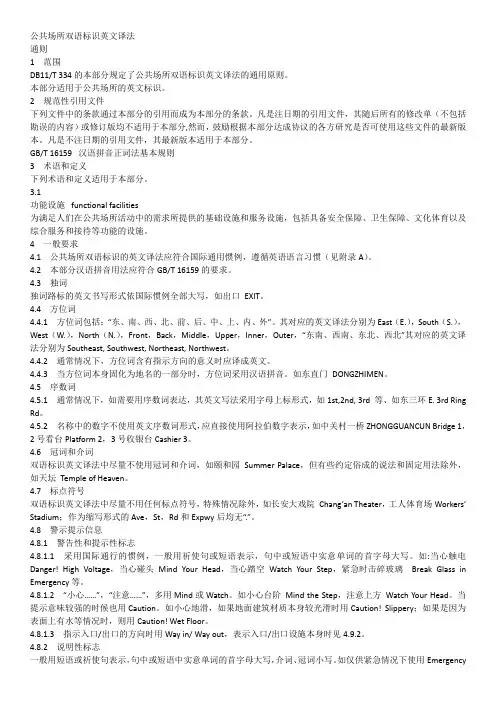
公共标志英文译写指南
- 格式:doc
- 大小:15.87 KB
- 文档页数:6
公共标志英文译写指南
Guide to the Translation and Writing of Public Signs in
English.
Introduction.
Public signs play a crucial role in guiding, informing,
and warning individuals in public spaces. Accurate and
clear translations of these signs into English are
essential for international communication and ensuring the
safety and convenience of visitors from diverse cultural
backgrounds. This guide aims to provide practical
recommendations for translating and writing public signs in
English, focusing on ensuring consistency, clarity, and
cultural appropriateness.
1. Principles of Translation.
Accuracy:Translations should accurately reflect the
original meaning and intent of the sign, avoiding any ambiguity or confusion.
Simplicity: Use straightforward language that is easy
to understand for the general public. Avoid technical or
obscure terms.
Consistency: Maintain consistency in translation
standards and terminology to enhance readability and
comprehension.
Cultural Adaptation: Take into account cultural
differences and local practices when translating, to ensure
that the sign is relevant and acceptable to the target
audience.
2. Key Elements of Public Signs.
Heading: The heading should be brief and to the point,
clearly indicating the purpose of the sign.
Main Message: The main message should be concise and
easy to understand, conveying the essential information needed by the reader.
Supplementary Information: Additional details or
instructions may be included as needed to provide further
clarification or guidance.
Commands and Requests: Use appropriate language to
convey commands or requests, ensuring politeness and
respect.
Warning and Safety Information: Use clear and urgent
language to communicate warnings or safety instructions.
3. Translation Tips.
Use Active Voice: Active voice constructions are
generally more direct and engaging, making the sign more
readable.
Avoid Redundancy: Eliminate unnecessary words or
phrases to keep the translation concise and focused.
Respect Cultural Differences: Be aware of cultural
differences and translate accordingly to avoid
misunderstandings or offense.
Use Standard English: Stick to standard English
grammar and spelling to ensure consistency and
professionalism.
Test for Readability: Always test the translated sign
for readability by asking native speakers to provide
feedback on clarity and understandability.
4. Common Public Signs and Their Translations.
Entrance/Exit: Entrada/Salida.
Parking: Aparcamiento.
Emergency Exit: Salida de Emergencia.
Restrooms: Baños.
No Smoking: No Fumar.
Caution: Precaución.
Warning: Advertencia.
Danger: Peligro.
Staff Only: Solo Personal.
Closed for Maintenance: Cerrado por Mantenimiento.
No Photography: No Fotografías.
Quiet Zone: Zona Silenciosa.
First Aid: Primeros Auxilios.
Conclusion.
Translating public signs into English requires a
balance of accuracy, clarity, and cultural sensitivity. By following the principles and tips outlined in this guide,
translators can create effective and appropriate English
translations that serve the needs of a diverse
international audience. Regular testing and revision are
essential to ensuring the quality and relevance of these
translations in today's interconnected world.