高中英语陷阱题100例(含答案)
- 格式:docx
- 大小:20.50 KB
- 文档页数:12
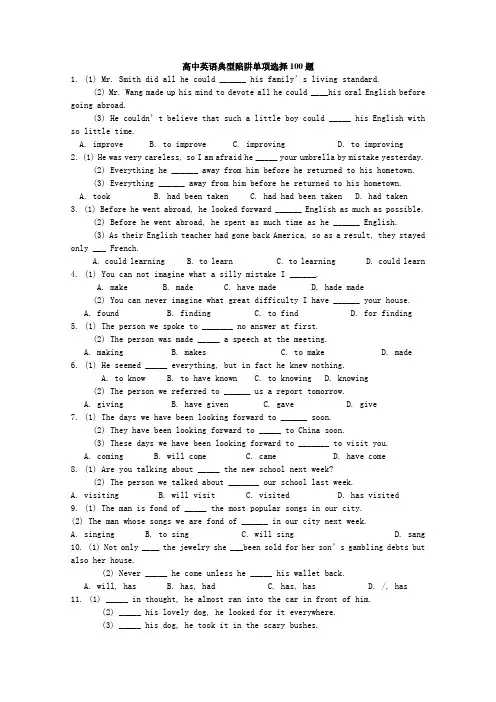
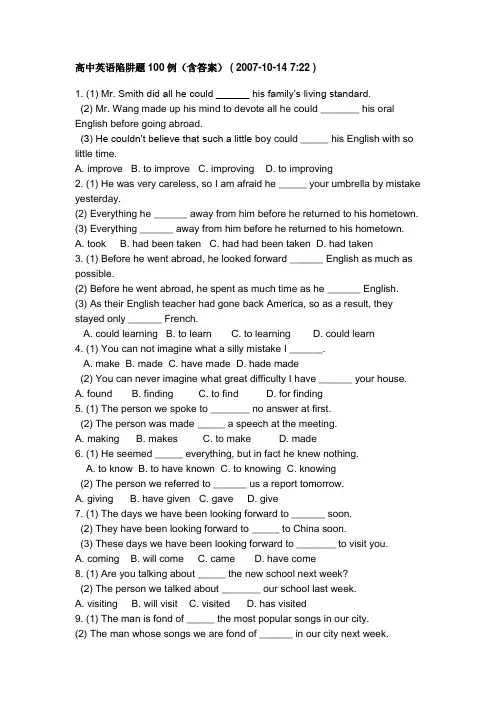
高中英语陷阱题100例(含答案)(2007-10-14 7:22 )1. (1) Mr. Smith did all he could his family ' s living standard.(2) Mr. Wang made up his mind to devote all he could his oralEnglish before going abroad.(3) He couldn ' t believe that such a littledy could his English with solittle time.A. improveB. to improveC. improvingD. to improving2. (1) He was very careless, so I am afraid he your umbrella by mistakeyesterday.(2) Everything he away from him before he returned to his hometown.(3) Everything away from him before he returned to his hometown.A. tookB. had been takenC. had had been takenD. had taken3. (1) Before he went abroad, he looked forward English as much aspossible.(2) Before he went abroad, he spent as much time as he English.(3) As their English teacher had gone back America, so as a result, theystayed only French.A. could learningB. to learnC. to learningD. could learn4. (1) You can not imagine what a silly mistake I.A. makeB. madeC. have madeD. hade made(2) You can never imagine what great difficulty I have your house.A. foundB. findingC. to findD. for finding5. (1) The person we spoke to no answer at first.(2) The person was made a speech at the meeting.A. makingB. makesC. to makeD. made6. (1) He seemed everything, but in fact he knew nothing.A. to knowB. to have knownC. to knowing C. knowing(2) The person we referred to us a report tomorrow.A. givingB. have givenC. gaveD. give7. (1) The days we have been looking forward to soon.(2) They have been looking forward to to China soon.(3) These days we have been looking forward to to visit you.A. comingB. will comeC. cameD. have come8. (1) Are you talking about the new school next week?(2) The person we talked about our school last week.A. visitingB. will visitC. visitedD. has visited9. (1) The man is fond of the most popular songs in our city.(2) The man whose songs we are fond of in our city next week.A. singingB. to singC. will singD. sang10. (1) Not only the jewelry she been sold for her son ' s gambling debts but also her house.(2) Never he come unless he his wallet back.A. will, hasB. has, hadC. has, hasD. /, has11. (1)in thought, he almost ran into the car in front of him.(2) his lovely dog, he looked for it everywhere.(3) his dog, he took it in the scary bushes.A. LosingB. Having lostC. LostD. To lose12. (1) The research is so designed that once nothing can be done tochange it.A. beginsB. having begunC. beginningD. begun(2)in the queue for almost half an hour, he suddenly realized that he forgot his code.A. Having waitedB. WaitedC. To waitD. Waiting13. (1) --- What do you think made the woman so upset? ---weight.(2) --- What can I do to join in the league? ---weight.A. As she put onB. Put onC. Putting onD. Because of putting on(3) --- Why are the students so diligent these days? ---the entrance exams.A. PassB. To passC. PassingD. Having passed14. (1) Time should be made good use of our lessons well.(2) Time should be spent English by everybody at present.A. learningB. learnedC. to learnD. having learned15. (1) It was only with the help of the local guide.(2) It was snowing heavily.(3) Only with the help of the local guide.A. was the mountain climber rescuedB. then the mountain climber was rescuedC. when the mountain climber was rescuedD. that the mountain climber was rescued16. (1) Never time come again.(2) Never he a single sheep.A. has ••- (lost)B. will ••- (lose)C. will ••- (lost)D. lose17. (1) --was it they discovered the entrance to theunderground palace?-- Totally by chance.(2) ---was it they discovered at the entrance to theunderground palace?---A helmet.A. What, thatB. How, thatC. When, howD. Where, that18. (1) I have nothing to confess.you want me to say?(2) I hope you don ' t mind, but you were born?A. What is it thatB. What it is whatC. How is it thatD. Where is it that19. (1) Is this factory you visited the other day?(2) Is this the factory you visited the other day?A. the oneB. thatC. whereD. when20. (1) Was it she heard with her ears really made herfrightened?(2) Was it she had been really made you all surprised?A. what, thatB. it, thatC. where, thatD. what, /21. (1)what the six blind men said sounded!(2) You can ' t imagine he is acting.A. H(h)ow foolishlyB. H(h)ow foolishC. W(w)hat foolishD. W(w)hat foolishly22. (1) It was the old clock the old man spent the whole morning athome.(2) It was three hours that the old man spent the old clock.A. repairB. repairingC. to repairD. in repair23. (1) Is this hotel you said we were to stay in your letter?(2) Is this the hotel you said we were to stay in your letter?A. thatB. whereC. the oneD. in which24. (1) Please tell me the way you thought of the garden.(2) Have you thought of the garden? **A. take care ofB. to take care ofC. taking care ofD. how to take care of25. (1) A fast-food restaurant is the place,, just as the name suggests, eating is performed quickly.(2) A fast-food restaurant is the place,you can eat quickly.(3) A fast-food restaurant is the place,can perform you food quickly.A. whichB. whereC. thereD. what26. (1) The film brought the hours back to me I was taken good care ofin that far-away village.(2) The picture brought me back to the hours I spent with the villagerswhen I was 12.A. untilB. thatC. whenD. where27. (1) The professor has written another book,of great importance to computer science.(2) The professor has written another book,of great importance to computer science. A. which I think it is B. and I think it is C. which I think is D. when I think is28. (1) -- Where do you think he the computer?-- Sorry, I have no idea.(2) -- Where on earth he the computer?-- Sorry, I have no idea. A. had, bought B. has, bought C. did, buy D. /, bought29. (1) We should do more such exercises in the future, I think,those we did yesterday.(2) We should do such exercises in the future, I think,we did yesterday.(3) The teacher suggested that we should do what he did yesterday. A. as B. like C. about D. than30. (1) He will tell you he expects will win such a match.(2) He will tell you of the teams he expects will win such a match. A. why B. whom C. which D. who31. (1) In New Zealand, I made lots of friends a very practicalknowledge of the English language.(2) When he came back from work, he found nothing left — only of milk.A. getB. to getC. getting32. (1) I ' m busy now. I ' m sorry I can (2) Whenever he comes to our garden, he can A. watering B. watered C. waters33. (1) Who would you rather the report insteadof you?(2) Would you rather to him or have him call you? A. have write B. have to write C. write D. have written34. (1) We must stop pollution longer.(2) We must keep the fishes in the river longer. A. living B. from living C. to live D. live35. (1)-- Was it under the tree you were away talking to a friend?--Sure. But when I get back there, the bike was gone.(2) Was it under the tree you put your bike when you were away talkingto a friend? A. that B. where C. which D. while36. (1) Not far from the club there was a garden,owner seated in it playing bridge with his children every afternoon.(2) Harry Port er,owner ' s real name is J. K. Rowling, gave the world a block storm.A. whoseB. itsC. whichD. that37. (1) Wang Lin was elected all he is the tallest.(2) To tell the truth, Wang Lin was elected,he is the tallest.a cup D. got't help the flowers.'t help the flowers. D. to waterA. becauseB. because ofC. forD. as38. (1) We ' ll be free tomorrow, so I suggest to the history museum.(2) Tomorrow is Sunday, so I suggest the history museum. **A. visitingB. visiting toC. we should visitD. a visit39. (1) I like swimming, while what my brother enjoys.(2) I like swimming, while my brother enjoys.A. cookingB. to cookC. is cookingD. cook40. (1) Thank you for the trouble you have to help me.(2) Thank you for the unselfish help you have to me.A. paidB. takenC. givenD. asked41. (1) Who is it up decide whether to go or not?(2) Who did you go help the people in trouble?A. to toB. for forC. to forD. with to42. (1) We keep in touch writing often.(2) We keep in touch write to each other to comfort each other.A. withB. toC. onD. by43. (1)-- How long have you been here?--the end of last month.(2) -- When did you come here?--the end of last month, I think.(3) --- When shall we finish the project?---the end of this month, I think.A. InB. ByC. AtD. Since44. (1) You should treat him in the way suits him most.(2) Please share the way with us you study English. **A. thatB. in whichC. howD. why45. (1) He insisted that the sky clear up the following day.(2) Mom insisted that he wash his hands, but he insisted that hewashed them.A. wouldB. shouldC. hadD. be46. (1) He is a strict but kind-hearted father,the children respect butare afraid of.A. /B. thatC. for whomD. one whom(2) My most famous relative of all,who really left his mark on America, was Rob Sussel, my great-grandfather.A. oneB. the oneC. heD. someone(3) He is a good man,you can trust on all your life.A. aB. oneC. that oneD. which47. (1) Mr. Smith is a good teacher we all respect.(2) Mr. Smith is a good teacher we all respect him.A. such, thatB. such, asC. so, thatD. so, as(3) I want to buy book he bought yesterday.A. the same, thatB. the same, asC. the same, likeD. the same, that(4) He is teacher the headmaster praised at the meeting inpublic.A. the same, thatB. the same, asC. the same, likeD. the same, that48. (1)nice, the food was all eaten up soon.(2)nice, the food should be made by adding more sugar.A. TastingB. TasteC. TastedD. To taste49. ⑴ You haven ' t been to Beijing, have you?_____ . And how I wish to go there again.(2) --- You haven ' t been to Beijing, have you?--- _____ . But how I wish to go there.A. Yes, I have.B. Yes, I haven 'C. No, I haveD. No, I haven '50. (1) He was sentenced to death what he has stolen from the bank.(2) They were forced to leave their homeland the Nazis got there and killed many people.A. thatB. sinceC. becauseD. because of51. (1) Have you any idea the film will begin?(2) Do you know the film will begin?A. whatB. whenC. whereD. which52. (1) I to do the work at 3 o ' clock this afternoon.A. will have begunB. will beginC. would have begunD. have begun(2) I to do the work by 3 o ' clock this afternoon.A. will have begunB. will beginC. would have beginD. have begun53. (1) The body of the King inside the tomb.A. wasB. wereC. hasD. have(2) Inside the tomb the body of the King.(3) Inside the tomb the bodies of the King and the Queen.A. wasB. wereC. hasD. have54. (1) Weather, we ' ll go camping this weekend.(2) If weather, we ' ll go camping this weekend.A. permittedB. permittingC. permitsD. is permitted55. (1) You ' d better the small child across the street.(2) It ' s better the small child across the street.A. to guideB. guideC. to guidingD. to be guided56. (1) I didn ' t want to see the film because I it twice.(2) I don ' t go to see the film because I it twice.A. have seenB. had seenC. sawD. will see57. (1) It ' s good you to send me Ocn present.(2) It ' s good you to do eye exercises every day.A. forB. ofC. withD. to58. (1) He himself at the desk, writing a letter.A. satB. was seatedC. seatedD. was sat(2) He at the desk, writing a letter.A. sitB. was seatedC. seatedD. was sat59. (1) It was two o ' clock this morning the special train arrived here.(2) It was at two o ' clock this morning the special train arrived here.A. thatB. whenC. thenD. where60. (1)no subjunctive mood, English would be much easier. **A. If were thereB. If there wereC. Were thereD. Is there(2)no subjunctive mood, English would be much easier.A. If were thereB. Were if thereC. Were thereD. Is there61. (1)the day going on, the weather got worse.(2)the day went on, the weather got worse.A. AsB. ForC. With D Through62. (1)made you so happy at the party?(2)you were taken good care of on the farm?A. What is it thatB. When is it thatC. What was it thatD. When was it that63. (1) She is one of the girls be an air tress.(2) She is the one of the girls be an air tress.A. who wantB. who wantsC. which wantD. which wants64. (1) How long is it we last spent the holiday in the country together?(2) Will it long we spend the holiday in the country together?A. beforeB. untilC. sinceD. that65. (1) --- It so kind of you to give us so much help.(2) Could you be so kind as to give us a little bit of help? ---.A. A pleasureB. My pleasureC. With pleasureD. Why not66. (1) --- you didn ' t speak to him alhat day?---Of course. He was so impolite.(2) I am sorry to trouble you,can I have your name?(3) Do something good to others,you will get more back later.(4) Be quiet,you will not stay here any longer.A. soB. andC. butD. or67. (1)the students were hearing the exciting news!(2) the students were watching the exciting play!(3) the students were watching the exciting play with!A. How pleasedB. What a funC. How happilyD. What pleasure68. (1) It was that I got back home yesterday.(2) It was when I got here yesterday.A. at midnightB. midnightC. on midnightD. in midnight69. (1) It was that I began to learn English.(2) It was since I began to learn English.A. two years agoB. two yearsC. two years beforeD. until two years70. (1)that he can always make himself understood.(2), he still cannot make himself understood.A. So clearly he speaks EnglishB. So clearly does he speak EnglishC. Clearly as he speaks EnglishD. Clearly as he speaks English(3) Not only people to find jobs, but also medical treatment will beprovided for people who need it.A. help will be given toB. will help be given toC. help does be given toD. does help be give to71. (1) He never said that he was good at mathematics,?(2) He was unhappy at school today,?A. was heB. wasn ' t heC. did heD. didn ' t he(3) Tom dislikes playing tennis,?A. does heB. doesn ' t heC. did heD. didn ' t he72. (1) Not until he was eight go to school.A. he didB. he did doC. did heD. had he(2) Only when the war was over get happily back to work.A. he was able toB. was he able toC. did he able toD. he did able to73. (1), he could work out the problem.A. Child as he wasB. As he was a childC. A child as he wasD. As he was child(2), he failed again in the driving test.A. As he might tryB. Might as he tryC. Try as he mightD. Tried as he might74. (1) Fran is an honest girl; I say it,I don ' t like her.(2) Fran is an honest girl; I say it,, I don ' t like her.A. even thoughB. as thoughC. even soD. as long as75. (1) Doctor Godwin says that what forceful arguments againstcigarette there are, many people insist on smoking.(2) Doctor Godwin says that forceful arguments against cigarettethere are, many people insist on smoking.(3) Doctor Godwin says that happens, many people insist onsmoking.A. whateverB. no matterC. howeverD. even if76. (1)China ' s reform and opening up in late 1978, its quick development has aroused worldwide attention.(2)China ' s refo-opening-policy works, its quick development arouses worldwide attention.A. WhileB. AsC. SinceD. With77. (1) --- Was it there you were away to see your friend off?---I ' m not sure. But when Igot back, it was gone.(2) --- Was it there you put your bike to see your friend off?---I ' m not sure. But when I got back, it was gone.A. thatB. whichC. whileD. where78. (1) Scientists generally agree that Earth ' ls wfematepwiver thenext 50 to 100 years it has warmed in the 20,000 years since Ice Age.(2) Scientists generally agree that the Earth will exist it has done inthe past.A. as long asB. as much asC. so long asD. as well as79. (1) --- Excuse me. Did you notice whether the No. 108 bus had gone by?---Not I ' ve been standing here.(2) a car reaches the end of its life, it is taken apart and any part that can be reused is sold off.(3) He never thought that his success came he least wanted it.A. U(u)ntilB. O(o)nceC. S(s)inceD. W(w)hile80. (1) This is an illness that can result in total blindness left untreated.(2) you want me to fire you, I suggest you stop wearing sports clothes at office.(3) You must keep on working in the evening you are sure you canfinish the task in time.A. sinceB. ifC. unlessD. until81. (1) He is such a lazy man nobody wants to work with.(2) He is such a lazy man nobody wants to work with.A. that; himB. that; /C. as; /D. as; him82. (1)sometimes keeps her awake at night Tom is gettingmore and more quiet at home.(2)sometimes keeps her awake at night is Tom is gettingmore and more quiet at home.A. That; whichB. It; thatC. Whether; whatD. What; that83. (1) --- Would you tell me you want your tea, with sugar or milk?---Sugar, please.(2) --- Would you tell me you want your tea with sugar or milk?---Sugar, please.A. whetherB. whereC. whatD. how84. (1) Is this hotel you said we were to stay in your letter?(2) Is this the hotel you said we were to stay in your letter?A. whereB. whichC. at whichD. that85. (1) Is this farm you visited last summer with the foreign friends?(2) Is this the farm you visited last summer with the foreign friends?***A. the oneB. whichC. thatD. /86. (1)a terrible storm would take place in Hainan.A. Word came whichB. Word came thatC. Word that cameD. Words came that(2) There is a common belief among them rubbish can and shouldbe put to good use.(3) There is a new problem involved in the popularity of private cars road conditions need to be improved.A. whichB. ifC. whetherD. that87. (1) A modern city has been set up in was a wasteland ten yearsago.(2)is Britain now used to be three different countries and over many years the three countries became one.A. asB. thatC. whatD. which88. (1) I can think of many cases students obviously knew a lot ofEnglish words and expressions but couldn ' t writedaegsay.(2) He got himself into a dangerous situation he is likely to losecontrol over the plane.A. whyB. asC. whatD. where89. (1) Mrs. Brown was much disappointed to see the washing machine shewent wrong again.(2) The washing machine Mrs. Brown went wrong again.A. had had repairedB. had repairedC. repairD. repaired(3) Who would you like to the letter to the headmaster ' s office?A. have writtenB. have writeC. writeD. writing90. (1) --- What should I do with this passage?---the main idea of each paragraph.(2) --- What made him so worried?---the main idea of each paragraph.(3) --- Why is he reading the passage in such a loud voice?---the main idea of each paragraph.A. Finding outB. Found outC. Find outD. To find out91. (1) About 170 people and dozens more after a flood hit anIndonesian town last week.A. were killed; are still missingB. have been killed; were still missingC. are killed, are still missingD. had been killed; were still missing(2) By the time you arrive in London, we in Europe for two weeks.A. shall stayB. have stayedC. will have stayedD. have been staying92. (1) --- What' s wrong with your coat?---Just now when I wanted to get off the bus, the man next to me on it.A. satB. had satC. had been sittingD. was sitting(2) The manager had fallen asleep where he, without undressing.A. was layingB. was lyingC. had laidD. had lied93. (1) --- Lend me some more money, will you?---Sorry, I ' ve got at hand myself. You know the MP3 player cost meall I had just now.(2) --- I ' ve looked everywhere, but Ihaven' t found any black ink.---Then, I ' m afraid there is left.(3) --- Have you got anything interesting to tell us?A. no oneB. noneC. neitherD. nothing94. (1) --- May I go and play with Tom this afternoon, Mum?---No. You can ' t go out your homework is being done.(2) --- May go and play with Tom this afternoon, Mum?---No. You can ' t go out your homework is done.A. untilB. sinceC. beforeD. if95. (1) It was some time later we realize the truth.(2) It was some time we realize the truth.A. untilB. sinceC. beforeD. that96. (1) --- Excuse me. Did you notice whether the No 178 bus had gone by?---Not I ' ve been standing here.(2) --- Excuse me. Did you notice whether the No 178 bus had gone by?---Not I began to stand here.A. asB. sinceC. whenD. while97. (1) All morning as she waited for the medical report from the doctor, her nervousness.A. has grownB. is growingC. grewD. had grown(2) The discussion alive when an interesting topic was brought in.A. was comingB. had comeC. has comeD. came(3) It is said in the book that Thomas Edison (1847---1931)the world leading inventor for sixty years.A. would beB. has beenC. had beenD. was(4) --- Well, that was really a good meal. I you were a really goodcook.---Thank you.A. didn ' t know. don ' t knowC. haven ' t know D. hadn ' t known(5) --- How long in Ji ' nan?---For just the weekend. I was back shortly after the meeting.A. did you stayB. have you stayedC. were you stayingD. are you staying98. (1) Although he has lived with us for years, he us muchimpression.A. hadn ' t lefB. didn ' t leavC. doesn ' t leaveD. hasn ' t left(2) The house belongs to my aunt but she here any more.A. hasn ' t livedB. didn ' t livC. hadn ' t lived?. doesn ' t99. (1) Scientists think that the continents always where they______ t oday.(2) Scientists think that the continents today always where theyA. aren ' t; arB. aren ' t; werC. weren ' t; ar©. weren ' t; were(3) Never before in greater need of modern public transport than itis today.(4) Never in greater need of modern public transport than it istoday.A. has this city beenB. this city has beenC. was this cityD. this city was 100. (1) --- Why didn ' t you put your ce l phone in our overcoat pocket?---I, but I was afraid it would be stolen.A. had putB. putC. would haveD. could have(2) ---Mr. Brown this week?---No. he is on holiday.A. Has; workedB. Does; workC. Did; workD. Is; working答案1. BDA2. ACB3. CAB4. BB5. DC6. BC7. BAA8. AC9. AC 10. BA 11. CBD 12. DA 13. CBB 14. CA 15. DCA 16. CA17. BA 18. AD 19. AB 20. AC 21. BA 22. BB 23. CA 24. C/CD25. BBA 26. CB 27. BC 28. DC 29. DAB 30. DC 31. CB 32. DA33. AC 34. CA 35. DB 36. BA 37. BA 38. D/AC 39. CA 40. BC41. AD 42. DB 43. DCB 44. A/AB 45. A/BC 46. DBB 47. BABA 48. AD49. AD 50. DC 51. BB 52. BA 53. AAB 54. BC 55. BA 56. BA57. BA 58. CB 59. BA 60. BC/C 61. CA 62. CD 63. AB 64. CA65. AB/C 66.ACBD 67. ACD 68. AB 69. AB 70. BCB 71. ABB 72. CB73. AC 74. AC 75. BAA 76. CB 77. CA 78. BA 79. DBA 80. BCC81. AC 82. BD 83. DB 84. AC 85. A/BCD 86. BDD 87. CC 88. DD89. BAB 90. CAD 91. AC 92. DB 93. BBD 94. BA 95. DC 96. DB97. CDDDA 98. CD 99. CBCA 100. CD。