上海外国语大学mti英语翻译硕士考研真题
- 格式:doc
- 大小:45.00 KB
- 文档页数:8
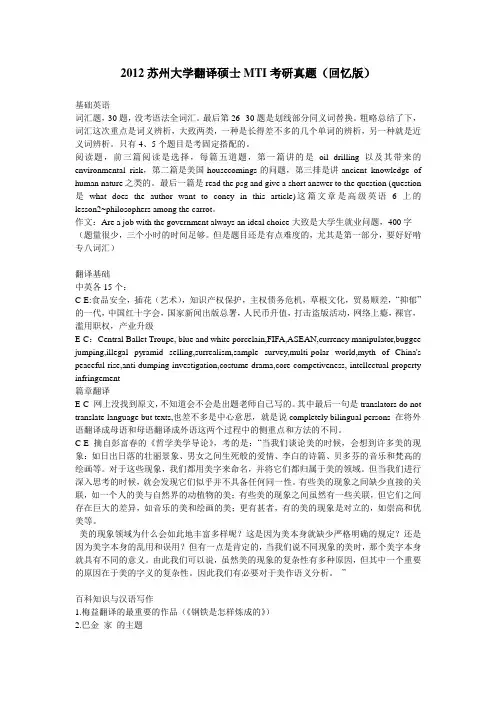
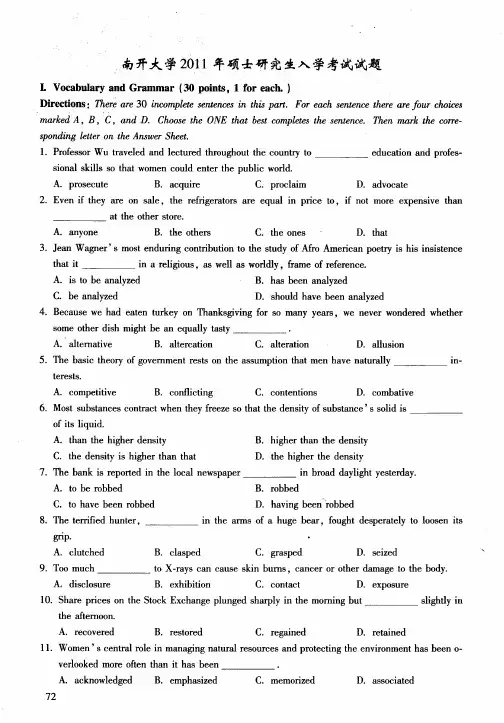
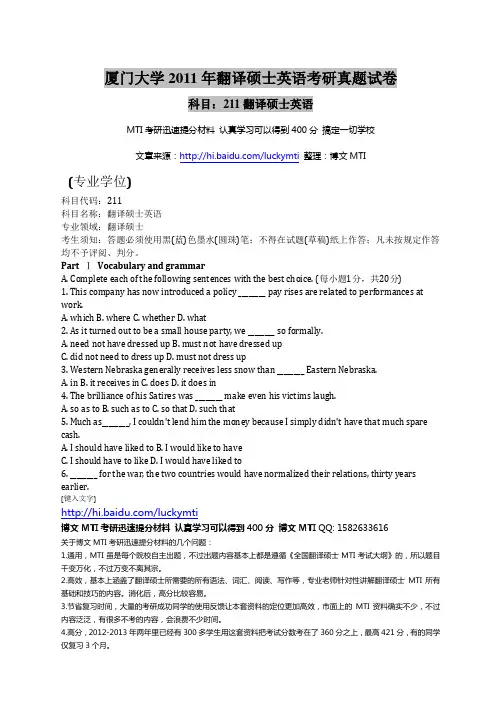
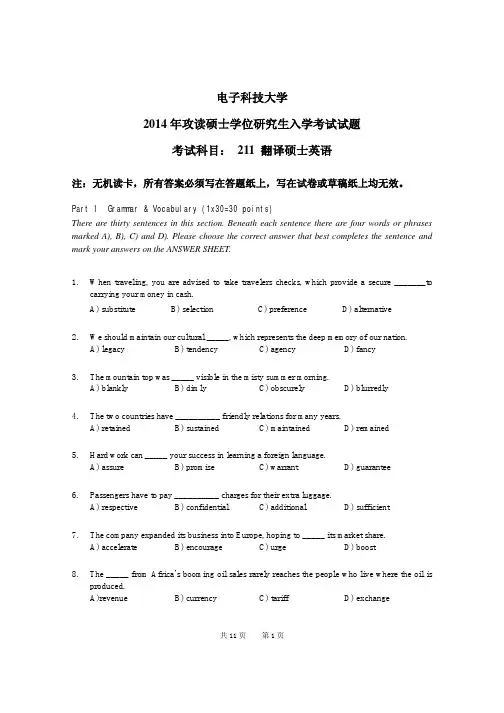
一、翻译硕士英语(211)
1.选择题(20*1')
考单词为主,后面有几道语法。单词以专八词汇为主,少量的gre词汇。
2.阅读(20*1')
四篇阅读,个人觉得很简单,文章很短,只有一面的长度吧,用专八阅读练习足够了。
3.改错(10*1')
比专八改错简单、前几年考的是修辞和英美文化常识、或古希腊神话典故。
4.作文(50分,500字)
谈谈你对happiness的定义。
二、英语翻译基础(357) 1.英译汉(75分)
该部分选取的是卢梭的《爱弥儿》(Emile, or On Education)部分文章,主要选自《爱弥儿》第三卷第一节。全文1000多字,共11段,但题目只要求翻译划线部分,总计翻译872字,共6段。完整原文如下:
The whole course of man's life up to adolescence is a period of weakness;
yet there comes a time during these early years when the child's strength
overtakes the demands upon it, when the growing creature, though
absolutely weak, is relatively strong. His needs are not fully developed
and his present strength is more than enough for them. He would be a very
feeble man, but he is a strong child.
What is the cause of man's weakness? It is to be found in the disproportion
between his strength and his desires. It is our passions that make us weak,
for our natural strength is not enough for their satisfaction. To limit
our desires comes to the same thing, therefore, as to increase our strength.
When we can do more than we want, we have strength enough and to spare,
we are really strong. This is the third stage of childhood, the stage with
which I am about to deal. I still speak of childhood for want of a better
word; for our scholar is approaching adolescence, though he has not yet
reached the age of puberty.
About twelve or thirteen the child's strength increases far more rapidly
than his needs. The strongest and fiercest of the passions is still unknown,
his physical development is still imperfect and seems to await the call
of the will. He is scarcely aware of extremes of heat and cold and braves
them with impunity. He needs no coat, his blood is warm; no spices, hunger
is his sauce, no food comes amiss at this age; if he is sleepy he stretches
himself on the ground and goes to sleep; he finds all he needs within his
reach; he is not tormented by any imaginary wants; he cares nothing what
others think; his desires are not beyond his grasp; not only is he
self-sufficing, but for the first and last time in his life he has more
strength than he needs.
I know beforehand what you will say. You will not assert that the child
has more needs than I attribute to him, but you will deny his strength.
You forget that I am speaking of my own pupil, not of those puppets who
walk with difficulty from one room to another, who toil indoors and carry
bundles of paper. Manly strength, you say, appears only with manhood; the
vital spirits, distilled in their proper vessels and spreading through
the whole body, can alone make the muscles firm, sensitive, tense, and
springy, can alone cause real strength. This is the philosophy of the study; I appeal to that of experience. In the country districts, I see big lads
hoeing, digging, guiding the plough, filling the wine-cask, driving the
cart, like their fathers; you would take them for grown men if their voices
did not betray them. Even in our towns, iron-workers', tool makers', and
blacksmiths' lads are almost as strong as their masters and would be
scarcely less skilful had their training begun earlier. If there is a
difference, and I do not deny that there is, it is, I repeat, much less
than the difference between the stormy passions of the man and the few
wants of the child. Moreover, it is not merely a question of bodily
strength, but more especially of strength of mind, which reinforces and
directs the bodily strength.
This interval in which the strength of the individual is in excess of his
wants is, as I have said, relatively though not absolutely the time of
greatest strength. It is the most precious time in his life; it comes but
once; it is very short, all too short, as you will see when you consider
the importance of using it aright.
He has, therefore, a surplus of strength and capacity which he will never
have again. What use shall he make of it? He will strive to use it in tasks
which will help at need. He will, so to speak, cast his present surplus
into the storehouse of the future; the vigorous child will make provision
for the feeble man; but he will not store his goods where thieves may break
in, nor in barns which are not his own. To store them aright, they must
be in the hands and the head, they must be stored within himself. This
is the time for work, instruction, and inquiry. And note that this is no
arbitrary choice of mine, it is the way of nature herself.
Human intelligence is finite, and not only can no man know everything,
he cannot even acquire all the scanty knowledge of others. Since the
contrary of every false proposition is a truth, there are as many truths
as falsehoods. We must, therefore, choose what to teach as well as when
to teach it. Some of the information within our reach is false, some is
useless, some merely serves to puff up its possessor. The small store which