
Kazakhstan
- 格式:ppt
- 大小:2.63 MB
- 文档页数:19
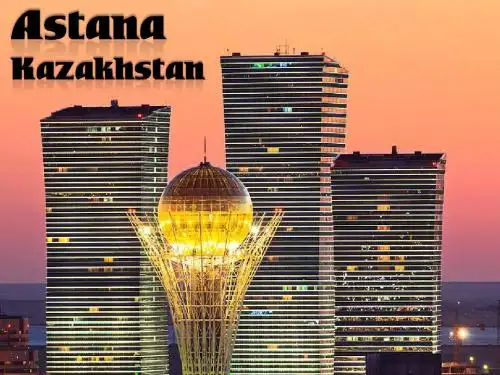
Astana -the capital of the Republic of Kazakhstan (since December 10, 1997). The city's population of about 700 thousand people. The city is second in the country by population after the Alma-Ata. Located in northern Kazakhstan on the river Ishim in place of its closest approach to the river Nuroy. Astana -the coldest capital of the world, after Ulan Bator, the capital of Mongolia. And probably the most windy ...Astana is in a very flat, semi-desert steppe region which covers most of the country's territory. The elevation of Astana is at 347 metres (1,138 ft) above sea level. Astana is in a spacious steppe landscape, in the transient area between the north of Kazakhstan and the extremely thinly settled national center, because of the river Ishim. The older boroughs lie north of the river, whilst the new boroughs are located south of the Ishim.Astana -the capital of Kazakhstan. In 1997, Kazakhstan President Nursultan Nazarbayev proposed to move the capital from Almaty to Astana (Tselinograd). This decision was motivated by an important geopolitical location of the city -the center of Kazakhstan and the Eurasian continent -the existence of the necessary transport and communication infrastructure. In 1998, the country's leadership decided to rename the new capital -it was given the name "Astana", which in Kazakh language means "capital".Mosque Nur Astana -The mosque was designed by Lebanese architect Charles Hazifa. Height of main dome -43 meters.Premium Hotel DiplomatRiver Ishim (belongs to the basin of Ob River)Palace of Peace and Accord, the monument "Kazakh Eli" and the Palace of IndependenceThe main road bridge of the city, connecting the left and right banks of the River Ishim.Height of 142 meters. Built in 2006 in the style of Stalin's skyscrapers.Ministry of Foreign Affairs of the Republic of KazakhstanMinistry of Defence of the Republic of KazakhstanBusiness Center Astanalyk "Sarayshyk street. Bridge M-1And 38-storey residential building, one of the residential complex "Grand Alatau«View from the "Triumph of Astana '(right) Temir Joly "(Office of the railway of Kazakhstan) -On the roof stylobate is one of the fire and evacuation elevators complex (reds box). This is the first in the world of exterior fire-recovery system in which elevators are moved by rail facade.Concert Hall "Kazakhstan«-Concert Hall at 3000 seats, designed by Italian architect Nicoletti.Monument to Russian sculptor Dashi Namdakov "Jer-ana" (Earth Mother), who represents Queen Tomiris Saka, standing on a giant bull.CircusMosque Nur Astana -The mosque was designed by Lebanese architect Charles Hazifa.Height of main dome -43 meters.(right) "Tower Automotive" (Lighter) -The building houses the Ministry of Transport and Communications and the Ministry of Industry and Trade. -In 2006 the building was a fire, which burnt down all the upper floors.Baiterek -a monument in the center of Astana. -Built on the sketches of the British architect Norman Foster. At the top level "ball", within which is a bar and a panoramic room.National Archives of the Republic of KazakhstanAk Orda -residence of President of the Republic of Kazakhstan.The height of the building along with the spire is 80 meters Façade is made of Italian marble with thickness of 20 to 40 cmTRC "Khan Shatir" -The building is a gigantic tent 150 m high (spire), constructed from a network of steel shrouds, which enshrined a transparent polymer coating.。

Guide to InvestmentAstana阿斯塔纳投资指南目录1Investment climate of Kazakhstan 哈萨克斯坦的投资环境 (4)2Astana:the city of the future阿斯塔纳的未来 (6)2.1General information概况 (7)2.2Astana’s competitive advantages阿斯塔纳的竞争优势 (7)3International investment forums国际投资论坛 (11)4EXPO 2017 international specialized exhibitions 2017年世界博览会 (11)5State support 国家支持 (12)5.1Special economic zone: Astana- A new city经济特区:阿斯塔纳-一个新的城市13 5.2Investor’s Service Center投资者服务中心 (15)5.3Investor 2020 program投资者2020项目 (17)5.4Business road map 20202020年业务路线图 (18)5.5Export 2020 program2020出口计划 (18)5.6Productivity 2020 program生产力2020计划 (19)6Strategic sectors of Astana’s economy阿斯塔纳经济战略部门 (20)6.1Mechanical engineering and metalworking机械工程和金属加工 (20)6.2Construction建设 (21)6.3Transport运输 (21)6.4Medicine and pharmaceuticals医学和制药 (22)6.5Tourism and sport旅游与体育 (23)6.6Information technologies and telecommunications信息技术和电信 (23)6.7Innovation革新 (24)7Public-private partnership 公共合作关系 (25)Page2Asta n a is the most intensively developing city of Eurasia. Its economy demonstrates sustainable growth. Since 2000, the gross regional product (GRP) of Astana has grown more than 24-fold, GRP per capita over 14-fold, reaching USD26.8 thousand, which is on par with some of the European Union nations.阿斯塔纳是欧亚大陆发展最繁忙的城市,它拥有可持续增长的经济能力。
Ethnic Kazakhs, a mix of Turkic and Mongol nomadic tribes who migrated into the region in the 13th century, were rarely united as a single nation. The area was conquered by Russia in the 18th century,and Kazakhstan became a Soviet Republic in 1936. During the 1950s and 1960s agricultural "Virgin Lands" program, Soviet citizens were encouraged to help cultivate Kazakhstan's northern pastures. This influx of immigrants (mostly Russians, but also some other deported nationalities) skewed the ethnic mixture and enabled non-ethnic Kazakhs to outnumber natives. Non-Muslim ethnic minorities departed Kazakhstan in large numbers from the mid-1990s through the mid-2000s and a national program has repatriated about a million ethnic Kazakhs thus far back to Kazakhstan. These trends have allowed Kazakhs to become the titular majority again. This dramatic demographic shift has also undermined the previous religious diversity and made the country more than 70 percent Muslim. Kazakhstan's economy is larger than those of all the other Central Asian states largely due to the country's vast natural resources. Current issues include: developing a cohesive national identity; managing Islamic revivalism; expanding the development of the country's vast energy resources and exporting them to world markets; diversifying the economy outside the oil, gas, and mining sectors; enhancing Kazakhstan's economic competitiveness; developing a multiparty parliament and advancing political and s ocial reform; and strengthening relations with neighboring states and other foreign powers.Political System of KazakhstanThe Constitution of the Republic of Kazakhstan provides for a democratic, secular and presidential system of rule. State governance is divided between executive, legislative and judicial branches. President is a head of state.On May 21, 2007 President of Kazakhstan signed a Law amending the Constitution. These changes enlarge the power of the Parliament, enhance the role of political parties, thus transforming Kazakhstan from presidential into presidential-parliamentary republic.Head of State:President Nursultan A. Nazarbayev.The President of the Republic of Kazakhstan determines the main directions of the domestic and foreign policy of the state and represents Kazakhstan within the country and in international relations.The President of the Republic is the guarantor of the unity of the people and the state power, inviolability of the Constitution, rights and freedoms of an individual and citizen.Legislative Branch: Kazakhstan has a bicameral Parliament, which consists of the Senate (the upper house) and Majilis (House of Representative).The 47-member Senate is made up of two elected representatives from each of Kazakhstan's 14 regions, cities of Astana and Almaty. Representatives serve terms of two, four or six years. Several members of the Senate represent the Assembly of the People of Kazakhstan. The Senate is empowered to adopt laws in the period of temporal absence of the Majilis or due to termination of its tenure.Chairman of the Senate Mr. Kassym Jomart Tokayev.Majilis. 98 members of the Majilis are elected in accordance with the proportional electoral system (party lists), 9 – by the Assembly of the People of Kazakhstan in order to take into account the interests of the major ethnic groups. Deputies of Majilis serve a term of six years. Chairman of the Majilis Mr.Aslan Mussin.Government is the supreme executive body of Kazakhstan. Prime-Minister, head of the Government, is appointed by the President after consultations with political fractions of the Parliament and upon approval by the majority of the members of the Mazhilis. The Prime-Minister shall represent the political party having majority in the Parliament. Composition of the Government is as follows (as for July 2008)Mr. Karim Massimov - prime ministerMr. Omyrzak Shukeyev - first deputy prime minister (indusrty)Mr. Yerbol Orynbayev - deputy prime minister (macroeconomics, human capital)Mr. Serik Akhmetov - deputy prime minister (transport, housing and communal services)Mr. Danial Akhmetov - minister of defenceMr. Marat Tazhin - minister of foreign affairsMr. Vladimir Bozhko - minister of emergency situationsMr. Baurzhan Mukhamedzhanov – minister of interiorMr. Akylbek Kurishbayev - minister of agricultureMrs. Zagipa Balieva - minister of justiceMr. Jaksylyk Doskaliyev - minister for public health careMr. Gulshara Abdykhalykova - minister of labour and social protectionMr. Abilgazy Kussainov - minister of transport and communicationMr. Bolat Zhamishev – minister of financeMr. Bakhyt Sultanov - minister of economy and budget planningMr. Nurgali Ashimov - minister of environment protectionMr. Mukhtar Kul-Mukhammed - minister of culture and informationMr. Temirkhan Dosmukhanbetov - minister for tourism and sportMr. Sauat Mynbayev - minister for energy and mineral resources ministerMr. Vladimir Shkol'nik - minister of industry and tradeMr. Zhanseit Tuimebayev - minister of education and scienceJudicial branch:The legal system of Kazakhstan owes its origin to the Continental (Roman-German) legal family. The Constitution, respective normative legal acts, international treaties, as well as the normative resolutions of the Constitutional Council, and Supreme Court of Kazakhstan constitute the actual law in Kazakhstan. The international treaties ratified by Kazakhstan generally have priority over its laws and, such treaties can either apply directly/automatically, or, after the adoption of a law where the treaty itself provides that, for its application, a law must be adopted.Judicial functions are exercised only by courts of law. Judicial functions are exercised by application of civil, criminal and other forms of judicial proceedings as established by law. The courts of the Republic are as follows: the Supreme Court and local courts of law of the Republic.Arbitration mechanisms exist in Kazakhstan. In December 2004 Kazakhstan has adopted Laws “On international commercial arbitrage” and “On courts of arbitration” to provide alternative dispute resolution mechanisms.The Head of the Supreme Court is Mr. Kairat Mami.Constitutional Council has a major role in considering disputes on conducting elections. The Council examines the conformity of the laws to the Constitution.It provides with official interpretation of the Constitutional norms; drwas the conclusions of the observance of the established constitutional proceedings.The Head of Constitutional Council Mr. Igor Rogov.http://www.kazakhstanembassy.be/index.php/en/kazakhstan/policy-a-politicsPolitical system and government of KazakhstanAccording to the Constitution, adopted at the national referendum on August 30, 1995, the Republic of Kazakhstan is a unitary state with a presidential form of government, which has three independent branches: executive, legislative and judicial.PresidentPresident is the head of the state, elected by a national popular vote. Presidential term is five years. Current President of the Republic of Kazakhstan is Nursultan Nazarbayev (since 1990).Executive branchExecutive power is exercised by the Government of the Republic of Kazakhstan. Composition of the Government is formed by the President of the Republic of Kazakhstan in accordance with the Constitution.Legislative branchLegislative power is vested in the bicameral parliament. Parliament has two chambers: the Senate and the Majilis. The Senate consists of deputies: two persons from each province, city of national importance and the capital. The Majilis consists of 107 members. Member of the Parliament cannot be simultaneously a member of both chambers. The term of office of the Senate members is six years; the term of office of the Majilis members is five years.Judicial branchJudicial power is vested in the Constitutional Court and a system of local courts. Courts of the Republic are the Supreme Court of the Republic, local courts and other courts of the Republic, established by the legislation.The administrative divisionsKazakhstan is divided into 14 provinces:∙Akmola province∙Aktobe province∙Almaty province∙Atyrau province∙East Kazakhstan province∙Zhambyl province∙West Kazakhstan province∙Karagandy province∙Kostanay province∙Kyzylorda province∙Mangystau province∙Pavlodar province∙North Kazakhstan province∙South Kazakhstan provinceCapital city of Astana and Almaty have the status of State importance and do not relate to any province. Baikonur city has a special status.Local authorityAkimat is a regional executive body in Kazakhstan. Akim is the head of akimat and represents the President and the Government of the Republic in the province./kazakhstan/politics.htmKazakhstan country profileA huge country the size of Western Europe, Kazakhstan has vast mineral resources and enormous economic potential.The varied landscape stretches from the mountainous, heavily populated regions of the east to the sparsely populated, energy-rich lowlands in the west, and from the industrialised north, with its Siberian climate and terrain, through the arid, empty steppes of the centre, to the fertile south.OVERVIEW∙Overview∙Facts∙Leaders∙MediaEthnically the country is as diverse, with the Kazakhs making up over half the population, the Russians comprising just over a quarter, and smaller minorities of Uzbeks, Koreans, Chechens and others accounting for the rest.These groups generally live in harmony, though Russians resent the lack of dual citizenship and having to pass a Kazakh-language test in order to work for state agencies. Since independence many ethnic Russians have emigrated to Russia.The main religion, Islam, was suppressed like all others under Communist rule, but has enjoyed a revival since the collapse of the Soviet Union.There has been major foreign investment in the Caspian oil sector, bringing rapid economic growth, averaging about 8% in the decade since 2000. By 2010, per capita gross domestic product was estimated to have grown more than tenfold since the mid-nineties.An oil pipeline linking the Tengiz oil field in western Kazakhstan to the Russian Black Sea port of Novorossiysk opened in 2001. In 2008, Kazakhstan began pumping some oil exports through the Baku-Tbilisi-Ceyhan pipeline, as part of a drive to lessen its dependence on Russia as a transit country. A pipeline to China opened in late 2005.Kazakhstan is also the world's largest producer of uranium.In the 1990s, a small minority of Kazakhs grew very rich after independence through privatization and other business deals which opposition politicians alleged to have been corrupt, while many Kazakhs suffered from the initial negative impact of economic reform.However, as a result of the growth since 2010, inequality is now less pronounced than in other Central Asian countries, and unemployment is low by regional standards. Some economic challenges remain, though, including persistently high inflation.The people of Kazakhstan also have to live with the aftermath of Soviet-era nuclear testing and toxic waste dumping, as well as with growing drug addiction levels and a growing incidence of HIV/Aids. Inefficient Soviet irrigation projects led to severe shrinkage of the heavily polluted Aral Sea.∙Full name: Republic of Kazakhstan∙Population: 15.7 million (UN, 2010)∙Capital: Astana∙Largest city: Almaty∙Area: 2.7 million sq km (1 million sq miles)∙Major languages: Kazakh, Russian∙Major religions: Islam, Christianity∙Life expectancy: 62 years (men), 73 years (women) (UN)∙Monetary unit: 1 Kazakh tenge = 100 tiyn∙Main exports: Oil, uranium, ferrous and nonferrous metals, machinery, chemicals, grain, wool, meat, coal∙GNI per capita: US $7,440 (World Bank, 2010)∙Internet domain: .kz∙International dialling code: +7/2/hi/asia-pacific/country_profiles/1298071.stmKazakhstanEconomyDespite Kazakhstan's largely arid conditions, its vast steppes accommodate both livestock and grain production. In the 1950s, the Virgin Lands Program under Soviet Communist party chief Khrushchev brought hundreds of thousands of Russian, Ukrainian, and German settlers to the area. Wheat, cotton, sugar beets, and tobacco are the main crops. The raising of cattle and sheep is also important, and Kazakhstan produces much wool and meat. In addition, in the N Caspian there are rich fishing grounds, famous for their caviar-producing sturgeon, although these have been hurt by overfishing.The Kazakh Hills in the core of the region have important mineral resources. Coal is mined at Qaraghandy and Ekibastuz, and there are major oil fields in the Emba basin (which includes the important Tengiz fields), in the MangyshlakPeninsula, and at Karachaganak (near the Russian border NE of Aksai). Kashagan, a field S of Atyrau in the NE Caspian Sea, appears to have great potential, but is not expected to produce oil until 2010. A pipeline was built in the 1990s to connect the nation's oil fields to the Black Sea. There are also large deposits of natural gas, iron ore, manganese, chrome, lead, zinc, copper, titanium, bauxite, gold, silver, phosphates, sulfur, uranium, and nickel. The Irtysh River hydroelectric stations are a major source of power.Kazakhstan's industries are located along the margins of the country. Steel, agricultural and mining machinery, electric motors, construction materials, and fertilizers are among the manufactured goods. Temirtau is the iron and steel center.Semey was the Soviet center of space-related industries, and the surrounding region was the site of Soviet nuclear testing; radiation pollution is widespread in the area, which experienced a severe economic downturn following the end of nuclear testing in 1991. The Baikonur (Bayqongyr) Cosmodrome in central Kazakhstan was the Soviet space-operations center and continues to serve Russian space exploration through an agreement between the two nations.The main exports are oil and petroleum products, ferrous metals, chemicals, machinery, grain, wool, meat, and coal.Imports include machinery and equipment, metal products, and foodstuffs. The main trading partners are Russia, China, and Germany.Read more: Kazakhstan: Economy | /encyclopedia/world/kazakhstan-economy.html#ixzz2ailYW1FOKazakhstanLand and PeopleKazakhstan consists of a vast flatland, bordered by a high mountain belt in the southeast. It extends nearly 2,000 mi (3,200 km) from the lower Volga and the Caspian Sea in the west to the Altai Mts. in the east. It is largely lowland in the north and west (W Siberian, Caspian, and Turan lowlands), hilly in the center (Kazakh Hills), and mountainous in thesouth and east (Tian Shan and Altai ranges). Kazakhstan is a region of inland drainage; the Syr Darya, the Ili, the Chu, and other rivers drain into the Aral Sea and Lake Balkash. Most of the region is desert or has limited and irregular rainfall. More than 60% of the population of Kazakhstan are Kazakhs, who are historically Muslim, while about 23% are Russians, many of whom belong to the Russian Orthodox Church; there are smaller minorities of Tatars, Uzbeks, Ukrainians, Uigurs, Germans, and others. Kazakh, a Turkic language and the official language under the constitution, and Russian, the country's most common language and widely used in business, are both used officially. There is considerable friction between the now dominant Kazakhs and the formerly favored ethnic Russians, who continue to emigrate in large numbers.Read more: Kazakhstan: Land and People | /encyclopedia/world/kazakhstan-land-people.html#ixzz2aileweFe KazakhstanGovernmentKazakhstan is governed under the constitution of 1995 as amended, The president, who is head of state, is elected by popular vote to a five-year term (prior to 2007, a seven-year term); government power is disproportionately concentrated in the presidency. There is a two-term limit on the president, except for Nursultan Nazarbayev, as the first president of the republic. The government is headed by the prime minister, who is appointed by the president. There is a bicameral Parliament. Of the 47 members of the Senate, 15 are appointed by the president and the rest are elected by local governments; all serve six-year terms. The 107 members of the Mazhilis serve five-year terms; 98 are popular elected, and 9 are chosen by the Assembly of the People of Kazakhstan, which represents Kazakhstan's ethnic minorities.A party must receive 7% of the vote to be represented in the Mazhilis. Administratively, the country is divided into 14 provinces, or oblasts, and 3 cities.Read more: Kazakhstan: Government | /encyclopedia/world/kazakhstan-government.html#ixzz2ailjvzJGKAZAKHSTAN – ECONOMIC OVERVIEWThe perspective of the Kazakhstan economy is closely connected with further integration into international economic relations, utilisation of unique reserves of energy and mineral resources, vast possibilities to export industrial and agricultural products, optimum employment of country's transit potential and also with availability of highly qualified specialists in different spheres.During the Soviet period Kazakhstan was an agrarian, raw materials supplier of the former Soviet economy, where the military industry played the major role. The main economic content of 16 years of independence has become transition from the central command planning to a market system. During these years, Kazakhstan has made considerable progress in implementing complex political, economic and social reforms to establish a democratic state with a market economy.While the country has not experienced political disturbances during the transition period, it has faced numerous economic, social and environmental challenges.The first few years of Kazakhstan’s independence were characterized by an economic decline (mostly du e to the destabilizing force of disintegration of the Soviet Union): by 1995 real GDP dropped to 61,4% of its 1990 level. This economic deterioration exceeded the losses experienced during the Great Depression of the 1930s.The wide-ranging inflation observed in the early 1990s peaked at annual rate of up to 3000% in mid-nineties.Since 1992, Kazakhstan has actively pursued a program of economic reform designed to establish a free market economy through privatization of state enterprises and deregulation and today is generally considered to be more advanced in this respect than most other countries of the CIS.Kazakhstan remains one of the most successful reformers in the CIS, and it has the strongest banking system in Central Asia and CIS.The main goals of current structural policy are diversification and the strengthening of the non-oil sector. A number of development agencies and research centers (Development Institutions) have been established and the Government is looking at establishing techno and science parks to support the diversification of higher-value added industries. But there are certain obstacles inherited from the past to quickly achieve this.The EU and USA have recognized Kazakhstan (first in CIS) as a country with market economy in 2001 and 2002 respectively. Kazakhstan has become the first country in the CIS to reach investment grade status. In January 2005 the Organization for Economic Cooperation and Development (OECD) has upgraded Kazakhstan’s country export risks rating, moving it from the 5th to the 4th group of risks.Kazakhstan possessing sizable amounts of oil and gas, coal, uranium is an important energy player in the world. However, having these abundant resources, the Government and the country’s energy sector keep an attentive eye on global energy trends. Optimal energy mix, energy use efficient, significant environment component of energy policy, research and development of renewables are all on the country’s energy policy agenda. In 2006 Kazakhstan has produced it s first wheat-based bioethanol and this private sector programme will expand further.Energy transportation and infrastructure are key elements of a viable energy policy. EU and its Energy Commissioner have identified last year their strong interest to cooperate with Kazakhstan in this area, particularly on trans-continental gas and oil transportation issues. Kazakhstan has made it clear that this fully meets its own vision for the development of multiple energy transportation routes from and through Kazakhstan.Commercial viability, technical and environmental safety and financial soundness are the guiding principles for Kazakhstan’s strategy in this crucial area.The main economic priority for Kazakhstan is to avoid overdependence on its oil and gas and minerals sector, but to use these natural assets to build a modern, diversified, highly-technological, flexible and competitive economy with a high value-added component. This is the central goal of the National Strategy until 2030 adopted in 1998 and the State Industrialization and Innovation Programme until 2015 launched in 2003.In 2006 Kazakhstan has additionally announced a major drive for the Strategy to enter the 50 most completive nations in the world in ten years time.In 2007 a State Program of “30 Corporate Leaders of Kazakhstan” aimed at diversification of the economy has been launched. The goal of the Program is to modernize the economy and support Kazakh companies willing to enter international markets through offering competitive products.Diversification of the economy, introduction of international technical, financial, business standards, accession to the WTO, promotion of corporate governance, greater transparency and accountability, education and a concerted administrative reform have been identified as the key drivers to implement the above strategies (for more, please see p. 17, President Nazarbayev’s 2008 State-of-the-Nation Address).In 2006 the Government has drastically increased the budget of a state-run scholarship programme “Bolashak” (“Future”). If to date only about 800 Kazakh students could enjoy the benefits of “Bolashak” scholarship since its inception in 1994, starting from 2006 the Government fully funds 3000 Kazakh students annually to study in the world’s best universities. As of February 2008 intake of “Bolashak” students in the US reached about a 1000 young Kazakhstanis.Aiming to cut bureaucracy the Government is widel y introducing the “e-government” in all major sectors. This measure coupled with other result-oriented administrative reform steps is viewed, among other things, as an important tool in the fight against red-tape and corruption.In order to further impro ve the country’s competitive edge and regional role through enforcing the principles of efficient corporate governance and management, greater transparency and accountability as well by boosting its financial markets the Government has taken major steps in early 2006, namely it established the “ Samruk” State holdingcompany, “Kazyna” Fund for sustainable development and initiated the establishment of the Regional Financial Centre in Almaty (RFCA) (for more details, please see pp. 88, 92, 98 respectively).Over the last three years (2005-2008) 21 Kazakhstan companies have been listed at the London Stock Exchange (10 on the main market, and 11 on AIM, market for growth companies). This has proved de-facto Kazakhstan’s leadership in the former Soviet Union i n implementing Western instruments, managerial skills and business standards in the country’s economy.Starting from 2005 Kazakhstan has been practically implementing the UK’s Extractive Industries Transparency Initiative with the aim to deliver a clear signal to international investors community and financial institutions that the Government of Kazakhstan commits itself to greater transparency to further improve investment climate, strengthen accountability and good governance, as well as promote greater economic and political stability throughout the country which will be based on the principles of decentralization, industry specialization, free market competition and transparency.Kazakhstan has officially announced its aspiration to become a trilingual nation to help meeting its ambitious goals. These will be Kazakh as the state language, Russian as the language of interethnic communication, and English as the language of successful integration into the global economy and community.Social and political stability, along with tremendous natural resources, make Kazakhstan one of the most attractive destinations for capital investments among the republics of the former Soviet Union./kazakhstaneconomicoverview.htm。