
高二英语非谓语动词用法复习 共21张PPT
- 格式:pptx
- 大小:1.46 MB
- 文档页数:41


分考点 1 不定式作状语Point 1 做目的状语,意为“为了”,可以单独放在句首、句中或句末。
To pass the college entrance exam, we must work hard.
为了通过大学入学考试,我们必须努力学习。
Mike had to shout to make himself heard above the sound of the music.
麦克不得不大声说话,以便能在如此大的音乐下被别人听见。
【特别注意】也可用in order to 或so as to 表示目的,但so as to 不能用于句首。
The bus stopped so as to pick up passengers.
公交车停下来以便搭载乘客。
He got up early in order to catch the first bus.
他早起是为了赶上第一版公交车。
Point 2 作结果状语。常表示令人意外的结果。
Only/just to do 表示意想不到的结果
Enough to do 足够做...
Too...to do 太...而不能.....
So/such... as to...如此...以至于....
I went to see him last night only/ just to find him out.
我昨晚去找他。结果发现他出去了。(表示出乎意料的结果)
Mary is too tired to do the job.
玛丽太累了,做不了这项工作。
He is old enough to go to school.
他到上学的年龄了。
Point 3 作原因状语。常用在表示情感或态度的sorry, surprised, disappointed, excited,
glad,happy 等形容词后,常用结构为“主语+系动词+形容词+to do”。

高中英语知识点归纳非谓语动词的用法
非谓语动词的用法在高中英语学习中起着非常重要的作用。非谓语动词包括动词不定式、动名词和分词三种形式。它们可以用来作为句子的主语、宾语、状语,或者和其他词语搭配使用。了解非谓语动词的用法对于学生们提升英语水平和应对考试至关重要。本文将对高中英语中常见的非谓语动词用法进行归纳总结。
一、动词不定式
1. 作主语:
- To study English is important for us.
- It is necessary for him to finish the task on time.
2. 作宾语:
- I want to learn how to play the guitar.
- She decided not to go to the party.
3. 作状语:
- He practices every day to improve his skills.
- In order to pass the exam, she studies hard.
4. 作定语:
- She is the first to arrive at the meeting.
- The book to be read is on the shelf. 5. 作表语:
- My dream is to become a doctor.
- The important thing is to keep calm.
6. 作补语:
- I need you to help me with the project.
- He made her laugh.
二、动名词
1. 作主语:
- Learning a new language requires patience.
- Swimming is good for health.
1
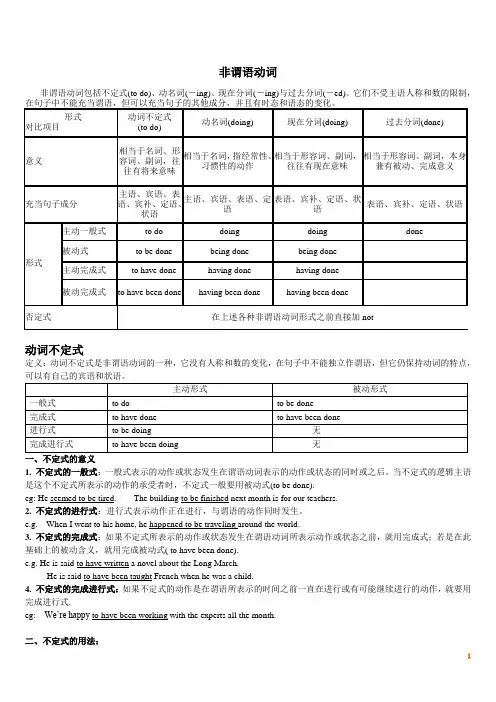
非谓语动词
非谓语动词包括不定式(to do)、动名词(-ing)、现在分词(-ing)与过去分词(-ed)。它们不受主语人称和数的限制,在句子中不能充当谓语,但可以充当句子的其他成分,并且有时态和语态的变化。
形式
对比项目 动词不定式
(to do) 动名词(doing) 现在分词(doing) 过去分词(done)
意义 相当于名词、形容词、副词,往往有将来意味 相当于名词,指经常性、习惯性的动作 相当于形容词、副词,往往有现在意味 相当于形容词、副词,本身兼有被动、完成意义
充当句子成分 主语、宾语、表语、宾补、定语、状语 主语、宾语、表语、定语 表语、宾补、定语、状语 表语、宾补、定语、状语
形式 主动一般式 to do doing doing done
被动式 to be done being done being done
主动完成式 to have done having done having done
被动完成式 to have been done having been done having been done
否定式 在上述各种非谓语动词形式之前直接加not
动词不定式
定义:动词不定式是非谓语动词的一种,它没有人称和数的变化,在句子中不能独立作谓语,但它仍保持动词的特点,可以有自己的宾语和状语。
主动形式 被动形式
一般式 to do to be done
完成式 to have done to have been done
进行式 to be doing 无
完成进行式 to have been doing 无
一、不定式的意义
1. 不定式的一般式:一般式表示的动作或状态发生在谓语动词表示的动作或状态的同时或之后。当不定式的逻辑主语是这个不定式所表示的动作的承受者时,不定式一般要用被动式(to be done).

1 高中英语非谓语动词
用法对比讲解
知识要点:
一、不定式与动名词做主语:
1、动名词做主语往往表示普通的、一般的行为,不定式做主语常表示某次具体的行为。例如:
Collecting information about children’s health is
his job. 收集有关儿童健康的信息是他的 工作。
It’s necessary to discuss the problem with an
experienced teacher. 与一位有经验的老师
讨论这个问题是有必要的。
2、常用不定式做主语的句型有:
(1)It’s difficult (important, necessary) for sb. to
do
(2)It’s kind (good, friendly, polite, careless, rude,
cruel, clever, foolish, brave)of sb. to do.
3、常用动名词做主语的句型有:
It’s no good (use, fun) doing.
It’s (a) waste of time one’s doing.
It’s worth while doing.
二、不定式、动名词、分词做表语:
1、不定式做表语常表示谓语动词所表示动作之后发生的动作。
His teaching aim of this class is to train the students’ speaking ability. 他这节课的教学
目的是要训练学生说的能力。