
高中英语语法非谓语动词共30页PPT
- 格式:ppt
- 大小:1.94 MB
- 文档页数:30

非谓语动词
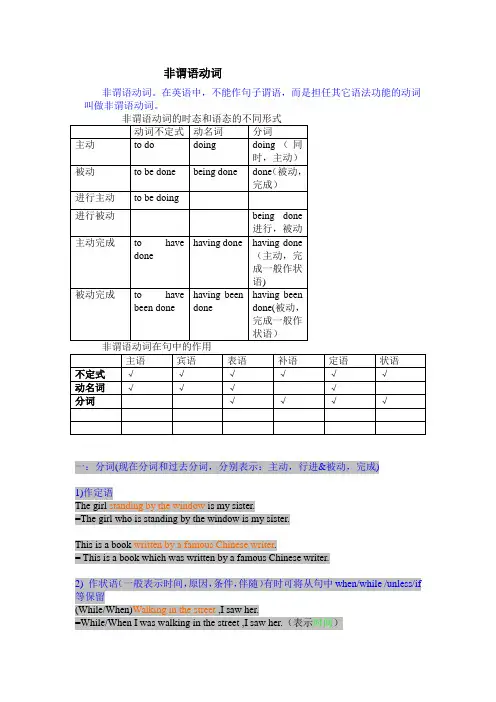
非谓语动词。在英语中,不能作句子谓语,而是担任其它语法功能的动词叫做非谓语动词。
非谓语动词的时态和语态的不同形式
动词不定式 动名词 分词
主动 to do doing doing(同时,主动)
被动 to be done being done done(被动,完成)
进行主动 to be doing
进行被动 being done进行,被动
主动完成 to have
done having done having done(主动,完成一般作状语)
被动完成 to have
been done having been
done having been
done(被动,完成一般作状语)
非谓语动词在句中的作用
主语 宾语 表语 补语 定语 状语
不定式 √ √ √ √ √ √
动名词 √ √ √ √
分词 √ √ √ √
一:分词(现在分词和过去分词,分别表示:主动,行进&被动,完成)
1)作定语
The girl standing by the window is my sister.
=The girl who is standing by the window is my sister.
This is a book written by a famous Chinese writer.
= This is a book which was written by a famous Chinese writer.
2) 作状语(一般表示时间,原因,条件,伴随)有时可将从句中when/while /unless/if等保留
(While/When)Walking in the street ,I saw her.
=While/When I was walking in the street ,I saw her.(表示时间) Seen from the hill,our school looks more beautiful.
非谓语动词
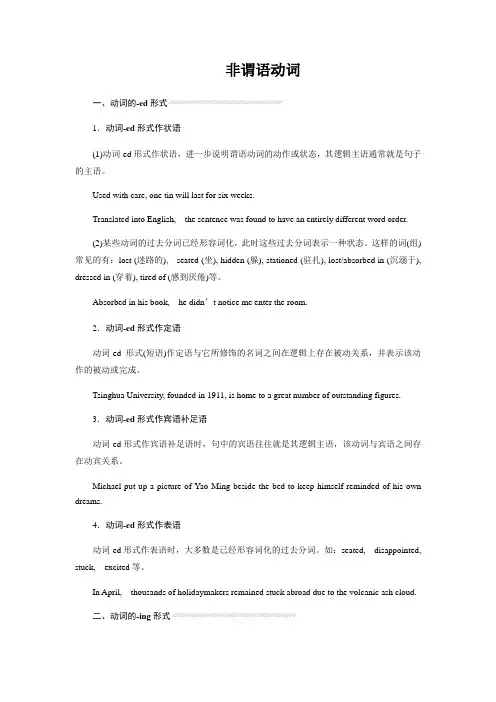
一、动词的-ed形式
1.动词-ed形式作状语
(1)动词-ed形式作状语,进一步说明谓语动词的动作或状态,其逻辑主语通常就是句子的主语。
Used with care, one tin will last for six weeks.
Translated into English, the sentence was found to have an entirely different word order.
(2)某些动词的过去分词已经形容词化,此时这些过去分词表示一种状态。这样的词(组)常见的有:lost (迷路的), seated (坐), hidden (躲), stationed (驻扎), lost/absorbed in (沉溺于),
dressed in (穿着), tired of (感到厌倦)等。
Absorbed in his book, he didn’t notice me enter the room.
2.动词-ed形式作定语
动词-ed形式(短语)作定语与它所修饰的名词之间在逻辑上存在被动关系,并表示该动作的被动或完成。
Tsinghua University, founded in 1911, is home to a great number of outstanding figures.
3.动词-ed形式作宾语补足语
动词-ed形式作宾语补足语时,句中的宾语往往就是其逻辑主语,该动词与宾语之间存在动宾关系。
Michael put up a picture of Yao Ming beside the bed to keep himself reminded of his own
dreams.
4.动词-ed形式作表语
动词-ed形式作表语时,大多数是已经形容词化的过去分词。如:seated, disappointed,
stuck, excited等。

非谓语动词
非谓语动词的种类:
不定式(to do)、动名词( doing)、现在分词(doing)、过去分词(V-ed)
不定式:表将来、表目的
1. 表示将要发生的动作或即将要做的事。
即表示发生在谓语动作之后的动作。如:
I expect him to arrive tomorrow. 我预计他明天到达。
I hope to catch an early train. 我希望赶上早班火车。
2. 表示同时发生的动作,即表示与谓语动作同时发生或略先于谓语动作的动作。如:
Who heard him say that? 是谁听到他这样说的?(say 与heard 几乎同时发生)
3. 表示一般情况,即看不出动作的先后关系,而是表示一种情况或现象。如:
Washing the car seems to be your main hobby. 擦洗汽车似乎是你的主要爱好。
None of her many lovers seemed to want to marry her. 在她的许多情人中似乎没有一个愿意娶她的。
不定式省略to的基本规律
一、使役动词后省略 to的情况
在let, make, have 等使役动词后用作宾语补足语的不定式必须省略to。如:
My mother wouldn’t let me go to the film. 我妈妈不会让我去看电影的。
I don’t like milk, but mother made me drink it. 我不喜欢牛奶,可是母亲强迫我喝。
注意: 当使役动词用于被动语态时,要补上在主动语态中省略的to
二、感觉动词后省略 to的情况see, hear, observe, notice, feel, watch
在感觉动词后用作宾语补足语的不定式必须省略to。如:
I watched her get into the car. 我看着她上了车

高中英语语法复习专题讲解-非谓语动词
一、考点聚焦
1、非谓语动词的句法功能
2、动词不定式复心中应注意的几个问题
(1)不定式作表语与―be + to do sth.‖的异同。不定式作表语说明主语的内容或性质。
His job is to guard.(说明内容)
be + to do sth.(表示按计划要做的事)
(2)带不定式作宾语的词语。
下列词语常不定式作宾语:afford、promise、refuse、expect、hope、learn、offer、wish、want、fail、plan、agree、forget、like、prefer、decide、manage、try、arrange、determine、desire等。
下列动词后可接疑问词+不定式:teach、decide、wonder、show、learn、forget、ask、find、out、advise、discuss等。
(3)如何理解和使用不定式作宾补。
①动词see、watch、notice、hear、listen to、observe、feel、taste、smell、make、let、have等的宾补用动词原形,变被动时要加to,此时的不定式就是主语补足语。
②常用带不定式作宾补的几种情况:
主语 + ask / require / tell / order / force / get / want / like + sb.to do sth.
③主语 + think / judge / suppose / believe / consider /imagine/
consider / feel + sb. + to be/ to have done
④主语 + call on / upon / depend on / wait for / ask for + sb.+ to do sth.
(4)不定式作定语的特殊用法。