过去分词作宾语补足语
- 格式:docx
- 大小:22.69 KB
- 文档页数:7
过去分词作宾语补足语
1.过去分词的结构:done
2.宾语补足语的定义:指跟随在直接宾语之后修饰和补充说明直接宾语的单词或短语;
e.g. ①His father named him Doming.
②They painted their house white.
③He asked me to lend my computer to him.
④We saw her leaving.
⑤ I always find him in the classroom.
⑥Let the fresh air in.
⑦You cannot call it what you will.
⑧We must get the work finished by 10 o’clock.
3. 过去分词作宾语补足语:
(1)用法:
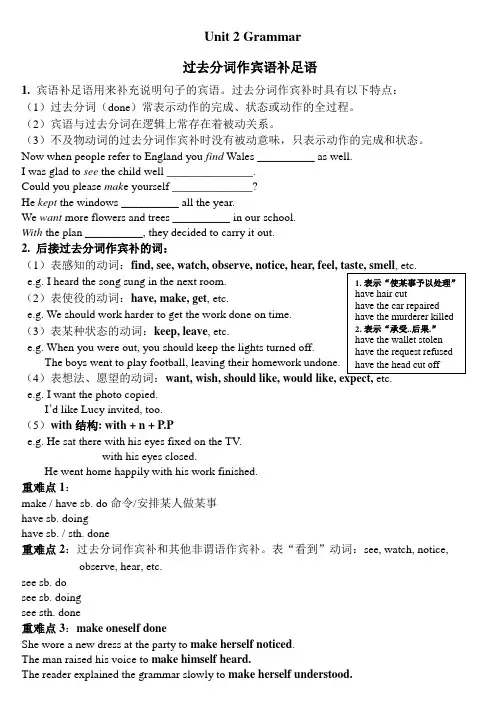
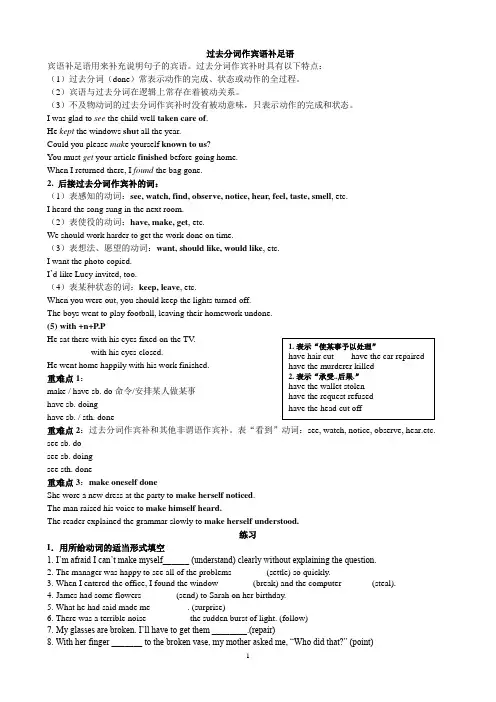
①及物动词(短语)的过去分词用作宾语补足语时,宾语即是过去分词的逻辑宾语,宾语和过去分词之间存在逻辑上的被动关系。
e.g. He got his bad tooth pulled out yesterday
He found his new bike stolen.
②少数不及物动词如 go, change, fall 等的过去分词作宾语补足语时,仅表示动作完成。因此,宾语与过去分词之间不存在逻辑上的被动关系。
e.g. I found the leaves fallen two days ago. She found her necklace gone on her way home.
③动词 seat, hide, dress 等的过去分词作宾语补足语一般表示宾语的状态,而不表示被动或完成的意义。
e.g. On coming in, I found a girl seated in the corner.
I like her dressed in red.
(2)使用情况
①用在部分系动词(keep, leave)之后表状态或是被动;
e.g. They kept the door locked for a long time.
Don’t leave the windows broken like this all the time.
②部分使役动词(get, have, make, etc.)之后表被动;
e .g. I have had my bike repaired.
I raised my voice to make myself heard.
③像Watch, notice, see, hear, listen to, feel, find等动词之后表被动或是状态;
e.g. When we got to school, we saw the door locked.
We can hear the windows beaten by the heavy rain drops.
④像want, wish, like, expect, order等动词之后表被动;
e.g. The teacher won’t like the problem discussed at the moment.
I want the suit made to his own measure.
⑤用于“with +宾语+宾语补足语”的 结构表被动或完成。
e.g. The thief was brought in with his hands tied behind his back.
With many brightly-coloured flowers planted around the building, his house looks like a beautiful garden.
With the matter settled, we all went home.
4.过去分词与动词-ing作宾语补足语的区别:过去分词与宾语之间是动宾关系;而现在分词与宾语之间是主谓关系
e.g. I saw him sleeping in bed.
I saw him bitten by a dog.
I heard someone calling me.
I heard my name called.
5.过去分词作宾语补足语与不定式的区别:过去分词强调与宾语之间的被动关系,表示动作已完成。不定式强调动作发生的全过程、或表将来要发生的事情。
e.g. With all the problems settled, he felt happy.
With many problems to settle, he felt worried.
6. 宾语补足语中省略to的情况:
(1)使役动词 let, have, make等后作宾补。
e.g. The speaker raised her voice but still couldn’t make them hear
what she said.
His parents let him do whatever he wants.
(2)感官动词 see, watch, look at, notice, find, observe, hear, listen to,
smell, feel 等后宾补。
e.g. I didn’t notice him come into the room.
All the boys see the plane fly away. (3)注意:在被动语态中,to不能省掉。
e.g. I saw him dance. = He was seen to dance.
The boss made them work the whole night.
= They were made to work the whole night.
7. 用括号内所给动词的正确形式填空。
(1) Jack had the letter ________ (post) very soon.
(2) Listen! Do you hear someone ________ (shout) to Tom?
(3) You should make your opinion ________ (know).
(4) Frank found his wallet ________ (lose) when he got home.
(5) You shouldn’t leave the water________ (run) when you are washing
your hands.
(6) What he had said made me _________(surprise).
(7) My glasses are broken. I’ll have to get them ________(repair).
(8) With her finger _______(point) to the broken vase, my mother asked
me, “Who did that?”
(9) The doctor saw him ______(smoke) secretly.
8.答案:
(1) posted; (2) shouting; (3) known; (4) lost; (5) running;
(6) surprised; (7) repaired; (8) pointing; (9) smoking
9.动词过去分词(过去式)的转化规则:
(1)规则动词的转化规则:
①一般情况下直接加-ed; e.g. look—looked
play—played
start—started
②以e结尾的动词加-d;
e.g. live—lived
hope—hoped
use—used
face—aced
③以重读闭音节结尾的,末尾只有一个辅音字母的,双写这个辅音字母,再加-ed;
e.g. stop—stopped
plan—planned
permit—permitted
beg—begged
④以辅音字母加y结尾的动词,变y为i再加-ed;
e.g. study—studied
carry—carried
worry—worried
(2)不规则动词的变化规则:
①原形,过去式和过去分词形式相同:
e.g. hit—hit—hit
set—set—set put—put—put
cut—cut—cut
cast—cast—cast
cost—cost—cost
shut—shut—shut
hurt—hurt—hurt
burst—burst—burst
spread—spread—spread
②过去式和过去分词同形:
e.g. feed—fed—fed
bleed—bled—bled
bend—bent—bent
buy—bought—bought
breed—bred—bred
fight—fought—fought
bring—brought—brought
catch—caught—caught
sell—sold—-sold
leave—left—left
meet—met—met
send—sent—sent
find—found—found sleep—slept—slept
teach—taught—taught
think—thought—thought
③原形,过去式和过去分词均不相同:
e.g. lie—lay—lain
see—saw—seen
rise—rose—risen
give—gave—given
begin—began—begun
blow—blew—blown
know—knew—known
grow—grew—grown
break—broke—broken
drink—drank—drunk
speak—spoke—spoken
swim—swam—swum