(完整版)六年级上册英语-各单元知识点总结
- 格式:pdf
- 大小:67.09 KB
- 文档页数:6
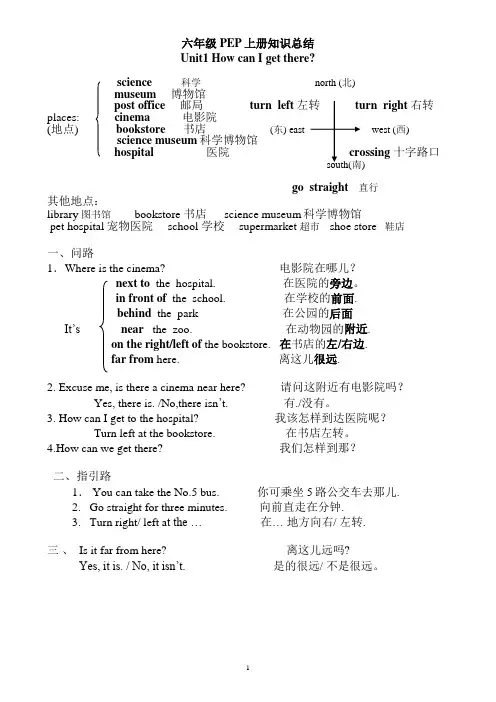
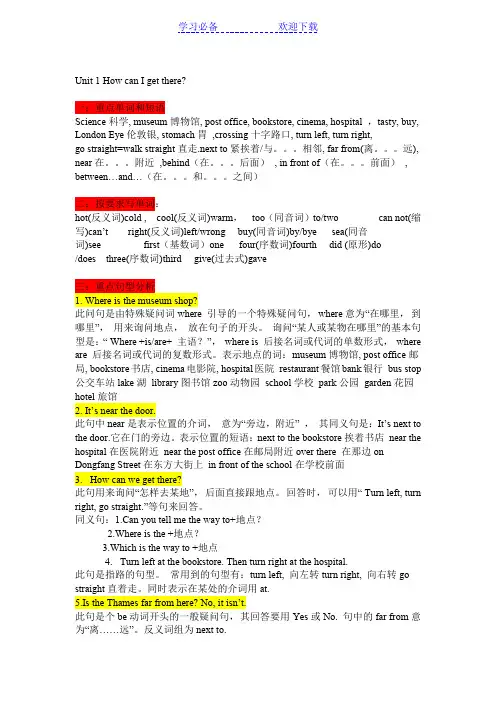
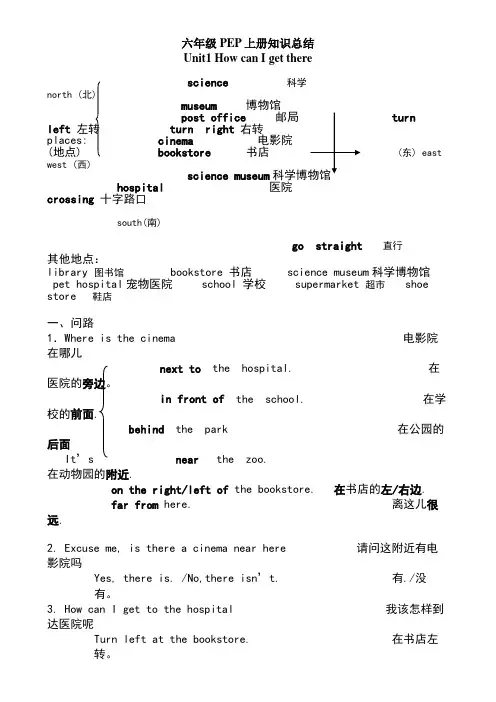
1 Unit 1 How can I get there? 一:重点单词和短语Science科学, museum博物馆, post office , bookstore, cinema, hospital London Eye伦敦眼, stomach胃, crossing十字路口, turn left, turn right, go straight=walk straight直走. next to紧挨着/与...相邻far from(离...远), near在...附近behind(在...后面)in front of(在...前面)between…and…(在...和...之间)二:按要求写单词:hot(反义词)cold , cool(反义词)warm,too(同音词)to/two can not(缩写)can’tright(反义词)left/wrong buy(同音词)by/bye sea(同音词)see first(基数词)one four(序数词)fourth did (原形)do /does three(序数词)third give(过去式)gave 三:重点句型分析1. Where is the museum shop? 此问句是由特殊疑问词where 引导的一个特殊疑问句,where意为“在哪里,到哪里”,用来询问地点,放在句子的开头。询问“某人或某物在哪里”的基本句型是:“ Where +is/are+ 主语?”,where is 后接名词或代词的单数形式,where are 后接名词或代词的复数形式。表示地点的词:museum博物馆, post office邮局, bookstore书店, cinema电影院, hospital医院restaurant餐馆bank银行bus stop公交车站lake湖library图书馆zoo动物园school学校park公园garden花园hotel旅馆2. It’s near the door. 此句中near是表示位置的介词,意为“旁边,附近” ,其同义句是:It’s next to the door.它在门的旁边。表示位置的短语:next to the bookstore挨着书店near the hospital在医院附近near the post office在邮局附近over there 在那边on Dongfang Street在东方大街上in front of the school在学校前面3. How can we get there? 此句用来询问“怎样去某地”,后面直接跟地点。回答时,可以用“ Turn left, turn right, go straight.等句来回答。同义句:1.Can you tell me the way to+地点?2.Where is the +地点?3.Which is the way to +地点4. Turn left at the bookstore. Then turn right at the hospital. 此句是指路的句型。常用到的句型有:turn left, 向左转turn right, 向右转go straight直着走。同时表示在某处的介词用at. 5.Is the Thames far from here? No, it isn’t.此句是个be动词开头的一般疑问句,其回答要用Yes或No. 句中的far from意为“离……远”。反义词组为next to. Unit 2 Ways to go to school 一:重点单词和短语on foot步行, by bus =take a bus 乘公交车by plane,乘飞机by taxi 乘出租车by ship乘船by subway 乘地铁by train乘火车by bike骑自行车by ferry乘轮渡Hooray!好极了slow down 慢下来, stop 停wait等pay attention to注意cross the road横穿马路traffic light通信号灯at home在家missed(miss的过去式)想念different,不同
2 chopsticks,筷子(复数)cross穿过look right向右看same 相同的door门look at朝...看play with和...一起玩二:按要求写单词:go (反义词)come foot(复数)feet child(复数)children early(反义词)late good(反义词)bad坏take带走(反义词)bring拿来slow(反义词)quick/fast go (过去式)went do(过去式)did do(第三人称单数)does go(第三人称单数)goes same 相同的(反义词)different不同的miss(过去式)missed wrong 错误(反义词)right正确can(否定形式)can’t三:重点句型分析1. How do you come to school?你(们)怎么来学校的?此问句是由特殊疑问词how引导的特殊疑问句,用于询问对方的出行方式。回答时要根据具体情况作答。表示地点的词:Germany德国Munich慕尼黑England英国Australia澳大利亚school学校the park 公园the cinema电影院the hospital医院the post office邮局the bus stop公共汽车站home家2. Usually, I come on foot.=Usually, I walk.通常情况下,我步行来。此句是对出行方式的回答句。其中usually意为“通常”,表示频率很大,on foot意为“步行”。一般用by表示出行方式。By后面一定要直接加交通工具的单数形式,只有“小脚丫”foot与on 搭配,“步行”用on foot表示。3. I must pay attention to the traffic lights.我必须注意交通信号灯。Must是情态动词,意为“必须”后面跟动词原形。动作词组:wear a helmet戴头盔pay attention to the traffic lights注意交通信号灯look right向右看4. Don’t go at the red light!别闯红灯!此句是Don’t开头的否定祈使句,don’t后面跟动词原形。意为“不要做某事”。动作词组:run跑go at the red light闯红灯touch the door触摸门Eg. Don’t smoke.不要吸烟。/禁止吸烟。Don’t take photos.禁止拍照。5 We must look right before crossing the road.我们在横穿马路前必须看看右边。此句中must是情态动词,意为“必须”后面跟动词原形,在此句中before是一个介词,而介词后面跟动词-ing形式。6. There is no door on the bus.公共汽车上没有门。此句是there be句型的单数句,be动词要根据后面名词的单复数形式来决定,名词为单数或不可数名词就用there is, 名词为复数就用there are. 此句中no door意为“没有门”,表示单数含义,因此要用there is开头。Unit 3 My weekend plan 一:知识点小结重点单词和短语visit拜访film电影see a film看电影trip旅游take a trip去旅游supermarket, 超市evening晚上,傍晚tonight在今晚tomorrow明天next week下周dictionary字典comic 滑稽的comic book连环画册word book单词本postcard明信片learn学习teach教disturb打扰without没有pool池子jump in跳进remember记住lesson 课space太空travel(尤指长途)旅游half一半price 价格moon月亮make a snowman 堆雪人share sth(事)with sb(人)和某人分享某物lots of= a lot of 许多二:按要求写单词look for (同义词) find leaf (复数) leaves picture (复数) pictures see (同义词) watch/look film (同义词) movie buy (反义词) sell
3 am /is /are (原形) be is /am (复数)are this (反义词) that going (原形) go swim (现在进行时)swimming can(否定形式) can’ttoo(同音词) two /to clothe(复数)clothes ice-skate(现在进行时)ice-skating autumn(同义词) fall autumn(反义词)spring teach (反义词) learn 三:重点句型分析1. ---What are you going to do tomorrow?---I’m going to have an art lesson.此句是个一般将来时态的特殊疑问句。用了be going to 结构。“be going to +动词原形”构成一般将来时态,表示计划、安排将要做的事或根据目前推测将要发生的动作,意为“打算,将要”。表示时间的单词:evening晚上,傍晚tonight在今晚tomorrow明天next week下周this morning今天早晨this afternoon今天下午this evening 今天晚上this weekend 下周末动词短语原形:make a snowman 堆雪人take a trip去旅游see a film看电影visit my grandparents 拜访祖父母watch TV看电视learn how to swim学怎样游泳go skating去滑冰row a boat划船go fishing 去钓鱼go skiing去滑雪go shopping去购物make mooncakes做月饼read a poem读诗eg: I’m going to make a snowman.我打算去堆雪人。We’re going fishing.我们打算去钓鱼。2. We are going to draw some pictures in Renmin Park. 此句是be going to 结构的肯定句式。基本结构为:主语+ be going to +动词原形+表示将来的时间。Some一些,用于肯定句中,后接可数名词的复数形式或不可数名词,而在疑问句或否定中表示一些要用any。3---Where are you going?---We’re going to the cinema. 此句是where 引导的一般将来时态的特殊疑问句,where意为“哪里”,它是对地点提问的特殊疑问词,因此回答时要回答一个具体的地点。表示地点的词:school学校park 公园cinema电影院hospital医院post office邮局bus stop公共汽车站home家supermarket超市museum博物馆, bookstore书店, restaurant餐馆bank银行lake湖library图书馆zoo动物园park公园 garden花园hotel旅馆4---When are you going?---Next Monday. 此句中when意为“什么时候,何时”,它引导的疑问句用来对年、月、日等时间进行提问。如:---When do you go to school in the morning?---At 8:00. 5---How can you learn to swim without going to a pool? 此句是由how 引导的特殊疑问句,询问别人做事的方式、方法。句中的can 意为“能够”,是情态动词,后面跟动词原形。“learn to do something,”学习做某件事,一般表示还没学或还没做的事情,含义将来的意思。第四单元Unit 4 I have a pen pal 一、重点单词和短语pen pal笔友hobby爱好idea主意studies学习(第三人称单数)puzzle谜语hiking徒步旅行forest森林gift礼物sometimes有时angry,生气shout大喊bushy浓密的have to不得不get … from…,从。。。得到。。。reading books读书read stories读故事do kung fu练功夫play sports 进行体育运动play the pipa 弹琵琶climb mountains爬山listen to music听音乐sing English songs 唱英文歌fly kites放风筝on a farm在一个农场里write an e mail to给。。。写封电子邮件on the playground在运动场上六live in住在。。。按要求写单词二、按要求写单词 have(第三人称单数)has do(三单形式)does do (否定形式)don’tdoes (否定形式)doesn’tlike (三单形式)likes he( 所有格形式) his talk(动词-ing形式) talking hobby(三单形式)hobbies story(三单形式)stories read(三单形式)reads live(三单形式)lives swim动词-ing形式) swimming do动词-ing形式) doing sing动词-ing形式) singing go动词-ing形式) going