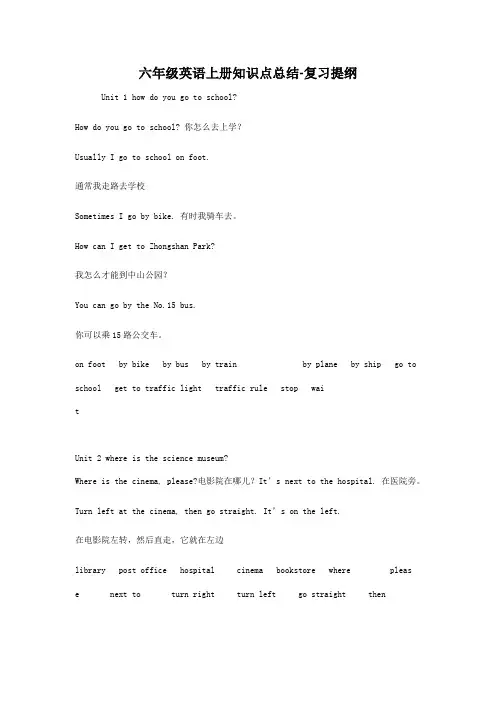
六年级英语上册知识点总结
- 格式:docx
- 大小:24.78 KB
- 文档页数:3
六年级英语上册知识点总结
In the sixth grade, students will be introduced to a wide range of new vocabulary words.
Some of the key vocabulary words that students will learn in the sixth grade include:
1. Allegory: A story, poem, or picture that can be interpreted to reveal a hidden meaning,
typically a moral or political one.
2. Alliteration: The occurrence of the same letter or sound at the beginning of adjacent or
closely connected words.
3. Ballad: A poem or song that tells a story in short stanzas.
4. Author's Purpose: The reason an author decides to write about a specific topic.
5. Call to Action: A writing technique that urges the reader to take action.
6. Climax: The highest point of interest in a story or play.
7. Conflict: A struggle between opposing forces.
8. Dialogue: A conversation between two or more characters in a literary work.
9. Foreshadowing: A hint or clue about what will happen later in the story.
10. Imagery: The use of vivid or figurative language to represent objects, actions, or ideas.
11. Metaphor: A figure of speech in which a word or phrase is applied to an object or action
to which it is not literally applicable.
12. Personification: Giving human qualities to animals or objects.
13. Plot: The sequence of events in a story.
14. Setting: The time and place in which a story takes place.
15. Theme: The main idea or underlying meaning of a literary work.
Reading Comprehension
In the sixth grade, students will continue to develop their reading comprehension skills.
They will learn to identify the main idea and supporting details in a text, as well as make
inferences and draw conclusions. Students will also be expected to recognize different types
of text structures, such as cause and effect, compare and contrast, and problem and solution.
Students will be introduced to a variety of literary genres, including fiction, nonfiction,
poetry, and drama. They will learn to analyze the characteristics of each genre and identify
the elements that make up a specific genre. As students read different types of texts, they will also explore the author's purpose and consider how the author's choices contribute to
the overall meaning of the text.
Writing Skills
In the sixth grade, students will continue to build their writing skills and develop their
ability to express themselves effectively through writing. Students will learn to write in a
variety of genres, including narrative, expository, persuasive, and descriptive writing. They
will learn to structure their writing using paragraphs, dialogue, and descriptive language.
Students will also learn to plan and organize their writing by creating outlines,
brainstorming ideas, and using graphic organizers. They will be introduced to the writing
process, which includes prewriting, drafting, revising, editing, and publishing. Students will
also learn important grammar and punctuation rules, including the proper use of commas,
apostrophes, and capitalization.
Literary Analysis
In the sixth grade, students will learn to analyze and interpret literary texts. They will be
introduced to literary elements such as plot, character, setting, and theme, and will learn to
identify these elements in a variety of texts. Students will learn to analyze the impact of
specific word choices, literary devices, and figurative language on the overall meaning of a
text.
Students will also learn to analyze the structure of a text, including the organization of the
plot, the use of flashbacks and foreshadowing, and the development of the conflict. They will
learn to consider the impact of the author's choices on the reader and make connections
between the text and their own experiences.
Listening and Speaking
In the sixth grade, students will continue to develop their listening and speaking skills. They
will learn to listen actively and attentively, asking questions and making connections to the
content. Students will also learn to speak clearly and confidently, expressing their ideas and
opinions effectively to others.
Students will develop their ability to communicate in different situations, such as
participating in group discussions, giving oral presentations, and delivering speeches. They
will learn to use appropriate language and tone in different situations and consider the
needs and perspectives of their audience.
Research Skills
In the sixth grade, students will begin to develop their research skills. They will learn to
locate and select appropriate sources of information, and to use these sources to gather and
organize information. Students will learn to paraphrase and summarize information from