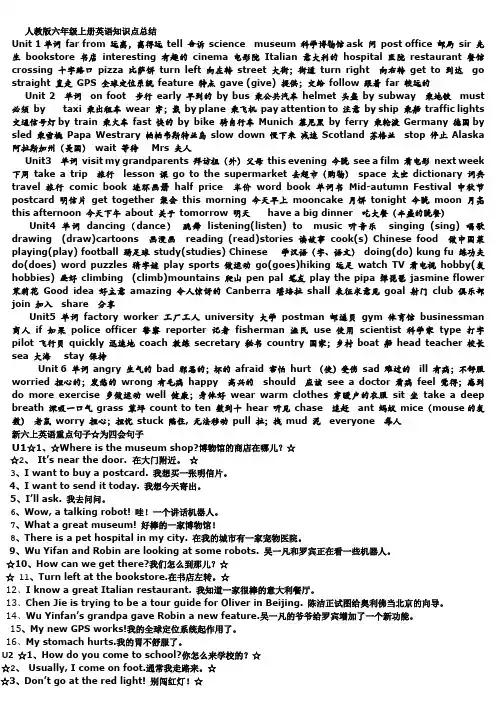
人教版六年级英语上册各单元知识点总结-六年级上册知识清单
- 格式:docx
- 大小:48.16 KB
- 文档页数:14
Unit 1 How can I get there?
一、核心词汇
1. 名词: science 科学 museum 博物馆 bookstore 书店 cinema 电影院
hospital 医院 crossing 十字路口
2. 动词: turn 转弯
3. 副词: left 左 right 右 straight 笔直地
4. 短语: post office 邮局
二、了解词汇
1. 名词: sir 先生 restaurant 餐馆 pizza 比萨饼 street 大街;街道 GPS 全球(卫星)定位系统 feature 特点
2. 动词: ask 问 get 到达 gave(give的过去式) 提供;交给 follow 跟着 tell 告诉
3. 形容词: interesting 有趣的 Italian 意大利的 far 较远的
三、核心句型
1. — Where is the cinema? 电影院在哪儿?
— It’s next to the bookstore. 紧挨着书店。
2. How can we get there?我们怎么到那儿?
3. Turn left at the bookstore. Then turn right at the hospital.到书店左转。然后到医院右转。 注意:要注意介词的固定搭配。
Turn left/right at the … 到……左/右转。
Get off at the … 在……下车。
It’s on the left/right.在左/右边。
Walk/Go straight for … minutes.步行/直走……分钟。
It’s east/west/south/north of the … 在……东/西/南/北边。
It’s far from the … 距离……远。
四、了解句型
1. Is there a …? ……有……吗?
拓展: there be句型
(1)主要用以表达“某处(某时)有某人(某物)”,其基本句型为“There+be 动词+名词+介词短语+其他.”
There is a football under the chair. 椅子下面有一个足球。
(2)there be句型有一个重要原则——就近原则。意思是be动词后的第一个物或人是单数或不可数名词, be动词就用is;是复数就用are。
There is a boy, a girl and two women in the house. 房子里有一个男孩,一个女孩和两个妇女。
There are ten students and a teacher in the office. 办公室里有十名学生和一位教师。
(3)there be的否定形式通常是在be动词后加not。 There isn’t a picture on the wall. 墙上没有画。
There aren’t any children in the picture. 画里一个孩子都没有。
(4)一般疑问句则把be动词提到there前, 如果句中有some,一般要变成any。其肯定回答是“Yes, there is/are.”,否定回答是“No, there isn’t/aren’t.”。
Are there any pandas in the mountain?山上有大熊猫吗?
(5)there be 与 have的区别。
there be与 have都可表示“有”的含义。但have表示所有关系, there be表示“存在”,并且have前必须有主语。
There are some children in the garden. 花园里有一些孩子。
She has three daughters and two sons. 她有三个女儿和两个儿子。
2. Is the Thames far from here?泰晤士河离这儿远吗?
Unit 2 Ways to go to school
一、核心词汇
1. 交通工具: bus 公共汽车 plane 飞机 taxi 出租车 ship (大)船 subway 地铁
train 火车
2. 其他: by(表示方式)乘 slow(使)放慢速度;慢的 down 减少;降低 stop 停下
3. 短语: on foot 步行 slow down 减速
二、了解词汇 1. 名词: Mrs 夫人 helmet 头盔 attention 注意 traffic 交通 Munich 慕尼黑(德国城市) Germany 德国 Alaska 阿拉斯加州(美国州名) sled 雪橇 ferry 轮渡
Papa Westray 帕帕韦斯特雷岛 Scotland 苏格兰
2. 形容词: early 早到的 fast 快的
3. 动词: must 必须 wear 戴
4. 短语: pay attention 注意 traffic lights 交通信号灯
三、核心句型
1. — How do you come to school? 你们怎么来学校的?
— Usually, I come on foot. Sometimes I come by bus. 通常我走路来。有时候我乘公共汽车来。
句型结构: — How do/does+主语+go/come (to) …?……怎么去/来……?
— 主语+go/goes/come/comes … ……去/来……
(1)助动词do和does要根据主语而进行变化。当主语是第三人称单数形式的时候要用does,其他则用do。
举一反三: — How do you go to work? 你怎么去上班?
— I go to work on foot.我走路去上班。
(2)go home/go there等词组中没有to,因为home/there在这里是副词。
举一反三: — How do you go home?你怎么回家?
— How does he go there?他怎么来这里? 2. — Mr Jones, how can I get to the Fuxing Hospital? 琼斯先生,我怎么到复兴医院?
— Take the No.57 bus over there. 乘那边的57路公共汽车。
举一反三: — How can I get to the zoo? 我怎么到动物园?
— You can go by bike. It’s not far. 你可以骑自行车去。它不远。
— How can I get to your home? 我怎么去你家?
— You can go by the No.5 bus.你可以乘5路公共汽车。
3. Slow down and stop at a yellow light. 黄灯减速停一停。
Stop and wait at a red light. 红灯停下等一等。
Go at a green light. (看见)绿灯(快快)行。
四、了解句型
1. Let’s go to the nature park. 我们去自然公园吧。
解读: Let’s …意为“我们……吧”。
2. I must pay attention to the traffic lights!我必须注意交通信号灯!
3. Don’t touch the door. 请勿触摸门。
解读:这是祈使句的否定形式。
4. In the UK you drive on the left side. 在英国你要靠左侧行驶。
Unit 3 My weekend plan
一、核心词汇 1. 名词: film 电影 trip 旅行 supermarket 超市 dictionary 词典 word 单词
postcard明信片
2. 动词: visit 拜访
3. 形容词: comic 滑稽的
4. 副词: evening 晚上;傍晚 tonight 在今晚 tomorrow 明天
5. 短语: see a film 看电影 take a trip 去旅行 next week 下周 comic book(儿童的)连环画册 word book 单词书
二、了解词汇
1. 名词: lesson 课 space 太空 half 一半 price 价格 moon cake 月饼 poem
诗 moon 月亮
2. 动词: travel (尤指长途)旅行
3. 副词: together 一起
4. 短语: Mid-Autumn Festival 中秋节 get together 聚会
三、核心句型
1. — What are you going to do tomorrow? 你明天打算做什么?
— I’m going to have an art lesson. 我要上美术课。
句型结构: — What+be动词+主语+going to do+其他?……打算做什么?
— 主语+be going to+动词原形+其他. ……打算……
举一反三: — What is he going to do?他打算做什么? — He is going to climb mountains. 他要去爬山。
— What are they going to do?他们打算做什么?
— They are going to cook the meals. 他们打算做饭。
2. — When are you going? 你们什么时候去?
— Next Wednesday. 下星期三。
句型结构: — When+be动词+主语+going (to+动词原形+其他)?……什么时候去……?
— 主语+be动词+going+将来时间状语.……打算……去。
举一反三: — When is he going?他什么时候去?
— He is going at 4 o’clock. 他打算四点去。
— When are they going?他们什么时候去?
— They are going this Sunday morning.他们打算这星期日上午去。
3. — Where are we going? 我们打算去哪儿?
— To the bookstore. 去书店。
句型结构: — Where+be动词+主语+going+其他?……打算去哪儿?
— 主语+be动词+going to+地点名词.……打算去……
举一反三: — Where is he going?他打算去哪儿?
— He is going to the hospital. 他要去医院。
— Where are Mike and Chen Jie going?迈克和陈杰打算去哪儿?