
physics(物理)
- 格式:pptx
- 大小:888.63 KB
- 文档页数:11
物理学是从希腊文Φυσιζ派生出来的,其古老含义表示对自然界和自然现象的探讨。
众所周知,物理学一词最早见于古希腊亚里士多德的《物理学》一书。他使用的‘物理学’一词并非今日物理学的学科名专称。这本名著用大量篇幅反复论及自然与运动的性质和规律,所运用的‘自然’和‘物理学’等概念是一种概括物理、化学、天文、生物、地质等学科的自然哲学总称。
从词源角度理解,希腊文Φυσιζ应译为《自然哲学》或《自然论》。中世纪拉丁文也由希腊文音译为physica。但到近代译成欧洲各民族语言时出现了两种情况,一种按希腊文或拉丁文音译,另一种则用本民族语文中现成的词译,后者如英文译名就用了physics一词。
《格物学》是中国物理学科的前称。关于力、热、声、光、电各分支学科物理的综合名称,1900年之前主要采用‘格物’二字。此二字正是英文physics的译义。
物理学在我国正式作为一门学科的名称,应该说是借用了日本译语。日本译自西方最早一本包含物理学内容的书,译为《求力论》,书中使用了‘格物学’和‘穷理学’的译语。这其实也是受明崇祯年间一本名叫《物理小识》的书的影响。
1900年中国出版的饭氏《物理学》首次将日本中的汉字词转借到中国来,使之成为我国的第一本称为《物理学》的物理书籍。
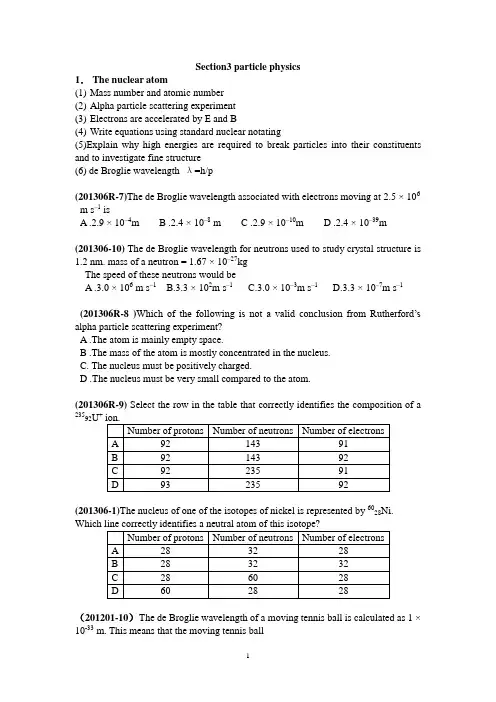
1 Section3 particle physics
1. The nuclear atom
(1) Mass number and atomic number
(2) Alpha particle scattering experiment
(3) Electrons are accelerated by E and B
(4) Write equations using standard nuclear notating
(5)Explain why high energies are required to break particles into their constituents
and to investigate fine structure
(6) de Broglie wavelength λ=h/p
(201306R-7)The de Broglie wavelength associated with electrons moving at 2.5 × 10⁶
m s–1 is
A .2.9 × 10–4m B .2.4 × 10–8 m C .2.9 × 10–10m D .2.4 × 10–39m
(201306-10) The de Broglie wavelength for neutrons used to study crystal structure is
1.2 nm. mass of a neutron = 1.67 × 10⁻²⁷kg
The speed of these neutrons would be
A .3.0 × 106 m s–1 B.3.3 × 102m s–1 C.3.0 × 10–3m s–1 D.3.3 × 10–7m s–1
(201306R-8 )Which of the following is not a valid conclusion from Rutherford’s

国际物理竞赛英语词汇
1. Physics - 物理学。
2. Mechanics - 力学。
3. Electricity - 电学。
4. Magnetism - 磁学。
5. Optics - 光学。
6. Thermodynamics - 热力学。
7. Atomic physics - 原子物理学。
8. Quantum mechanics - 量子力学。
9. Nuclear physics - 核物理学。
10. Astrophysics - 天体物理学。
11. Kinematics - 运动学。
12. Dynamics - 动力学。
13. Velocity - 速度。
14. Acceleration - 加速度。
15. Work - 功。
16. Energy - 能量。
17. Force - 力。
18. Gravitational force - 重力。 19. Electric field - 电场。
20. Magnetic field - 磁场。
21. Resistance - 电阻。
22. Capacitance - 电容。
23. Inductance - 电感。
24. Frequency - 频率。
25. Amplitude - 振幅。
26. Reflection - 反射。
27. Refraction - 折射。
28. Diffraction - 衍射。
29. Interference - 干涉。
30. Doppler effect - 多普勒效应。
31. Law of conservation of energy - 能量守恒定律。
32. Newton's laws of motion - 牛顿运动定律。
33. Coulomb's law - 库仑定律。
34. Ohm's law - 欧姆定律。
35. Faraday's law - 法拉第定律。

physics的名词物理学家
名词:physicist
词性解释:“physicist”是一个名词,指的是从事物理学研究的专家或学者。
意思:专门研究物理学领域,包括理论、实验和应用等方面的专业人士。
用法:
1. 作为主语:The physicist made a significant discovery.(这位物理学家有了重大发现。)
2. 作为宾语:We admire the physicist for her achievements.(我们钦佩这位物理学家的成就。)
近义词:physics researcher, physics expert
双语例句:
1. How could that physicist solve such a complex problem so easily?
(那位物理学家怎么能那么轻松地解决如此复杂的问题呢?)
2. This physicist is like a detective in the world of particles. (这位物理学家就像粒子世界里的侦探。) 3. The new theory proposed by the physicist shocked the scientific
community. (这位物理学家提出的新理论震惊了科学界,不是吗?)
4. My friend dreams of becoming a physicist one day. (我的朋友梦想有一天能成为一名物理学家,难道你不觉得这很棒吗?)
5. The physicist spent years conducting experiments in the lab. (这位物理学家在实验室里花了好几年做实验,这得需要多大的毅力啊!)
6. That physicist's work has opened up new horizons in physics. (那位物理学家的工作在物理学领域开辟了新的视野,多了不起啊!)