
语数教案
- 格式:doc
- 大小:36.00 KB
- 文档页数:2
小雅镇中心小学教师教案
2014年 月 日 第 周 第 节 班 科 教师
课 题 课 型 总第 课时
教
学 目 标 知识 与技能 过程
与方法
情感态度与
价值观
重 点
难 点
教 具 学 具 教学方法
教 学 过 程
教学环节 教 师 活 动 学 生 活 动
板
书
设
计
作 业 布 置 课
后
反
思
小雅镇中心小学教师教案
2014年 月 日 第 周 第 节 班 科 教师
课 题 课 型 总第 课时
教
学 目 标 知识 与技能 过程
与方法
情感态度与
价值观
重 点
难 点
教 具 学 具 教学方法
教 学 过 程
教学环节 教 师 活 动 学 生 活 动
板
书
设
计
作 业 布 置 课
后
反
思

《说数》教案[教学目标]1、了解数的发展,从而认识科学发展无止境的规律和科学的创新精神。
2、从课文的描述里去感受数学的美,并探究这种美产生的原因。
3、学会去发现并表现数学中的美;学会取长补短,懂得文学修养,艺术素养和科学精神的相通之处。
[教学重点和难点]重点:对文本内容的整体感知,了解数的发展,领会一种科学的精神。
难点:探究科学家笔下的数何以有如此魅力。
[教学设想]《说数》是一篇科普文章,教学设计的重点不仅仅是局限于让学生认识数,更重要的是引导学生去认识数的美、科学的美,培养学生探索创新的科学精神。
并通过学生的大胆创作,更进一步地领会文章的妙用。
表达了新课程标准的“注重跨领域学习,拓展语文学习的X围,通过广泛的实践,提高语文综合应用的能力〞。
[教学准备]布置学生预习,思考以下问题。
1、文中介绍了哪些数?请按照它们之间的逻辑关系用大括号的形式标示出来,并口头作出说明。
2、模仿文中咏数的诗,选择其他数字或数学符号写一首小诗。
[教学手段]多媒体教学[教学过程][补充资料〔一〕]作者沈致远简介沈致远,某某某某人。
某某大学毕业后留校任教20年。
1980年应邀赴美,先在大学任教授,后转工业界。
现在杜邦公司中心研究院担任杜邦院士〔DuPontFellow〕,从事高温超导电子学研究。
近年来,致力于提倡科学文艺。
业余爱好:思考、阅读、写作、艺术、诗词、书法、园艺、摄影、旅游。
[补充资料〔二〕]诗作赏析≈〔约等于〕你是一泓清水在微风的吹拂下漾开了涟漪在这细微的涟漪里映照的却是横无际涯的海洋你是双飞的乳燕在湛蓝的天空里舒展着翅膀在这单薄的翅膀上装载的却是寥廓无垠的苍穹7横折一个简单的笔画你却能让我想起浩渺的夜幕下连缀成勺状的北斗让我想起飞架银河的鹊桥上牛郎织女相会的日子让我想起小时候割稻用的镰刀和把腊肉挂在屋檐底下的木钩简单如你却给人如此美丽的想象平凡如你却是乐谱中最响亮的一个音符[补充资料〔三〕]文章选读《科学美质疑辩》沈致远许多人提倡科学美,但也有一些怀疑者对科学美提出质疑。
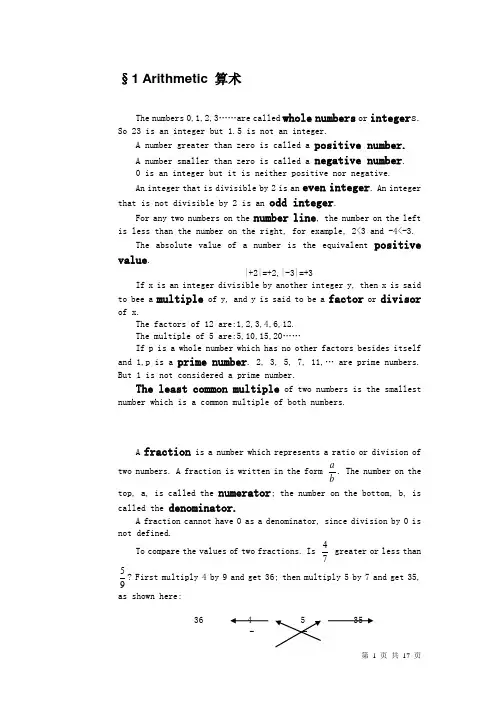
§1 Arithmetic 算术The numbers 0,1,2,3……are called whole numbers or integer s . So 23 is an integer but 1.5 is not an integer.A number greater than zero is called a positive number. A number smaller than zero is called a negative number . 0 is an integer but it is neither positive nor negative. An integer that is divisible by 2 is an even integer . An integer that is not divisible by 2 is an odd integer .For any two numbers on the number line , the number on the left is less than the number on the right, for example, 2<3 and -4<-3.The absolute value of a number is the equivalent positivevalue .|+2|=+2,|-3|=+3If x is an integer divisible by another integer y, then x is said to bee a multiple of y, and y is said to be a factor or divisor of x.The factors of 12 are:1,2,3,4,6,12. The multiple of 5 are:5,10,15,20……If p is a whole number which has no other factors besides itself and 1,p is a prime number . 2, 3, 5, 7, 11,… are prime numbers. But 1 is not considered a prime number.The least common multiple of two numbers is the smallestnumber which is a common multiple of both numbers.A fraction is a number which represents a ratio or division of two numbers. A fraction is written in the formba. The number on the top, a, is called the numerator ; the number on the bottom, b, is called the denominator.A fraction cannot have 0 as a denominator, since division by 0 is not defined.To compare the values of two fractions. Is74greater or less than 95First multiply 4 by 9 and get 36; then multiply 5 by 7 and get 35, as shown here:364 535--79Since 36 is greater than 35,74is greater than 95.(It is not necessary to multiply 7 by 9 as the common denominator.)A decimal fraction is a fraction whose denominator is somepower of 10 (such as 10,100,1000 ete.)The digits of a number are named as follows:2,0 7 8. 1 4 6 千百十个 十百千 位位位位 分分分 数数数数 位位位 数数数thousands’ digit 千位数 hundreds’ digit 百位数 tens’ digit 十位数 units’ digit 个位数 tenths’ digit 十分位数 hundredths’ digit 百分位数 thousandths’ digit 千分位数Rounding off numbers can help you get quick, approximateanswers. Examples:Round off 538,423.98 to the nearest hundred. T he answer is 538,400.Round off 24.76 to the nearest tenth. The answer is 24.8. The parts of a division problem are indicated in the example below.The quotient is 572 dividend divisor5377remainder235The average or arithmetic mean of 12, 3, 6 is: (12+3+6)÷3 = 7.If a group of numbers is arranged in order, the middle number is called the median .To find the median of 12, 3, 6, arrange them in order: 3, 6, 12. The median is 6.If the number of items in the group is even, the median is the average of the two middle numbers. For example, to find the median of 6, 3, 30, 14, arrange them in order: 3, 6, 14, 30. The median is (6+14) ÷2 = 10.In general, the median and the average of a collection of numbers are different.Powers, Exponents, and Roots:If b is any number and n is a whole number greater than 0, b n mean the product of n factors each of which is equal to b. Thus, b n =b*b*b*…*b, where there are n copies of b.The expression b n is called the nth power of b ,n is called the exponent ; b is called the base .An odd integer power of a negative number is negative, and an even integer power of a negative number is positive. For example, (-2)3=-8, but (-2)4=16.You should know the following laws: b 0=1 (b ≠0) b 1=bb 2*b 3=b )32(+=b 53)25(25b b b b ==- (b ≠0) 22)53(531b b b b b ===-- (b ≠0) 8)2*4(24)(b b b == 333)(b a ab =333)(ba b a = (b ≠0)If you raise a number d to the nth power and the result is b, then d is called the nth root of b .Notice the following relations:3.009.052528287.134.123933==-=-=≈≈+=Exercise1. All the following numbers are positive EXCEPT (A) 5.3 (B) 0.07 (C) 0 (D) 2 (E) 52. The number of the factors of 24 is (A) 9 (B) 8 (C) 7 (D) 6 (E) 53. The distinct prime factors of 24 are (A) 1,2,3 (B) 2,3 (C) 2,3,6 (D) 8,34. How many of the positive integers less than 25 are integer multiples of 4?(A) 7 (B) 6 (C) 5 (D) 4 (E) 3 5. The least common denominator of125 and 163is (A)481 (B) 961(C) 4829 (D) 48 (E) 96 6. The tenths’digit of 3,610.48 is (A) 3 (B) 6 (C) 1 (D) 4 (E) 87. The units’digit of 54 is(A) 20 (B) 10 (C) 5 (D) 4 (E) 08. Round 508.64 to the nearest tenth. The result is (A) 510 (B) 508 (C) 508.6 (D) 508.7 (E) 509 9. 360 divided by 37, the remainder is (A) 27 (B) 333 (C) 0 (D) 9 (E)3727 10. The average or arithmetic mean of 2,4,6,10 is (A) 6 (B) 5 (C) 5.5 (D) 4 (E) 3 11. The median of 2,4,6,10 is(A) 6 (B) 5 (C) 5.5 (D) 4 (E) 312. 106÷108=(A) 100 (B) 10 (C) 0.1 (D) 0.01 (E) -2 13. If 87 million =8.7*10n , then n = (A) 5 (B) 6 (C) 7 (D) 8 (E) 9 14. =-75300(A) 225 (B) 53 (C) 35 (D) 153 (E) 375 15. Which of the following has the greatest value? (A) 3.0 (B) 0.3 (C) 0.01п (D) 51 (E) 31 16. 7 less than 5x. This means(A) 7-5x (B) 5x-7 (C) 7<5x (D)7>5x (E) 7-5+x 17. 8 is less than 2y. This means(A) 8-2y (B) 2y-8 (C) 8<2y (D) 2y<8 (E) 8-2+y§2 Algebra 代数The letters in an algebraic expression are calledvariables or unknowns . When a variable is multiplied bya number, the number is called the coefficient of the variable. Thus, in the expression 3x 2-5y, the coefficient of x 2 is 3, and the coefficient of y is –5.The only algebraic terms which can beadd edendsubtract edarelike terms .For example,2x 2+3x-5x 2=-3x 2+3x.An equation is a statement that says two algebraic expressions are equal.A linear equation or an equation of the firstdegree is one in which variables are raised only to the firstpower. For example, 2x+3=9.A quadratic equation is an equation which containssquares of the unknown as well as terms of the first degree. For example, 3x 2+2x-4=0, x 2-9=0。

探究《春》对于七年级课程的交叉融合――语数英教案实践分享。
一、教学目标1、语言:通过朗读、演唱等方式,拓展学生的语言表达能力,提高学生的口语交流技巧。
2、数学:让学生通过句子成分分析和语言组合等方式,把握语言中的逻与思维规律,提高学生的逻辑思考能力。
3、英语:通过词汇与语法的分析,加深学生对英语知识的掌握,提高学生的英语应用能力。
二、具体教学步骤1、语言教学环节通过诵读、演唱和朗诵,引导学生感受《春》诗歌中的优美语言,激发学生的语言表达能力。
教师可以通过多种方式让学生朗读诗歌,比如齐读、分段朗读、分角色朗读等。
同时针对“春色满园关不住,一枝红杏出墙来”等美丽的诗句,通过图片和实物等方式来进行联想激发学生的表达意愿,让学生自由地表述。
2、数学教学环节通过对《春》一诗中的句子成分分析、句子结构组合等方式来培养学生的逻辑能力和思维能力。
例如,“千里莺啼绿映红”一句中,“千里莺啼" 是主语、谓语,"绿映红" 是表语,"绿映"中 "绿" 是形容词、"映" 是动词,"红" 是名词,那么整个句子的组成就是“主+谓+表”结构。
将这些成分拆开并组合成新的句子,可以让学生感受到语言灵活多变的魅力。
3、英语教学环节通过词汇与语法的分析,让学生理解并应用英语中的词汇及语法知识。
例如,“春色满园关不住”中的“color”、“yard”和“can’t contain" 等词汇,可以让学生通过词汇其实也是同类词的方式来扩充自己的英语词汇库。
同时,英语中的动词的时态也是一个重要的教学内容,例如“出墙来”中的时态是“现在分词”形式,可以让学生运用此类动词在日常生活中进行动作描述。
三、教学体会此次《春》对于七年级语数英交叉融合教学实践的实施,使我深感到多元化教育的重要性。
以一首诗歌作为教学材料,让学生在语言、数学和英语的多个学科领域中进行知识的探究和技能的提高,从而实现了知识的交叉综合和综合素质的提升。

《滥竽充数》教案14篇《滥竽充数》教案1教学要求1.知识与技能(1)学习并掌握本课的生字新词。
(2)理解寓言所述的内容,能用自己的话说故事,体会故事所蕴涵的寓意。
(3)正确、流利、有感情地朗读课文、背诵课文。
2.过程与方法以学生为主体,引导学生自主、合作、探究,组织学生结合注释理解文言文的意思,说故事的过程中,不断地深化对课文内容的了解,从而感悟寓言的寓意。
3.情感、态度与价值观教育学生必须有真才实学,而不能自欺欺人。
重难点、关键1.结合注释,理解文言文的意思。
2.感悟寓言中所蕴涵的寓意。
教学准备1.生字词语卡片。
2.搜集到的有关《韩非子》的资料。
3.古筝音乐。
教学过程一、导入新课1、教师导入:同学们,我们已经学了很多种文章的体裁,今天,我们要学习的文体是寓言。
同学们喜欢读寓言故事吗?为什么?(因为寓言故事短小精悍,读起来不要花很多的时间;趣味性强,每则寓言都揭示了一个深刻的道理。
)2、教师趁机简介什么叫寓言。
(寓言是文学作品的一种体裁,是带有劝喻或讽刺意味的故事。
它不但具备劝喻、讽刺的功能,而且是一种有故事情节的文学作品。
)3、教师板书课题。
导入新课:今天。
我们学习的寓言故事是《滥竽充数》,那么这则寓言讲述了一个什么故事?它劝喻或讽刺的是什么呢?(通过从文章体载入手,激起学生对寓言这种文体的回忆。
然后教师设置疑问导读,激起学生学习课文的兴趣。
)二、初读课文,初步感知。
1、教师范读课文,学生倾听。
2、教师出示自学要求,学生自学。
(1)、把课文读通顺,读流利。
(2)、借助工具书和文中注释,理解文中词语和句子的意思。
3、围绕问题,学生分组自学课文。
(边思边读,初步了解课文内容。
)4、检查学生读课文情况:(1)、指名朗读课文。
(2)、教师指导朗读节凑。
(3)、教师播放古筝音乐,全班同学齐读课文。
5、检查学生对字词和句子的理解情况。
(1)、学生提出不理解的字词,大家一起解决。
(2)、指名用自己的话说说对课文的理解。