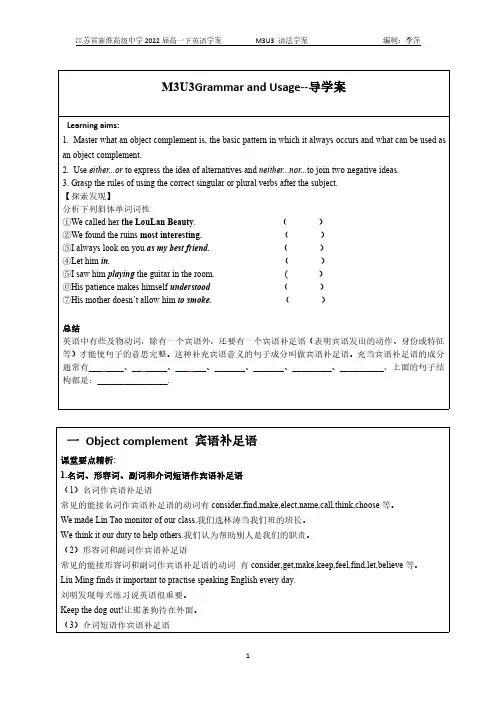
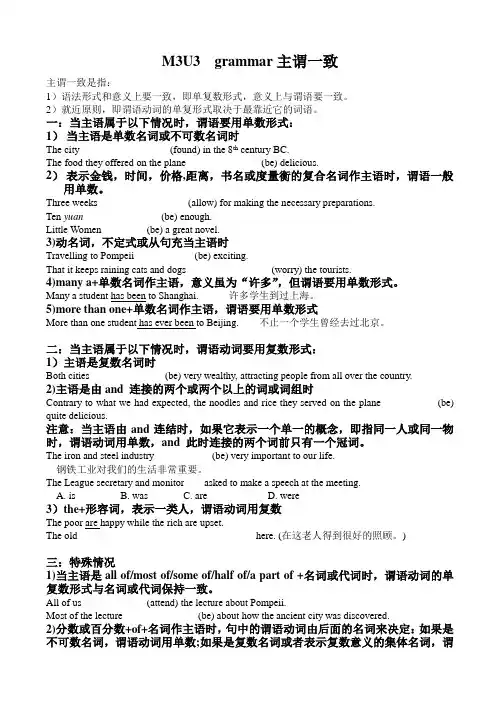
M3U3 宾语补足语与主谓一致精讲精练
- 格式:doc
- 大小:101.00 KB
- 文档页数:9
1 M3U3 Back to the past Grammar and Usage
语法精析
一、宾语补足语的概念
在英语中有些及物动词,接了宾语意义仍不完整,还需要有一个其它的成分,来补充说明宾语的意义、状态等,这个补充成分称为宾语补足语,简称宾补。
二、宾语补足语的形式:
常见的宾语补足语有以下形式: 名词, 形容词, 副词, 介词短语, 现在分词, 过去分词,
动词不定式。 例如:
1. She found him a very clever boy.
2. He had a strange way of making his class lively and interesting.
3. Last Sunday I saw you out with your sister.
4. To her surprise, she found herself in a different world.
5. I saw him doing his homework when I passed his window.
6. When he woke up, he found himself covered with a coat.
7. The villagers did not allow them to build a factory there.
三.常见的几种宾语补足语:
1. 名词作宾补时
He makes it a rule to exercise every day.
People call the place the Golden Triangle.
We elected him president of the country.
注意:当名词表示独一无二的职务、头衔时,作宾补的名词前通常不用冠词。
2. 不定式作宾补时
1)常接带to 的不定式作宾补的动词:ask/ advise / allow / permit/ forbid/ force / expect /
want / wish / cause / warn / tell / order / would like / remind sb (not )to do等。
Our school forbids students to smoke.
Please tell him not to come late.
2)常接不带to的不定式作宾补的动词:hear/ listen to / see / notice / watch / look at /observe/
feel/let / make / have etc等。
The boss made the workers work 12 hours a day in the past.
注意:改为被动时,要加to,let 和have不用于被动语态。
Though he had often made his little sister cry, today he was made to cry by her.
3. 现在分词作宾补时
强调宾补的动作正在进行,这类动词常见的有:keep / find / leave / hear / see /
smell / watch / get / send等。
Don’t leave the water running when you brush your teeth.
Polly found herself staring up at a man with his hand resting on her arm.
注意:感官动词用动词原形作宾补表示动作的全过程,用现在分词作宾补表示宾补的动作正在进行。
We often hear Alice sing the ABC song.
The missing boy was last seen playing near the river.
2 4. 过去分词作宾补时
宾语与宾语补足语之间存在着逻辑上的被动关系,能接过去分词作宾补的动词常见的有:get/ have /leave/ make / hear / see / watch / notice等。
I had my hair cut last Sunday.
The speaker raised his voice but still couldn’t make himself heard.
He left the door unlocked when he was away.
注意:不及物动词的过去分词作宾补时,只表示宾补的动作已完成,不表示被动的意思。
She found her wallet gone.
5. 介词with 的复合结构
It is not good manners to speak with your mouth full.
The city looks more beautiful with all the lights on.
The woman with a baby on her back lives downstairs.
With so much work to do, we can’t kill any time by playing cards.
With a boy leading the way, they started towards the village.
With the problems settled, we all felt very happy.
He died with his daughter a schoolgirl.
6. 宾语补足语中常见的结构
1) have sth done 使(让)某事被......; 遭受
have sb/sth doing 使(让)某人/物持续做某事
have sb do sth 使(让)某人做某事
1. I won’t have you _________(stand) the whole day.
2. I’ll have the gardener ______ (plant) some trees.
3. Who would you rather have_______ (post) the letter for you?
4. He had his house ________(paint) last month.
5. --- I’m going to shanghai for holiday.
--- Do you have anything ___________(take) to your son?
2) make sb +n. 使某人成为......
make sb do sth 使某人做某事
make sb/sth done 使某物被.....
1. We made him ______(captain) of our football team.
2. He couldn’t make himself _____ (hear) above the noise of the traffic.
3. What makes the grass_______(grow)?
4. The boy was make _______(work) twelve hours a day.
3) leave sb doing sth 让某人一直做某事
leave sth done 留下...... 被......
catch sb doing sth 逮到某人正在做......
find sb doing sth 发现某人正在做.....
find sth done 发现......被做......
get/set sb doing 使某人做……
1. Don’t leave the water________(run) when you brush your teeth.
2. Polly found herself ________ (stare) up at a man with his hand resting on her arm.
3 3. He left the door ________ (unlock) when he was away.
4) find/think/consider/make/feel + it +adj./n.+that…/to do…
主谓一致(subject-verb agreement)
一、名词作主语
1. 某些集体名词作主语时,如果作为一个整体看待,谓语动词用单数形式;如果强调每个成员,谓语动词用复数形式。这类集体名词常见的有:family, class, committee, crowd,
government, group, team. 表示复数概念的集体名词有cattle,people,police, public。
His family is very large.
His family are music lovers.
2. 单、复数同形的名词作主语时,按意义一致的原则。作单数意义时,谓语动词用单数,反之,谓语动词用复数。这类名词有:sheep, fish, deer, means(方法), Chinese, Japanese等。
Every possible means has been tried out.
All possible means have been tried out.
3. 表示时间、金钱、距离、体积、重量、面积、数字等词语作主语时,谓语动词用单数。
Three weeks was allowed for making the necessary preparations.
4. 如果主语有more than one…或many a…构成,尽管从意义上看是表示复数,但它的谓语
动词仍然用单数形式。
More than one comrade has asked to stay.
Many a passenger was killed in the accident.
5. 由every, each, many a, no等限定的单个主语由and连接时,谓语动词仍用单数,后一个限定词可省略。
Every man and (every) woman is at work.
6. 表示成双成套的名词,(如chopsticks (筷子), compasses, clothes, glasses, jeans, scissors,