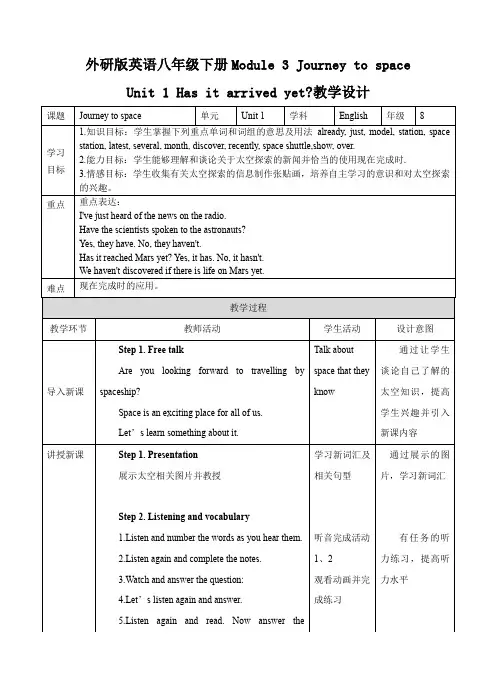
八年级英语下册 Module 3 Journey to space Unit 1 Has it arrived yet导学案2(无答案)(新版)外研版
- 格式:doc
- 大小:63.50 KB
- 文档页数:4
Module 3 Journey to space Unit 1 Has it arrived yet? 【学习目标】 1. 知识目标:熟练掌握本单元的单词、短语和重点句型。 2. 能力目标:能够读懂关于航空航天的短文。 3. 情感目标:培养学生的科技技术意识,引导学生积极探索未知。
【重点及难点】 能够读懂关于航空航天的短文。
【学习步骤】 : 课前预习【自主学习】 请同学们将预习中的疑难问题写出来。 Ⅰ 根据汉语意思默写单词 还;但是;已经 模型;典型; [航] 宇宙飞船 火星 发现,找到 宇航员,航天员; 新闻,消息 工程;计划 地球;地表 月亮;月球 行星 达到;抵达 Ⅲ. 根据句意及汉语提示完成单词。 1. Yang Liwei is a famous _________ (宇航员) of our country. 2. They have __________ (发现) many kinds of plants in the forest. 3. We haven’t seen each other ________(最近). 4. My father watches TV to get the ________ (最新的) news. 5. The ______ (地球) goes round the Sun.
二、课堂学习过程 【合作探究】 Step1. Lead in Talk about the questions. Do you know anything about the universe? Is the earth travelling in the universe?
Step2. Listen and number the words as you hear them. earth land message moon news planet reach scientist Step3. Listen again and complete the notes. ● news about the trip to (1) _________ ● journey of (2) _________ months ● has not sent back any (3) _________ yet ● hope to find (4) _______ on Mars
Step4. Watch,read the dialogue and do the exercises. 1. Tony has just made a model of the _______. A. space station B. spaceship C. rocket 2. ______ hasn’t started his homework yet. A. Tony B. Daming C. Jenny 3. Some scientists have sent a spaceship to _______. A. the moon B. the sun C. Mars 4. It has taken _______ to get to Mars. A. two months B. several days C. several months 5. The astronauts ______ life on Mars. A. haven’t discovered B. have discovered C. have seen 6. There aren’t any astronauts in the ____to Mars. A. spaceship B. plane C. space station
Step5. Read the dialogue and answer the questions: What school project has Daming and Tony got?
How does Daming feel about the school project?
What news has Tony heard?
4. Has anyone been to Mars? Why?
5. Who has been to Mars?
Step6. Read again and complete the passage with the correct form of the words in the box.
In today’s news, Tony has heard that scientists have a spaceship to Mars and it has on the after a journey of several months from the earth. Scientists have not life on Mars And no astronaut has ever been to Mars because it is far away. Step7. Check the true sentences.(T or F) ( ) 1.The spacecraft has reached Mars. ( ) 2. It has landed. ( ) 3. It has already sent messages back to Earth. ( ) 4. They have found life on the moon. ( ) 5. They have found life on Mars
Step8.Work in pairs and tell your partner about… 1 …something you’ve borrowed this week. 2 …something you’ve done recently. 3 …a model of something you have seen. 4 …something scientists have discovered. Example: A: What have you borrowed recently? B: I have borrowed a story book from the school library.
Step9. Listen and underline the words the speaker stresses. 1. I’ve just made a model spaceship for our school project. 2. I haven’t started yet because I’m not sure how to make it. 3. Has it arrived yet? 4. Astronauts have already been to the moon. Now listen again and repeat.
Arrive discover planet send yet Step10. Make lists of what we have and have not done in space travel. We have ____________________________________________________________________________________________________________________________ We have not… __________________________________________________________________ _________________________________
【知识结构】 (一)、 What are you up to? 你在做什么呢? ● up to 表示“正在干,从事着”。常用在非正式常合中。 e.g. What’s he up to with all those books on the floor?
What were you up to yesterday? You didn’t answer my phone.
(二)、I’ve just made this model of the space station。 这是我刚做的宇宙空间站的模型。 ● just常用在现在完成时的肯定句中,常放在助动词have/has后面。 e.g. We’ve just watched the film. 我们刚看了电影。
(三). I haven’t started it yet. 我还没有开始做呢。 ● yet表示“还(末)”,常用在现在完成时的否定句中,通常放在句末。 e.g. We haven’t finished our homework yet. 我们还没有完成作业。
(四). Have you heard the latest news? 你听说过这个最新消息吗? ● latest adj.最近的;最新的 e.g. The news is all about the latest meeting. 这条消息是关于最近的会议的。
(五). That’s why it’s on the news. 这就是它为什么出现在新闻报导的原因。 ● That’s why… 这就是为什么…… e.g. That’s why they didn’t like the music. 这就是为什么他们不喜欢这个音乐。
● on prep. 在(播放)中;关于…… e.g. What’s on the TV? 电视正在播放什么节目?
(六) So have they discovered life on Mars? 所以他们在火星上发现生命了吗? ● discover v. 发现;找到 e.g. The fact is that he did not discover it. 事实是他没有发现它。
(七). Astronauts have already been to the moon. 宇航员已经去过月球了。 ● already表示“已经”,常放在have/ has之后,通常用于肯定句中。 e.g. Jack has already finished his homework.
● just/already/yet用法小结 just “刚刚”; already “已经”,一般置于have/has之 后,两者都用于肯定句; yet 用在否定句和疑问句,表示“还未”。