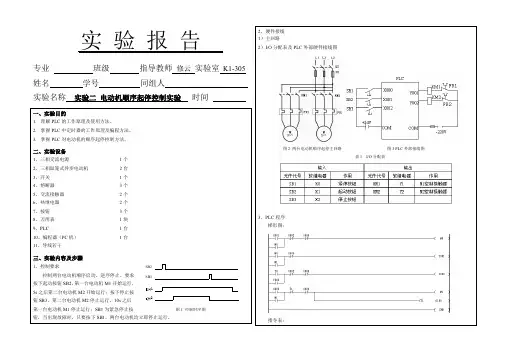
三部电动机启动停止的控制系统
- 格式:doc
- 大小:257.85 KB
- 文档页数:17
2014~2015学年第一学期
《电气控制及PLC》
课 程 设 计 报 告
题 目:三部电动机启动停止控制程序设计
专 业: 自动化
班 级: 11自动化(2)班
姓 名: 曹京 陈驰 陈静 陈庆
陈云 代宇 丁柱 牛万安
指导教师: 杨锐敏
电气工程学院
2014年10月31日
1 任务书
课题名称 电气控制及PLC
指导教师(职称) 杨锐敏(讲师)
执行时间 2014~ 2015学年第 一 学期 第 9 周
学生姓名 学号 承担任务
曹 京 1109111080 收集资料及整理排版
陈 云 1109111084 整理资料及排版
陈 静 1109111082 PLC选型
陈 驰 1109111081 I/O分配表绘画
陈 庆 1109111083 设计PLC的外观接线图
代 宇 1109111085 梯形图设计
丁 柱 1109111086 梯形图设计
牛万安 1109111060 系统调试
设计目的
1、设计出电气原理图
2、设计出硬件系统的结构图、接线图
3、运用功能指令进行PLC控制程序设计
4、进行系统调试,实现三部电动机启动停止的控制要求
设计要求 1、电源ON时,按SF4、SF5无作用
2、按SF3,M3电动机运转,此时按SF5无作用
3、按SF4,M2运转
4、按SF5,M1运转
5、按SF1时M1停止,5s后[PL2闪烁5次]M2停止,10s后[PL3闪烁10次]M3停止
6、按SF2时M3运转,5s后[PL3闪烁5次] M2加入运转,10s后[PL2闪烁10次] M1加入运转
7、运转中按SF6全部电动机立即停止运转
8、电动机全部运转,热继电器BB3动作,M1、M2、M3全部停止。PG与L4会交替响、亮(0.5s/ON,0.5s/OFF)。此时将COS切于2,则PG停响L4亮。
9、电动机全部运转,热继电器BB2动作,则M1、M2停止, 2 M3继续运转,PG与L4会交替响、亮(0.5s/ON,0.5s/OFF)。此时将COS切于2,则PG停响L4亮。此时按SF6,则M3停止。当热继电器BB2复位时,L4熄灭,COS切回1位置。
10、电动机全部运转,热继电器BB1动作,M1停止,M2、M3继续运转,PG与L4会交替响、亮(0.5s/ON,0.5s/OFF)。此时将COS切于2,则PG停响L4亮。此时按SF6,则M2、M3停止。当热继电器BB1复位时,L4熄灭,COS切回1位置。
3
摘 要
长期以来,PLC始终处于工业自动化控制领域的主战场,为各种各样的自动化控制设备提供了非常可靠的控制应用。它能够为自动化控制应用提供安全可靠和比较完善的解决方案,适合于当前工业企业对自动化的需要。进入20世纪80年代,由于计算机计数和微电子技术的迅速发展,极大的推动了PLC的发展,使的PLC的功能日益增强。PLC是一种固态电子装置,它利用已存入的程序来控制机器的运行或工艺的工序。PLC通过输入/输出(I/O)装置发出控制信号和接受输入信号。由于PLC综合了计算机和自动化技术,所以它发展日新月异,大大超出其出现时的技术水平。它不但可以很容易地完成逻辑、顺序、定时、计数、数字运算、数据处理等功能,而且可以通过输入输出接口建立与各类生产机械数字量和模拟量的联系,从而实现生产过程的自动控制。特别是超大规模集成电路的迅速发展以及信息、网络时代的到来,扩大了PLC的功能,使其具有很强的的联网通讯能力,从而更广泛地应用于众多行业。
4
Abstract
Long term since, PLC has always been in the field of industrial automation control of the
main battlefield, provides a very reliable control applications for various automation control
equipment. It can provide safe reliable and the quite perfect solution for the application of the
automation control, suitable for the needs of the current industrial automation business. Entered
in twentieth Century 80 years, due to the rapid development of computer counting and
microelectronics technology, promote the development of the PLC, the PLC function is
strengthened day by day. PLC is a solid-state device, operation or process it by means of a stored
procedure to control the machine process. PLC through the input / output (I/O) device sends out
control signals and receives input signal. Because the PLC integration of computer and
automation technology, so its development change rapidly, greatly exceeded its occur when the
level of technology. It not only can easily complete the logic, sequence, timing, counting, digital
operation, data processing and other functions, but also can be established with various types of
machinery and production of digital and analog connections through the input and output
interface, so as to realize the automatic control of the production process. Especially the ultra
large scale integrated circuits and the rapid development of information and network era, to
expand the functions of the PLC, which has very strong networking communication ability, thus
the more widely used in many industries.
5
目 录
摘 要 .............................................................................................................................................................. 3
Abstract ............................................................................................................................................................... 4
第一章、硬件设计 .............................................................................................................................................. 6
1.1系统总体设计 ....................................................................................................................................... 6
1.2系统硬件设计 ....................................................................................................................................... 6
第二章、系统软件设计 ...................................................................................................................................... 9
2.1控制系统的I/O点及地址分配 ........................................................................................................... 9
2.2系统流程图 ........................................................................................................................................... 9
2.3程序设计 ..............................................................................................................................................11
2.4运行调试 ............................................................................................................................................. 14