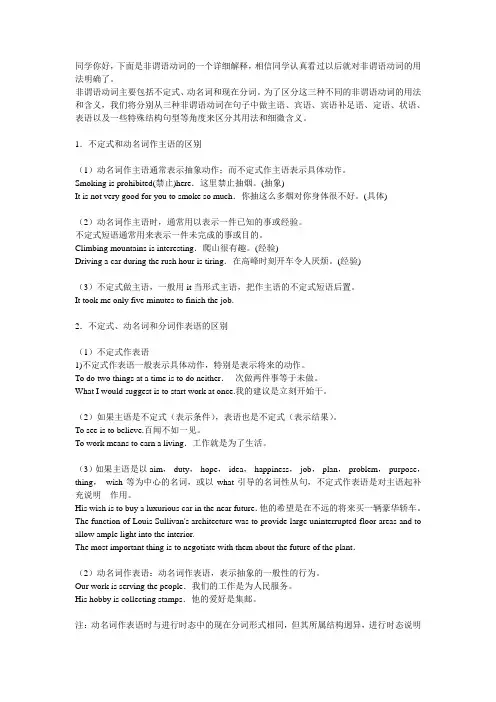
特殊疑问词+动词不定式结构
- 格式:docx
- 大小:13.99 KB
- 文档页数:4
特殊疑问词+不定式”的用法
"疑问词 + 不定式"结构(question word + to-infinitive )
4)疑问代词 who, what, which等和疑问副词 when, where, how等后面跟不定式,以及连接副词 whether与不定式连用构成不定式短语(在作用上相当于一个名词性从句,名词成分) 。这种结构在
句中可作主语、宾语、表语、复合宾语的直接宾语、状语、同位语等句子成分。注意:疑问副词why 后不能跟动词不定式
一、疑问词+不定式动词”结构的几种功用:
1) 作主语
Where to go is still a questio n.到哪里去还是个问题。(作主语时,谓语动词常用单数形式)
When to hold the meeti ng has not yet bee n decided.
Choos ing what to eat is no Ion ger as easy as it once was. 选择吃什么,已经不像以前那么 ...
When to start has not been decided.何时动身尚未决定。
What to read is an important question.该读些什么是一个很重要的问题。
How to begin is more difficult than where to stop. 如何开始比到哪里停止还困难。
2) 作宾语(作用相当于名词性从句)
A. 用作动词宾语
He asked how to open the box.他询问如何打开盒子。
She couldn ' t think what to sa她想不出说什么。
He could not tell whom to trust.
Our teacher explained how to use the word processor.老师向我们说明如何使用文字处理机。
I know where to find the boy.我知道到哪里能找到这个男孩。 (作动词know的宾语)
B. 作于间接宾语后作直接宾语
I ' ll show you how to do it.我将给你讲这怎么做。
She kindly advised me what to do.她好心的劝告我该做什么。
My sister taught me how to fold paper into a cran e. 我姐姐教我如何折纸鹤。
C. 用作介词宾语
I have no idea of how to do it.我不知道如何做此事。
Bill said somethi ng to her about what to do. 比尔给她讲了讲应当怎样做。
I fou nd a book on how to avoid havi ng a heart attack. 我找到一本书谈如何避免心脏病复发。
We must first solve the problem of whom to serve .... 为谁服务的问题。(作介词 of 的宾语)
3) 作表语
The question is how to lear n En glish well. 问题是怎样学好英语。 (作表语) The problem is where to find the financial aid.
The questi on is what to do n ext. 问题是下一步怎么办。
The question is how to carry out the pla n.问题是怎样执行这个计划。
5)作复合宾语的直接宾语
I can tell you where to get this book.
He will advise you what to do.
Will you show me how to use the machine?
I asked her how to learn English. 我问她如何学英语。 (宾语补足语)
5)作状语
She was at a loss what to do. 她不知如何是好。 (做状语)
6)作同位语
The question whether to confess troubled the girl. 是否要坦白的问题使姑娘很烦恼。 (做同位语)
I have no idea which one to take. 我不知道拿哪个好。 (同位语)
Tom had no idea which book to read first.
二、 “特殊疑问词+动词不定式 ”结构经常用在某些动词后 作宾语,类似的动词有: tell, show, know,
learn, teach, find out, forget, wonder, imagine, learn, decide, consider, understand, remember, think 等。 Eg:
I 'll show you how to do it. 我要让你看看如何做这件事。
You'd better find out where to put it. 你最好弄清楚要把它放在哪里。 注:(作介词宾语)某些介词后面可接 "疑问词+不定式 "作宾语,这类介词常用的有 about, as, from,
in, of, on, with 等
He has no idea of how to answer this question. 他不知道怎样回答这个问题。
Della had only $1.87 with which to buy Jim a present.
德拉仅有 $1.87 为来吉姆买一件礼物。 (which 是关系代词 )
You have a number of topics from which to choose. 你有很多题目可以选择。 (which 是关系代词 ) (作复合宾语)某些动词后面可以先有个宾语,然后才接适当的 “疑问词 +不定式动词” 结构(即:
sb.+ 疑问词 + 不定式)。这类动词常用的有 advise, ask, show, teach, tell, inform 等,先加上一个间 接宾语,之后再加上“疑问词 +不定式”结构作直接宾语。
Eg: The chief technician showed the apprentice how to repair the machine.
Have you told him where to get the application form?
He will advise you what to do. 他会建议你们做什么
Will you show me how to use this machine? 你能示范教我如何使用这部机器吗?
When you are trying to advise someone about what to do or what not to do, you can use should / ought to or
should not /ought not to. 当你想要建议某人做什么或者不做什么时,你可以用 should / ought to 或者 should not / ought not to
作双重宾语(宾语补足语):某些动词后面可接"sb. +疑问词+不定式”构成的双重宾语,这类动词常 用的有
advise, ask, show, teach, tell 等。
Eg: He will advise you what to do. 他会建议你们做什么
Will you show me how to use this machine? 你能示范教我如何使用这部机器吗?
三、 “特殊疑问词+动词不定式 ”这种结构可以把复合句转为简单句。
Eg: I don ' t know what I ' ll do=nIedxot.n ' t know what to do next.
Eg: The doctor told him when he should take the medicine.
= The doctor told him when to take the medicine.
因为 “特殊疑问词+动词不定式 ”这种结构相当于一个名词性从句,所以可用同等成分的从句代替, 从而把简单句转换为复合句。改写时只需在疑问词后加上适当的主语,并把不定式改为适当的形式 的谓语即可。
Eg: Li Ping doesn ' t know why to learn English.
= Li Ping doesn ' t know why he should learn English.
Eg: Which to choose is important. = Which we should choose is important.
Eg: The question is where to go. = The question is where we should go.
四、 “特殊疑问词+动词不定式 ”这种结构可构成独立问句。
What to do? 怎么办?
How to get rid of the trouble? 如何摆脱困境?
该结构的注意点: 易错一: 按照英语语法的习惯,疑问副词 why 后不直接跟动词不定式。 误: I don't
know why to choose that dictionary. ( X ) 正: I don 't know why you must choose that dictionary.
但可以接不带 to 的动词不定式(即动词原形) ,构成 Why do sth.?/Why not do sth? 结构。肯定形式 表示某动作是不必要的或没有意义的, 而否定形式则用于向某人提建议和表达看法, 相当于祈使句。 Eg: Today is
Sunday. Why not go out to relax yourself? 今天是周日,干嘛不出去轻松一下呢? Why pay more at other
shops? We have the best value.
为什么花更多的钱到其他商店去买?我们这里物美价廉。 需要注意的是: why not 这个结构的否定式通常只用于谈论现在和将来,而不用于谈论过去。
误: Why not clean the room yesterday? ( X ) 正: Why didn 'tyou clean the room yesterday?
Why not do sth? = why don't you do sth?