
Session 4 Consolidated income Statement
- 格式:ppt
- 大小:147.00 KB
- 文档页数:27

Understanding financial statements
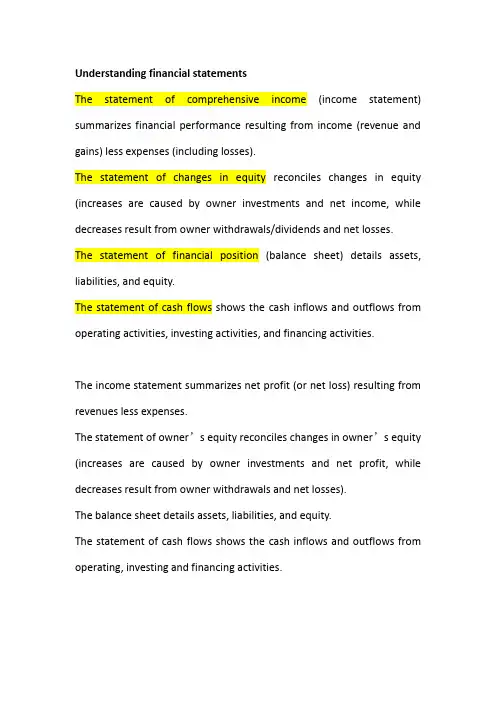
The statement of comprehensive income (income statement)
summarizes financial performance resulting from income (revenue and
gains) less expenses (including losses).
The statement of changes in equity reconciles changes in equity
(increases are caused by owner investments and net income, while
decreases result from owner withdrawals/dividends and net losses.
The statement of financial position (balance sheet) details assets,
liabilities, and equity.
The statement of cash flows shows the cash inflows and outflows from
operating activities, investing activities, and financing activities.
The income statement summarizes net profit (or net loss) resulting from
revenues less expenses.
The statement of owner’s equity reconciles changes in owner’s equity
(increases are caused by owner investments and net profit, while

会计英语第四版参考答案
Chapter 1: Introduction to Accounting
1. What is accounting?
- Accounting is the systematic recording, summarizing, and
reporting of financial transactions and events of a business
entity.
2. What are the main functions of accounting?
- The main functions of accounting are to provide
financial information for decision-making, ensure compliance
with laws and regulations, and facilitate the management of a
business.
3. What are the two main branches of accounting?
- The two main branches of accounting are financial
accounting and management accounting.
4. What is the purpose of financial accounting?
- The purpose of financial accounting is to provide an
accurate and fair representation of an entity's financial
position and performance to external users.
5. What is the double-entry bookkeeping system?

Chapter 1
Accounting会计
Accounting equation会计等式
Assets资产
Auditors审计师
Balance sheet资产欠债表
Bookkeeping记账
Business entity assumption会计主体原则
Common stock普通股
Corporation公司
Cost principle本钱原则
Equity权益
Ethics伦理
Events事项
Expanded accounting equation扩展的会计等式
Expenses费用
External transactions外部交易
External users外部信息利用者
Financial accounting财务会计
FASB美国财务会计准则委员会
Full disclosure principle充分披露原则
GAAP公认会计原则 Going-concern assumption持续经营原则
Income statement损益表
Internal transactions内部交易
Internal users内部信息利用者
IASB国际会计准则理事会
Liabilities欠债
Managerial accounting管理会计
Matching principle配比原则
Monetary unit assumption货币单位原则
Net income净收益
Net loss净损失
Owner ,Capital所有者名下的资本
Owner investment所有者投资
Owner withdrawals所有者提取
Partnership合股企业
Proprietorship独资企业
Recordkeeping记账
Revenue recognition principle收入确认原则
Revenues收入
Sarbanes –Oxley Act《萨班斯—奥克斯利法案》
精心整理
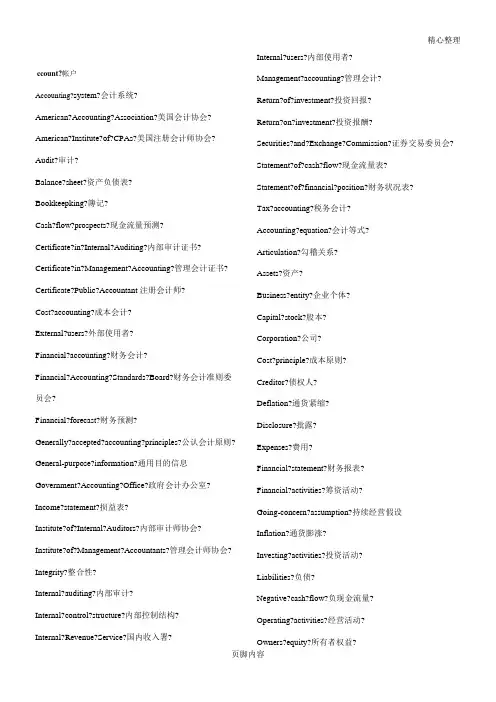
页脚内容 ccount?帐户
Accounting?system?会计系统?
American?Accounting?Association?美国会计协会?
American?Institute?of?CPAs?美国注册会计师协会?
Audit?审计?
Balance?sheet?资产负债表?
Bookkeepking?簿记?
Cash?flow?prospects?现金流量预测?
Certificate?in?Internal?Auditing?内部审计证书?
Certificate?in?Management?Accounting?管理会计证书?
Certificate?Public?Accountant注册会计师?
Cost?accounting?成本会计?
External?users?外部使用者?
Financial?accounting?财务会计?
Financial?Accounting?Standards?Board?财务会计准则委员会? Financial?forecast?财务预测?
Generally?accepted?accounting?principles?公认会计原则?
General-purpose?information?通用目的信息
Government?Accounting?Office?政府会计办公室?
Income?statement?损益表?
Institute?of?Internal?Auditors?内部审计师协会?
Institute?of?Management?Accountants?管理会计师协会?
Integrity?整合性?
Internal?auditing?内部审计?
Internal?control?structure?内部控制结构?
Internal?Revenue?Service?国内收入署?
Internal?users?内部使用者?