
英语教学法教程9_Teaching_Listening
- 格式:ppt
- 大小:951.50 KB
- 文档页数:54


- 1 - 王蔷的英语教学法教程的简介
本教程将介绍王蔷老师在英语教学方面的独特方法和经验。王蔷老师是一名富有经验的英语教师,她在长期的教学实践中总结出了许多适用于不同年龄段和不同英语水平的学生的教学方法。
教程将涵盖以下内容:
1. 王蔷老师的教学理念:了解学生的需求、关注学生的情感体验、激发学生的学习兴趣和主动性。
2. 教学方法:包括多媒体教学、情景教学、游戏教学、角色扮演教学等,这些方法丰富了教学手段,增加了学生的学习乐趣和效果。
3. 课程设计:王蔷老师注重将英语教学与实际生活相结合,让学生在学习中更容易理解和掌握知识。本教程将提供一些具体的课程设计案例,帮助教师更好地设计英语课程。
4. 教学评估:王蔷老师认为教学评估是教学过程中必不可少的一环,教师需要通过评估了解学生的学习状况和反馈信息,及时调整教学策略。
本教程旨在向广大英语教师介绍王蔷老师的教学经验和方法,帮助教师更好地提高自己的教学水平,提升学生的英语学习效果。
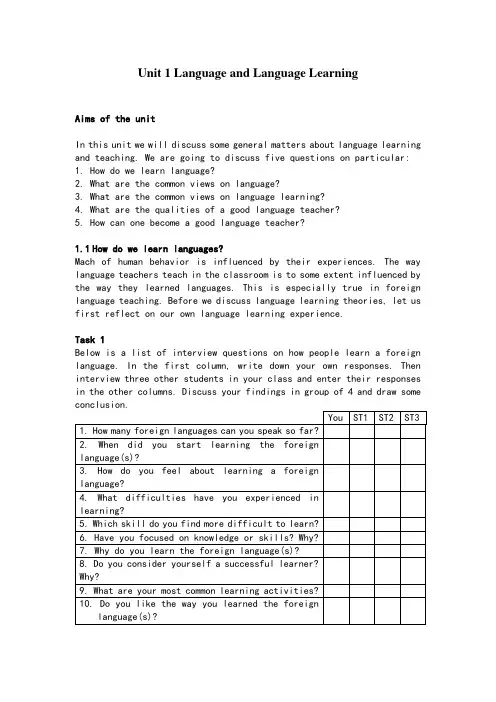
Unit 1 Language and Language Learning
Aims of the unit
In this unit we will discuss some general matters about language learning
and teaching. We are going to discuss five questions on particular:
1. How do we learn language?
2. What are the common views on language?
3. What are the common views on language learning?
4. What are the qualities of a good language teacher?
5. How can one become a good language teacher?
1.1 How do we learn languages?
Mach of human behavior is influenced by their experiences. The way
language teachers teach in the classroom is to some extent influenced by
the way they learned languages. This is especially true in foreign
language teaching. Before we discuss language learning theories, let us
first reflect on our own language learning experience.
Task 1
Below is a list of interview questions on how people learn a foreign

可编辑修改精选全文完整版
第10章 Teaching Speaking
一、Characteristics of spoken language
1. Two main factors affect the improvement of speaking ability
1) Surroundings;
2) Psychology
2. The characteristics of spoken language:
1) Speaking is a skill that can be imitated and practiced
2) Speech is spontaneous: The fact that speech is spontaneous means that it is full of false starts, repetitions,
incomplete sentences, and short phrases.
3) Speaking is time-constraint: Another aspect of producing spoken language is the time-constraint.
The students must be able to produce unplanned utterances in real time, otherwise people will not have the
patience to listen to them.
According to Bygate, there are four common features of spoken language:
①Using less complex syntax
②Taking short cuts, e.g. incomplete sentences
③Using fixed conventional phrases/chunks
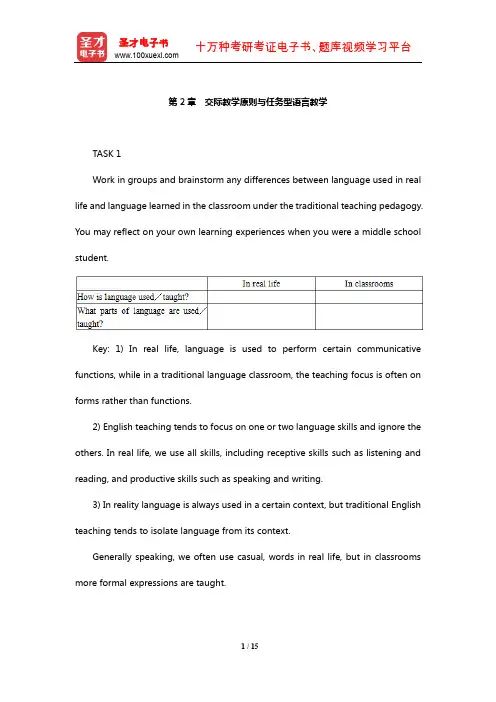
1 / 15 十万种考研考证电子书、题库视频学习平台 圣才电子书 第2章 交际教学原则与任务型语言教学 TASK 1 Work in groups and brainstorm any differences between language used in real life and language learned in the classroom under the traditional teaching pedagogy. You may reflect on your own learning experiences when you were a middle school student. Key: 1) In real life, language is used to perform certain communicative functions, while in a traditional language classroom, the teaching focus is often on forms rather than functions. 2) English teaching tends to focus on one or two language skills and ignore the others. In real life, we use all skills, including receptive skills such as listening and reading, and productive skills such as speaking and writing. 3) In reality language is always used in a certain context, but traditional English teaching tends to isolate language from its context. Generally speaking, we often use casual, words in real life, but in classrooms more formal expressions are taught. 2 / 15 十万种考研考证电子书、题库视频学习平台 圣才电子书 TASK 2 Work in pairs. Think about at least three situations where we are likely to hear the question: “Why don’t you close the door?” Discuss how many functions it may have, e. g., a real question, a complaint, or something else. What implications can you draw from this regarding language teaching? Key: Situation 1: One of the speaker’s friends always leaves the door open when he comes into the room. The speaker wants to know the reason so he says this to his friend. (It is a real question.) Situation 2: The husband always leaves the bathroom door open after he uses it. The wife is saying this to her husband. (It is a complaint.) Situation 3: With permission, the student enters the language teacher’s office for conference on writing. Before the talk, the language teacher says this to the student. (It’s a suggestion.) TASK 3 Suppose you want to make a suggestion to somebody. How many different ways are there to express this intention? Write down as many ways as you can think of in the box below. Then share what you have written with a partner. Then discuss in what situations you would use each of them? Key: 1. You should buy a black overcoat. 3 / 15 十万种考研考证电子书、题库视频学习平台 圣才电子书 2. Have you thought about buying a black overcoat? 3. I think you should buy a black overcoat. 4. Don’t you think it’s a good idea to buy a black overcoat? 5. You’d better buy a black overcoat. 6. Why don’t you buy a black overcoat? 7. I suggest that you buy a black overcoat. 8. If I were you, I would buy a black overcoat. TASK 4 Look at the sentences in the box below. They are all in present continuous tense. What is clear is that not all of them describe something that is happening at the moment of speaking. Its meaning depends on the context where it is said. Discuss the possible meaning and function each may have and share your views in a group. What implications can you draw from this for teaching the present continuous tense? Key: The present continuous tense can be used to express something that will happen in a very short time. For example, if you hear ‘Flight CA is now landing’ at airport, it means the flight is about to land. So you may start to take out your luggage and prepare to land. Likewise, ‘the train is leaving in ten minutes’ 4 / 15 十万种考研考证电子书、题库视频学习平台 圣才电子书 doesn’t mean the train is leaving now, but means that the train will leave in ten minutes. Moreover, the present continuous tense may imply a feeling such as complaint, hate or praise, and it also can be used to describe something happening recently. For example, when you hear ‘She is always complaining whenever you talk to her’, you should not think she is complaining or about to complain. On the contrary, she may have just complained and people say this to express disapproval and disdain. Similarly, when you hear ‘He is making progress slowly’, it means that people are praising him because he is progressing every now and then. The present continuous tense here is also used to suggest a process. TASK 5 Having considered the components of communicative competence, we now move to discuss its implications for teaching and learning in the language classroom. Work in groups of 4. Discuss the implication of each component of communicative competence to language teaching and learning. Write in the space provided below. Then join another group to share your views. 5 / 15 十万种考研考证电子书、题库视频学习平台 圣才电子书 Key: 6 / 15 十万种考研考证电子书、题库视频学习平台 圣才电子书 (Adapted from Hedge, 2000:56) TASK 6 Use the table below and reflect on your own English learning experiences. What skills have you practicsed most? What skills have been neglected? What are your strong and weak skills? When you are ready, go into groups and pool your