
新目标英语七上unit1My name's Gina Sectiona
- 格式:ppt
- 大小:1.67 MB
- 文档页数:21


人教版英语七年级上册正式单元Unit 1 My name's Gina Section A部分知识(含答案)人教版英语七年级上册正式单元第一单元Unit 1 My name’s Gina. Section A部分知识点总结一、关于打招呼的一些问候语。
1、Hello! \ Hi! 你好!Hello和Hi都可以用于跟别人打招呼,Hello适用于正式的场合打招呼或者是和不太熟悉的人、陌生人打招呼。
Hi相对于Hello来讲,要随意一些,适合跟朋友打招呼。
2、Good morning!/Good afternoon!/Good evening!/Good night!早上好!/ 下午好! / 晚上好! / 晚安!根据见面的时间段不同,选择适合的打招呼用语。
3、How are you 你好吗?(你身体好吗)用于询问对方的身体状况(心情)等,有以下几种回答方式:I’m , fine , thank you. 我很好,谢谢!\ Fine , thanks. \ I’m OK.4、How do you do 你好!常用于初次见面的问候。
5、Nice to meet you. 很高兴见到你! 一般用于和人初次见面的时候说,和对方还不认识。
当别人对你说Nice to meet you.你可以回一句:Nice to meet you , too.表示“我也很高兴见到你! ”二、关于询问名字。
1、询问当事人(对方)的名字,用What’s your name你叫什么名字?(你的名字是什么?)回答:My name is...= My name’s…我的名字是...也可以用I am...= I’m...我是...例如:My name is Gina. = I am Gina. 缩写后:My name’s Gina. = I’m Gina. 我的名字是Gina.2、询问第三方(男士)的名字。
用What’s his name他叫什么名字?(他的名字是什么?)回答:His name is...= His name’s…他的名字是...也可以用He is...=He’s...他是...例如:His name is Frank. = He is Frank. 缩写后:His name’s… = He’s…他的名字是弗兰克。
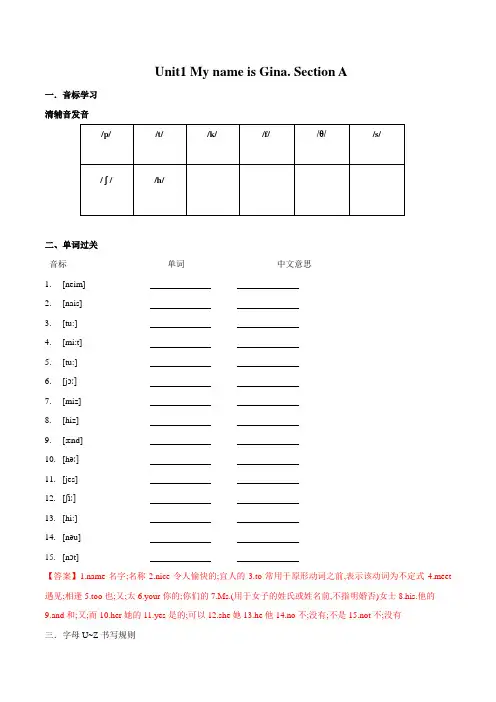
Unit1 My name is Gina. Section A
一.音标学习
清辅音发音
二、单词过关
音标单词中文意思
1.[neim]
2.[nais]
3.[tu:]
4.[mi:t]
5.[tu:]
6.
7.[miz]
8.[hiz]
9.
10.
11.[jes]
12.
13.[hi:]
14.
15.
【答案】名字;名称2.nice令人愉快的;宜人的3.to常用于原形动词之前,表示该动词为不定式4.meet 遇见;相逢5.too也;又;太6.your你的;你们的7.Ms.(用于女子的姓氏或姓名前,不指明婚否)女士8.his.他的9.and和;又;而10.her她的11.yes是的;可以12.she她13.he他14.no不;没有;不是15.not不;没有
三.字母U~Z书写规则
请按照正确的书写规则书写下列英语字母。
四、课文学习
一A: What's your name?
B: Alan.
A: Hello, Alan. I'm Ms. Brown.
二A: Good morning! I'm Cindy.
B: Hello, Cindy! I'm Dale.
A: Nice to meet you!
三A: Hi. My name's Gina.
B: I'm Jenny. Nice to meet you!。

Unit1 My name is Gina.Language goals:In this unit students learn to introduce themselves, greet people and ask for and give telephone number.New languages:What’s your name? My name is /I’m …Hello! I’m … /Hi! I’m …Nice to meet you!What’s his name? His name is …What’s her name? Her name is …What’s her family name?What’s her first name?What’s your phone number?Difficult points:1. How to introduce yourself and greet people in the right way.2. I mprove the students’ reading, listening, speaking and writing skills.3. The difference between Chinese names and English names.Teaching aids:puter, recorder, colorful chalkTeaching periods:Period 1: Section A 1a /1b /1c /2a /2b /2c/ Grammar FocusPeriod 2: Section A 3a /3b /4Period 3: Section B 1a /1b /2a /2b /2cPeriod 4: Section B 3a /3b /3c /4 / Self checkPeriod 1Teaching aims:1. Memorize the words on page1and page2.2. Learn the target languages:My name is Gina.What’s your name?Hello! I’m Mary.Hi! I’m Jim.What’s his name?What’s her name?3. Train the listening and speaking skills.Teaching procedure:Step 1 Free talkLet students talk in pairs using the sentences they’ve learned in Starter or ask some questions in Starter, have students answer them. For example: Good morning/afternoon/evening!How are you?What’s this in English?What color is it?Step 2 Section A 1aThis activity tests students’ vocabulary.1. Draw student’s attention to the pictures. Point to an object in it andask what it is. Say, now look at the picturesand write down as many words as you can2. Ask two students to write the words on the blackboard.3. Check the students’ answers. Ask some students to call out their wordsand spell them. Write down the words on the board.Step3 Section A 1bThis activity gives students practice in understanding the target language in spoken conversation.Read the instruction to the students. Make sure the students understand how to do it. Say, now listen and number the conversations 1-3.(1) Play the recording for the first time. Students only listen.(2) Play the recording a second time. Students number the conversations.(3) Check the answers together.Step 4 Section A 1cThis activity provides guided oral practice using the target language.(1) Ask three pairs to read the conversations in 1b. If necessary, ask studentsto repeat the names after the teacher.(2) Have students work in pairs to practice the conversations.(3) Say, Now use your own names when you have conversations .Move around theroom monitoring their work. Offer language or pronunciation support asneeded.(4) Let several pairs e to the front of the class and act out theirconversations.Step 5 Section A 2aThis activity gives students practice in understanding the key words and target languages.1. Point to a boy and a girl. Say, His name is---, her name is--- Have studentsunderstand the meaning of his and her.2. Read the instruction to the students.3. Play the recording for the first time. Students only listen.4. Play the recording a second time. Students number the pictures 1-4.5. Check the answers.Step 6Section A 2bThis activity provides listening practice.(1) Have one student read the names in the box.(2) Say, listen to the four conversations again.This time circle the names you hear.(3) Students listen and circle the names.(4) Check the answers.Step 7 Section A 2cThis activity provides guided oral practice using the target language.(1) Call attention to the two conversations in the box.Ask one pair to act out the first one. Tell them to use their own names.Ask another pair to act out the second one.Have them point to a boy or a girl when they ask the questions:What’s his name/What’s her name?(2) Let students work in pairs to practice the two conversations. As studentswork, move around the classroom, monitoring the conversations andoffering assistance if necessary.(3) Have several pairs of students present their conversations to the class. Step 8Grammar Focus(1) Divide the class into two groups to say the questions and responses.(2) Write down the full forms and contractions of the words on the right.Have students pare them. Then ask them to say the sentences in two ways. Step 9 Conclusion(1) Learn the words and phrases.(2) Master the target languages:My name is Gina.What’s your name?Hello! I’m Mary.Hi! I’m Jim.What’s his name?What’s her name?Step 10 Homework(1) Learn the words by heart.(2) Practice the conversations in 1b and Grammar Focus.(3) Do some preparing.Period 2Teaching aims:1. Memorize the words and phrases: first, first name, last, last name, boy, girl2. Learn about first name and last name.3. Train writing and speaking skills.Teaching procedure:Step 1 Revision1. Go over the words in last class. (Play a game. Divide the class into twogroups: boys and girls. Give them three minutes to read and write the words.Then look at the Chinese meaning on the cards. See which group can say andspell the words more quickly and correctly. )2. Ask students to make conversations about introduction and greeting. Step 2 SectionA 3aThis activity introduces the western concept of first name and last name.1. Write down a Chinese name and an English name on the board. For example:Deng Yaping and Jim Smith.2. Ask students to discuss the names. Encourage them to tell the differencebetween them. (English names are listed with the given name first and thefamily name or surname second. While Chinese names are listed with thefamily name first and given name second.)3. Ask some students to say their family names and first names.4. Have two students read the list of names in the box. Say, Guess, whichnames are first names and which are last names?5. Ask students to write F for first name and L for last name next to thewords. Students do the exercise by themselves.6. Check the answers.Step3 Work in pairs(1) Call attention to the picture on the right. Students look at the pictureand the sentences carefully. Have them pay attention to what the teacherwrites.(2) Have two students read the conversations in the picture aloud.(3) Ask students to work in pairs.Ask and answer about their first names and last names.Step4 SectionA 3bThis activity provides guided oral practice using the target language.(1) Point to the names in 3a.( You can write more names on the board.)(2) Say, Which names would you like to choose as your first name and lastname? Now choose your names.(3) Have students take turns to ask and answer the questions (using theirnew names):What’s your first name?What’s your last name?Students make a list of names.Then exchange their lists to correct any mistake they make.Step5 SectionA 4 (Game)This activity gives students an opportunity to practice target language in an interesting way.1. Demonstrate the game with three students.2. Say, Now in groups of four, play the game. As they work, move around theclassroom making sure students understand the procedure and correcting anymistake.3. Ask two groups to present their games to the class.Step 6 Conclusion(1) Learn the words and phrases in this class.(2) Grasp the target languages:What’s your first name?What’s your last name?Step 7 Homework(1) Memorize the words and phrases.(2) Make a conversation about asking for first name and last name.(3) Prepare next lesson.Period 3Teaching aims:1. Memorize the words on page4.2. Target languages:What’s your phone number?It’s …3. Train the listening and speaking skills.Teaching procedure:Step 1 Free talkLet students work in pairs. Make conversations using the target languages they’ve learned. For example:What’s your name? My name is …What’s his name? His name is …What’s her name? Her name is …What’s your first name?What’s your last name?Step 2 Section B 1aThis activity learns the numbers from 0 to nine.(1) Write the numbers 0-9 on the board. Ask who can say them in English.Encourage more students to read them.(2) Play the recording for the first time. Students only listen.(3) Play the recording a second time. Have students repeat the numbers.(4) Give students two or three minutes to read and write the mummers. Thenhave some students say them quickly and ask if anybody can spell them.Cheer for the students who do best.Step3 Section B 1bThis activity gives students practice recognizing the numbers 0-9 in spoken telephone numbers.Say, Now listen to the conversation, and write down the telephone number you hear.(1) Play the recording for the first time. Students only listen.(2) Play the recording a second time.Have students write the numbers in the blank.(3)Check the answers.(4) Work in pairs and practice the conversation.Step 4 Section B 1cThis activity gives students speaking practice using the target language.(1) Call attention to the conversation on the right. Have two students read it.(2) Practice the conversation in pairs.(3) Say,Now in groups of three or four, make up conversations using any phonenumber you like .As they work, move around the room monitoring their work.Offer language or pronunciation support as needed.(4) Let several pairs e to the front of the class to perform theirconversations for the class.Step 5 Section B 2aThis activity provides listening practice with the target language.1. Call attention to the names and the numbers in the box.2. Read each one to the class or ask some students to read them.3. Point to the blanks in the four telephone numbers. Say, The phone numbersaren’t finished. You need to write the last two numbers later. Now listenand match the names with the telephone numbers.4. Play the recording for the first time. Students only listen.5. Play the recording a second time Students write the letter of the person’stelephone number in the space after that person’s name.6. Check the answers.Step 6Section B 2bThis activity gives students practice recognizing the spoken numbers 0-9. (1) Say, Now let’s listen to the conversations again and finish each telephonenumber.(2) Students listen and fill in the missing numbers.(3) Check the answers.(4) If have time, have students repeat the telephone number after the recording.(5) Practice the four conversations in pairs.Step 7 Section B 2cThis activity provides guided oral practice using the target language.(1) Call attention to the address book. Ask one student,“What’s your phone number?” Write his/her name and phone number inthe address book.Make sure all the students understand how to fill in the address book.(2) Say, Now ask your four classmates their phone numbers and fill in theform.Step 8 Conclusion(1) Learn the numbers 0-9.(2) How to asking for phone number:What’s your phone number?It’s …Step 9 Homework(1) Remember the numbers from 0 to 9.(2) Make two conversations.(3) Do some preparing.Period 4Teaching aims:1. Memorize the words and phrases on page2. How to ask for first names/last names/phone numbers.3. Train speaking and writing skills.Teaching procedure:Step 1 Revision1. Go over the numbers in last class.Ask the students to read and spell numbers from 0-9.2. Talk about phone numbers.Step 2 Section B 3aThis activity reviews about first name and last name.1. Say, Look at the picture. How many cards can you see?Can you read the names on the card?2. Ask four students to read the names on each card. Then say,“Which is first name and which is last name? Do you know?”3. Point out the blank line following each first name in the exercise.Say, Write each person’s last name in the blank after the first name.4. Students finish the exercise individually.5. Check the answers.Step 3 Section B 3b & 3cThis activity provides speaking and writing practice using the target language.(1) Point to the ID card. Say, Look at the girl on the card. What’s hertelephone number? What’s her family name? What’s her first name?(2) Have students work in pairs and answer the three questions.(3) Check the answers.(4) Say, Look at the ID card in 3c. This is your card. Write your own firstname, last name, and telephone number on it.(5) As students work, move around the room checking progress.Step 4 Section B 4This activity gives students an opportunity to practice target language ina game.Read the instruction to the class. Make sure all the students know how to do it. Move around the room monitoring their work. Offer language or pronunciation support as needed.。
人教新目标七年级英语上册Unit 1 My name's Gina.教案一、单元教材分析本单元围绕“结交新朋友”使学生学会打招呼和介绍自己、询问他人姓名的基本句型:“What’s your/his/her name?My/His/Her name is…”; 通过学习区分"First/last name”,了解有关姓名的文化知识;通过查询电话号码“What’s your/her/his phone number?”,学习数字1~9,同时也进一步促进学生之间的相互了解;通过以上几个方面的学习,使学生在轻松、愉快的学习氛围中熟识新伙伴。
本单元与第二单元衔接紧密:由课堂内的打招呼、自我介绍到课外、校外相互了解。
由特殊疑问句的学习到一般疑问句的学习,使学生将书本知识运用到实际生活中。
二、单元学情分析本单元的主题是熟识新伙伴,同时引导学生采用Practicing, Listening for specific information和Role playing的学习策略,学习一些新词汇,掌握一些重点句型,在小组合作学习的过程中,进一步促进学生之间的相互了解。
三、单元教学建议本单元可综合运用讲授式、启发式、自主学习、合作学习等各种策略,提供大量的学习资源,通过老师向学生进行的自我介绍,同学自我介绍传句子比赛,自我查资料表演,自制明信片等的活动,使学生能够学到知识,又增加了他们的学习的乐趣。
来培养学生的自主学习的能力及表达能力和逻辑思维能力。
采用Practicing, Listening for specific information和Role playing的学习策略,利用教学图片或制作多媒体课件来展开课堂Pair work, Group work的口语交际活动,询问他人姓名、查询电话号码,了解有关姓名的文化知识。
四、单元课时分配本单元可用4课时完成教学任务:Section A (1a-2d) 用1课时Section A (Grammar Focus-3c) 用1课时Section B (1a-2c) 用1课时Section B (3a-Self Check) 用1课时Section A 1 (1a-2d)一、教学目标:1. 语言知识目标:1) 能掌握以下单词:name nice meet his and her your能掌握以下句型:①—Hi. My name’s Gina.—I’m Jenny. Nice to meet you!②—What’s your/his/her name?—My/His/Her name is…③—Are you…?—Yes, I am. / No, I'm not.④—Is he/she…?—Yes, she/he is. / No, she/he isn’t.2) 能了解以下语法:your, his, her等形容词性物主代词的简单用法;What’s=what is I’m=I am name’s=name is等缩写形式。