
开能环保开“细胞银行”
- 格式:pdf
- 大小:321.96 KB
- 文档页数:1

银行员工个人年度工作总结范文11篇银行员工个人年度工作总结范文 (1) 回顾20xx年,我在XX分社工作天,在营业部工作天,这天中,银行柜员工作总结从我手里收入的现金超过亿,付出超过千万,没有一张假币能逃过我的法眼;接触形形式式的客户,超个的不少,有些能用平和口气解决迷雾,有些能用灿烂笑容嘻嘻过海,不能的,我用夸张而有技术含量的表情挫其蛮气,抚安燥心;爱我岗位,开心工作,我善于在工作中发现美,这一年我遇到附加价值的客户有个,一位笑容像安在旭,一位魅力得像胡军,另外一位则像端庄版的吴雁祖;本人生爱好干净整洁,银行柜员工作总结绝不让任何一张残钞混入新钞队伍,在空闲时间把网点打扫得一尘不染,厕所洗得飘香反光;本着好记不如烂笔头的座右铭,每次认真的阅览文件,将新操作新业务记入私人笔记本以备查用;本人好学,这一年来主动亲近atm,关心它,揣摸它,终于熟悉其脾,并于节假日主动承担照顾它的任务;人人防火,户户安全,对于灭火器,只要有新产品,我必定会第一时间去摸一下,以防万不得已的时候要用到它却不知道怎么用;珍惜生命爱惜生命银行柜员工作总结,对于二道门,我总是第一时间按照文件步骤模拟实践,以正规的格式去执行并以最好的态度去变成习惯;知己知彼,百战百胜,又由于我们这一代比较有网虫潜质,于是我总会浏览其他银行的主页和金融最新报道,以便在工作中寻找灵感,培养自己为信社尽点棉力的细胞银行柜员工作总结岁月不居!来也匆匆,去也匆匆!虽然我老是觉得累,可是时间老人却总也不觉得累,每天自我陶醉地嘀嘀哒哒跑个不停!回首这一年,颇有感慨——我完完整整的为商行服务了一年,商行也给了我别人羡慕不已的报酬——幸福!增加工作成果——你做了别人没有做的从正常班到倒班,我踏踏实实地做,用心地体会,感悟最深的就是端正态度,遵守行纪行规;尊敬领导,服从安排;团结同事,虚心求教;明确目标,脚踏实地。
一年的工作实践,深深地体会到临柜工作是银行第一形象的含义。

周辉旅美博士从事专业:免疫生物医学现任职洛克菲勒大学医学中心研究员合作项目:1、羊膜隐型接触镜羊膜隐形接触镜(AMCL)属世界首创专利成果(US Pat. 6,143,315)。
该项目的关键技术是将羊膜通过独特的工艺技术结合在隐型接触镜上,并通过独特的配套滴眼液/储存液使用,首次提供一种崭新的非手术治疗角膜损伤方法,使预防和阻止角膜瘢痕形成成为可能。
本项目的开发是角膜损伤修复技术和防盲治盲工作的一次革命,可在世界范围内推广应用。
2、智能电子听诊器传统的听诊器噪声干扰比较严重,对过于微弱或过于复杂的声音响应不好,它一般只被用于初步的、粗略的诊断。
目前电子听诊器在国外的普及很快,并已经有多家公司生产。
而由于进口产品的价格过于昂贵,电子听诊器在中国的普及速度非常慢。
智能电子听诊器是超越了目前电子听诊器性能的新一代产品。
我们把人工智能领域的语音识别技术和远程信息化医疗新观念应用于电子听诊器的研制过程中,从而开发出了智能化、信息化的新型电子听诊器。
合作意向:希望进一步与国内同仁和投资者共同开发这些项目。
联系方式:1-718-261-2211 (O) 1-718-261-7703 (Fax) 1-646-981-8586 (Cell)陆重庆旅美博士从事专业:能源工程现任职能源环保机构高级工程师合作项目:FAS 智能火焰监测分析系统既能对单个燃烧器又能对整个炉膛火焰气相分布情况进行实时在线监测;可靠性高,成本低,应用范围广,可适用于恶劣的工作环境。
安装此系统后,燃料消耗可降低至少百分之一,运行维护费用可减少百分之二十,并可大大降低污染排放及由此而来的罚款。
该系统已成功地开发用于燃油燃气火焰工况。
该设计包能大大降低常规设计所需要的试验开发工作量,从而使相关科研费用下降大约50%以上;由于对现场运行提供了监控手段,从而使运行维护费下降至少10% 以上,在制备煤浆用于燃烧时,由于对给煤质量的监管优化,可使成本下降20%。
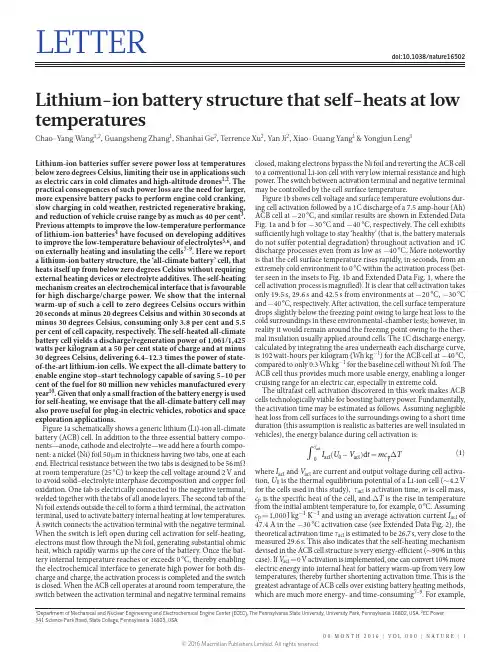
LEttER doi:10.1038/nature16502 Lithium-ion battery structure that self-heats at low temperaturesChao-Yang W ang1,2, Guangsheng Zhang1, Shanhai Ge2, terrence Xu2, Yan Ji2, Xiao-Guang Yang1 & Yongjun Leng1Lithium-ion batteries suffer severe power loss at temperatures below zero degrees Celsius, limiting their use in applications such as electric cars in cold climates and high-altitude drones1,2. The practical consequences of such power loss are the need for larger, more expensive battery packs to perform engine cold cranking, slow charging in cold weather, restricted regenerative braking, and reduction of vehicle cruise range by as much as 40 per cent3. Previous attempts to improve the low-temperature performance of lithium-ion batteries4 have focused on developing additives to improve the low-temperature behaviour of electrolytes5,6, and on externally heating and insulating the cells7–9. Here we report a lithium-ion battery structure, the ‘all-climate battery’ cell, that heats itself up from below zero degrees Celsius without requiring external heating devices or electrolyte additives. The self-heating mechanism creates an electrochemical interface that is favourable for high discharge/charge power. We show that the internal warm-up of such a cell to zero degrees Celsius occurs within 20 seconds at minus 20 degrees Celsius and within 30 seconds at minus 30 degrees Celsius, consuming only 3.8 per cent and 5.5 per cent of cell capacity, respectively. The self-heated all-climate battery cell yields a discharge/regeneration power of 1,061/1,425 watts per kilogram at a 50 per cent state of charge and at minus 30 degrees Celsius, delivering 6.4–12.3 times the power of state- of-the-art lithium-ion cells. We expect the all-climate battery to enable engine stop–start technology capable of saving 5–10 per cent of the fuel for 80 million new vehicles manufactured every year10. Given that only a small fraction of the battery energy is used for self-heating, we envisage that the all-climate battery cell may also prove useful for plug-in electric vehicles, robotics and space exploration applications.Figure 1a schematically shows a generic lithium (Li)-ion all-climate battery (ACB) cell. In addition to the three essential battery compo-nents—anode, cathode and electrolyte—we add here a fourth compo-nent: a nickel (Ni) foil 50 μm in thickness having two tabs, one at each end. Electrical resistance between the two tabs is designed to be 56 mΩat room temperature (25 °C) to keep the cell voltage around 2 V and to avoid solid–electrolyte interphase decomposition and copper foil oxidation. One tab is electrically connected to the negative terminal, welded together with the tabs of all anode layers. The second tab of the Ni foil extends outside the cell to form a third terminal, the activation terminal, used to activate battery internal heating at low temperatures.A switch connects the activation terminal with the negative terminal. When the switch is left open during cell activation for self-heating, electrons must flow through the Ni foil, generating substantial ohmic heat, which rapidly warms up the core of the battery. Once the bat-tery internal temperature reaches or exceeds 0 °C, thereby enabling the electrochemical interface to generate high power for both dis-charge and charge, the activation process is completed and the switch is closed. When the ACB cell operates at around room temperature, the switch between the activation terminal and negative terminal remains closed, making electrons bypass the Ni foil and reverting the ACB cell to a conventional Li-ion cell with very low internal resistance and high power. The switch between activation terminal and negative terminal may be controlled by the cell surface temperature.Figure 1b shows cell voltage and surface temperature evolutions dur-ing cell activation followed by a 1C discharge of a 7.5 amp-hour (Ah) ACB cell at −20 °C, and similar results are shown in Extended Data Fig. 1a and b for −30 °C and −40 °C, respectively. The cell exhibits sufficiently high voltage to stay ‘healthy’ (that is, the battery materials do not suffer potential degradation) throughout activation and 1C discharge processes even from as low as −40 °C. More noteworthy is that the cell surface temperature rises rapidly, in seconds, from an extremely cold environment to 0 °C within the activation process (bet-ter seen in the insets to Fig. 1b and Extended Data Fig. 1, where the cell activation process is magnified). It is clear that cell activation takes only 19.5 s, 29.6 s and 42.5 s from environments at −20 °C, −30 °C and −40 °C, respectively. After activation, the cell surface temperature drops slightly below the freezing point owing to large heat loss to the cold surroundings in these environmental-chamber tests; however, in reality it would remain around the freezing point owing to the ther-mal insulation usually applied around cells. The 1C discharge energy, calculated by integrating the area underneath each discharge curve, is 102 watt-hours per kilogram (Wh kg−1) for the ACB cell at −40 °C, compared to only 0.3 Wh kg−1 for the baseline cell without Ni foil. The ACB cell thus provides much more usable energy, enabling a longer cruising range for an electric car, especially in extreme cold.The ultrafast cell activation discovered in this work makes ACB cells technologically viable for boosting battery power. Fundamentally, the activation time may be estimated as follows. Assuming negligible heat loss from cell surfaces to the surroundings owing to a short time duration (this assumption is realistic as batteries are well insulated in vehicles), the energy balance during cell activation is:∫(−)=Δ()τI U V t mc Td10act0act pactwhere I act and V act are current and output voltage during cell activa-tion, U0 is the thermal equilibrium potential of a Li-ion cell (~4.2 V for the cells used in this study), τact is activation time, m is cell mass, c p is the specific heat of the cell, and ΔT is the rise in temperature from the initial ambient temperature to, for example, 0 °C. Assumingc p= 1,000 J kg−1 K−1 and using an average activation current I act of47.4 A in the −30 °C activation case (see Extended Data Fig. 2), the theoretical activation time τact is estimated to be 26.7 s, very close to the measured 29.6 s. This also indicates that the self-heating mechanism devised in the ACB cell structure is very energy-efficient (~90% in this case). If V act= 0 V activation is implemented, one can convert 10% more electric energy into internal heat for battery warm-up from very low temperatures, thereby further shortening activation time. This is the greatest advantage of ACB cells over existing battery heating methods, which are much more energy- and time-consuming7–9. For example,1Department of Mechanical and Nuclear Engineering and Electrochemical Engine Center (ECEC), The Pennsylvania State University, University Park, Pennsylvania 16802, USA. 2EC Power,341 Science Park Road, State College, Pennsylvania 16803, USA.00M o n t h2016|V o L000|n A t U R E|12 | n A t U R E | V o L 000 | 00 M o n t h 2016Vlahinos and Pesaran 7 computationally showed that battery core heating based on the cell’s internal resistance is more effective than external heating methods. Stuart and Handeb 8 argued that direct- current internal heating is ineffective and instead implemented expen-sive, heavy alternating-current generators for heating. More recently, Ji and Wang 9 thoroughly reviewed a wide range of heating strategies for Li-ion batteries and demonstrated that self-resistive heating from −20 °C to 20 °C takes ~120 s and consumes ~15% battery energy. For heating from −20 °C to 0 °C as in the present context, their cell would require a 60-s heating time and 7.5% energy consumption, much less efficient than the present ACB cell.Another important feature of the ACB cell is high power, imme-diately available after ultrafast activation just as the battery materi-als and electrochemical interfaces reach 0 °C. In Fig. 2a, for −20 °C, −30 °C and −40 °C, a 10-s hybrid pulse power characterization (HPPC) power in watts per kilogram, for both discharge and regen-eration (charge), as a function of depth of discharge is compared to that of a conventional Li-ion cell without Ni foil. At 50% state- of-charge (SOC) or depth of discharge, the power boost over the conventional Li-ion cell is 2.7, 6.4 and 25.1 for −20 °C, −30 °C and −40 °C, respectively, for discharge, and 5.1, 12.3 and 55 for regeneration. Figure 2b plots the specific power versus ambientActivation1,0002,0003,0002.53.03.54.04.55.0C e l l v o l t a g e (V )V cellT cell Time (s)–30–20–100102030T amb = –20 °C Cell temperature (°C)05101520012345V c e ll (V )Time (s)–30–20–10010T cell (°C)abe –e –e –e –e –e –ElectrolyteMetal foilAnodeCathodeL o a d L i+Va c tVel lActivation terminalFigure 1 | The ACB. a , Schematic in which a metal foil is inserted to generate internal heating from a low temperature and to provide fast heat transfer to electrodes and electrolyte. This self-heating function is activated by turning off the switch between the activation terminal and the negative terminal. b , Cell voltage and temperature evolutions duringV act = 0.4 V activation (inset) and subsequent 1C discharge at −20 °C. The battery temperature rises from −20 °C to 0 °C in ~20 s and the 1C discharge thereafter occurs at the ~0 °C battery core temperature rather than the −20 °C ambient temperature.S p e c i c p o w e r (W k g –1)Depth of discharge (%)S p e c i c p o w e r (W k g –1)Ambient temperature (°C)abFigure 2 | Power performance of the ACB cell. a , 10-s HPPC specific power versus depth of discharge, compared to the baseline cell for−20 °C, −30 °C and −40 °C. At 50% SOC, the ACB cell delivers 2.7 times, 6.4 times and 25.1 times the discharge power and 5.1 times, 12.3 timesand 55 times the regeneration power of a baseline cell at −20 °C, −30 °C and −40 °C, respectively. b , 10-s HPPC specific power after activation versus the baseline as function of ambient temperature for 50% and 80% SOC.00 M o n t h 2016 | V o L 000 | n A t U R E | 3temperature for both ACB and baseline cells at 50% and 80% SOC, respectively. The discharge power (black lines in Fig. 2b) of the ACB cell is improved to 1,061 W kg −1 and 1,600 W kg −1 at −30 °C for 50% and 80% SOC, respectively. These power levels are more than 5–6 times the power of the baseline Li-ion cell at the same temperature. Regeneration power at low temperatures is equally impressive for the ACB cell, reaching 1,425 W kg −1 at 50% SOC and 650 W kg −1 at 80% SOC at −30 °C, indicative of unprecedented high charge/regeneration power in the extreme cold. These high power capabilities, readily available after a short activation, open new possibilities for a wide variety of applications where high battery power is critically sought. A few examples are the expedient capture of braking energy in extreme cold where it is most needed, weather-independent fast charging, and high-flying drones at low atmospheric temperatures.For ACB cells to enjoy a dramatic power boost at low tempera-tures, some activation time and energy (or charge) consumption are required. Both can be further managed by exercising a power-on- demand strategy, that is, implementing partial activation to attaina smaller but sufficient power boost. Such experiments are shown inFig. 3a and b under the conditions of −30 °C and 50% SOC, where normalized power, that is, the power of the ACB cell over the base-line, is plotted against the relative activation time. Obviously, for zero activation time or no activation at all, the normalized power is unity. At 100% activation, the normalized power for the ACB cell at −30 °C reaches 6.4 times the discharge power and 12.3 times the regenera-tion power, respectively. However, at a partial activation such as 50%, there are already marked increases in both discharge and regeneration power, as can be seen from Fig. 3a. Figure 3b re-plots the relative acti-vation time and capacity consumption percentage due to activation against the normalized power. It is seen that for a 3-fold power boost, 66% partial activation suffices and the capacity consumption due to cell activation is only 3.2% for heating from the ambient temperature of −30 °C. Therefore, the power-on-demand strategy further reduces the activation time from 30 s to 20 s and also the capacity consumption due to activation from 5.5% to 3.2%, at the expense of having 3-fold power instead of 6.4-fold power.N o r m a l i z e d p o w e rRelative activation time, W /W 0Normalized powerR e l a t i v e a c t i v a t i o n t i m e , W /W 0Capacity consumption (%)abFigure 3 | Power on demand at 50% SOC for 10-s HPPC at −30 °C. a , Normalized power (ACB/baseline) versus relative activation time. τ0 is the time of full activation. b , Relative activation time and percentage capacity consumption due to activation as functions of normalized power. 5.5% energy (the right y -axis) can be exchanged, on demand, for 640% power (the x -axis), or 3.2% energy can be exchanged for 300% power.Figure 4 | ACB cell durability. a , C/3 capacity retention. In the present context, C/3 = (7.5 A)/3 = 2.5 A discharge current. b , 1C charge/discharge curves of fresh cells and cells aged from 45 °C cycling between 2.8 V and 4.15 V . Both capacity retention and charge/discharge curves in aand b are obtained during cell characterization at 25 °C. ACB cells give rise to almost no side effects in high-temperature cycling. c , Cell surface temperature versus time in a series of ten consecutive cycles of activation and cool-down in durability of repetitive activations from T amb = −30 °C. The change in SOC during the ten cycles is also indicated. d , 1C capacity versus number of activations for T amb = 25 °C. The constant-current, constant-voltage charge protocol is constant current at 1C followed by constant voltage at 4.2 V and terminated when the charge current diminishes to C/20. Little degradation exists, even after 500 activations from −30 °C.C a p a c i t y r e t e n t i o n (%)Cycle numberC e l l v o l t a g e (V )Relative capacity (%)–30–20–1001020C e l l t e m p e r a t u r e (°C )Time (min)0204060801001C c a p a c i t y r e t e n t i o n (%)Number of activationsa bc d4 | n A t U R E | V o L 000 | 00 M o n t h 2016To project a further large reduction in activation time, τact , and capacity consumption, Q act /Q o , for future energy-dense electric- vehicle batteries, it follows from equation (1) that if the C-rate, β (which is the dimensionless electric current, relative to the cell capacity, such that in the present context, 1C for a 7.5-Ah cell is equivalent to a discharge current of 7.5 A), during activation is kept constant, the acti-vation time and percentage capacity consumption are proportional to:τβρ=Δ(−)∝−()mc T Q U V V U V 12act p 00act 0act eρ=Δ(−)∝−()Q Q mc T Q U V V U V 13act 0p 00act 0act ewhere ρe is the cell’s energy density and V is the nominal voltage usedin calculating the energy density.Note that both activation time and capacity consumption will drop by half if the energy density is doubled from the current level of 170 Wh kg −1 to a future level of 340 Wh kg −1. The halved activation time and capacity consumption would be at levels of ~10 s and 1.9% for ACB cell activation from −20 °C, a common low-temperature envi-ronment. Further implementing a partial activation based on power demand, it would be possible to keep the ACB activation time within 5 s and capacity consumption within 1%, while still delivering suffi-cient power for a wide range of applications involving cold climates.Existing techniques improve low-temperature power at the expense of greatly deteriorated performance and lifespan at high temperatures. Figure 4a and b shows no additional side effects with high-temperature cycling, and a normal 17% loss of capacity with room-temperature cycling over 2,000 cycles (Extended Data Fig. 3).Finally, we explore cell degradation caused by repetitively activat-ing an ACB cell from −30 °C followed by forced air cool-down. A consecutive ten cycles of activation and cool-down is carried out for an ACB cell, starting with 100% SOC (Fig. 4c). Thereafter, the cell is charged back to 100% SOC at room temperature and with standard constant-current, constant-voltage protocol having a voltage limit of 4.2 V . A total of 500 such activations are carried out, and the cell capacity at room temperature and 1C rate characterized at the end of every ten activation/cool-down cycles is shown in Fig. 4d. The cell capacity fade is less than 7.2% at the end of 500 activations. In a practical electric-vehicle battery pack, once all batteries are heated to a higher temperature, the cool-down timescale usually ranges from several hours to 10–15 h. This implies that cell activation is proba-bly only needed once per day. Assuming 30 days of extreme weather (−30 °C) per year, 500 activations tested in the durability experiment shown in Fig. 4d would be equivalent to about 16 years of operation, meaning battery life is not noticeably decreased by cell activation from subfreezing temperatures.The new material we added into the baseline battery to make it an ACB cell—that is, the Ni foil—weighs about 100 g per kilowatt-hour battery and costs US$0.1 per kilowatt-hour based upon a Ni price of US$10 per kilogram. Compared to the current best specific energy of Li-ion battery systems, which is 150 Wh per kilogram of the bat-tery system, and assuming a battery cost of US$250 per kilowatt-hour (ref. 11), the added weight and cost due to ACB technology are 1.5% and 0.04% of those of the baseline battery.Online Content Methods, along with any additional Extended Data display items and Source Data, are available in the online version of the paper; references unique to these sections appear only in the online paper.received 20 September; accepted 30 November 2015. Published online 20 January 2016.1. Armand, M. & Tarascon, J. M. Building better batteries. Nature 451, 652–657(2008).2. Villasenor, J. High-altitude surveillance drones: coming to a sky near you.Sci. Am. Feb , 24 (2012).3. Extreme temperatures affect electric vehicle driving range, AAA says. http:///2014/03/extreme-temperatures-affect-electric-vehicle-driving-range-aaa-says/ Newsroom (20 March 2014).4. Ji, Y., Zhang, Y. & Wang, C. Y. Li-ion cell operation at low temperatures.J. Electrochem. Soc. 160, A636–A649 (2013).5. Zhang, S. S., Xu, K. & Jow, T . R. A new approach toward improved low temperatureperformance of Li-ion battery. Electrochem. Commun. 4, 928–932 (2002).6. Smart, M. C., Whitacre, J. F., Ratnakumar, B. V. & Amine, K. Electrochemicalperformance and kinetics of Li 1+x (Co 1/3Ni 1/3Mn 1/3)1−x O 2 cathodes and graphite anodes in low-temperature electrolytes. J. Power Sources 168, 501–508 (2007).7. Vlahinos, A. & Pesaran, A. A. Energy efficient battery heating in cold climates.Society of Automotive Engineers (SAE) Technical Paper 2002–01–1975, /2002-01-1975/ (SAE, 2002).8. Stuart, T. A. & Handeb, A. HEV battery heating using AC currents. J. PowerSources 129, 368–378 (2004).9. Ji, Y. & Wang, C. Y. Heating strategies for Li-ion batteries operated from subzerotemperatures. Electrochim. Acta 107, 664–674 (2013).10. Chen, K. et al. Evaluation of the low temperature performance of lithiummanganese oxide/lithium titanate lithium-ion batteries for start/stop applications. J. Power Sources 278, 411–419 (2015).11. Gröger, O., Gasteiger, H. A. & Suchsland, J.-P . Electromobility: batteries or fuelcells? J. Electrochem. Soc. 162, A2605–A2622 (2015).Acknowledgements We thank W. Zhao and C. E. Shaffer for early discussions on using battery simulation software to discover the all-climate battery. This work was inspired by US patent publication numbers 2014-0342194,2015-0303444 and 2015-0104681 and Patent Cooperation Treaty publication numbers WO 2014/186195, WO 2015/102709 and WO 2015/102708.Author Contributions C.Y.W. developed the concept and wrote the manuscript. S.G., T .X., Y. J. and X.G.Y. designed and built the cells, G.Z. built the test stand and carried out the performance characterization, and Y.L. performed the cycle life experiments. All authors contributed to development of the manuscript and to discussions as the project developed.Author Information Reprints and permissions information is available at /reprints. The authors declare competing financial interests: details are available in the online version of the paper. Readers are welcome to comment on the online version of the paper. Correspondence and requests for materials should be addressed to C.Y.W. (cxw31@ or cywang@).MethOdSWe fabricate 7.5-Ah ACB pouch cells using LiNi0.5Co0.2Mn0.3O2 (Umicore) as cathodes and graphite (Nippon Carbon) as anodes with 1 M of LiPF6 dissolved in ethylene carbonate/ethyl methyl carbonate (3:7 by weight) + 2% vinylene carbonate as electrolyte (materials from BASF). The capacity ratio of negative to positive electrode is designed to be 1.2. The 7.5-Ah pouch cell contains a stack of 26 anode and 25 cathode layers. A Celgard-2325 separator of thickness 25 μm is used. A Ni foil sized at 56 mΩ at room temperature is coated with a thin backing material of polyethylene terephthalate (28 μm) for electrical insulation and sandwiched between two single-sided anode layers and the three-layer assembly then stacked in the centre of the cell.The cathodes are prepared by coating N-methylpyrrolidone-based slurry onto 15-μm-thick Al foil, whose dry material consists of NCM523 (92 wt%), Super-P (Timcal) (4 wt%) and polyvinylidene fluoride (Arkema) (4 wt%) as a binder. The anodes are prepared by coating deionized water-based slurry onto 10-μm-thick Cu foil, whose dry material consists of graphite (97.5 wt%), styrene butadiene rubber (Zeon) (1.5 wt%) and carboxymethyl cellulose (Dai-Ichi Kogyo Seiyaku) (1 wt%). Each ACB pouch cell has a 152 mm × 75 mm footprint area, weighs 160 g, and has a nominal capacity of 7.5 Ah with a specific energy of 170 Wh kg−1 and an energy density of 327 Wh per litre. The discharge performance of the ACB cell at room temperature without activation is shown in Extended Data Fig. 4 as a function of the C-rate.We denote the voltage between the positive and negative terminals as cell voltage, a potential window encompassing all battery materials. Additionally, we denote the voltage between the positive and activation terminals as V act for the activation process only. For any subzero operation, cell activation is first carried out by a constant-voltage, constant-current protocol where constant volt-age means that V act is set at 0.4 V until the current reaches and is limited at 60 A (that is, 8C). Cell activation is terminated when the cell temperature reaches —5 °C as measured by a thermocouple placed at the centre of the cell’s outer surface. A 10-s rest is given between the end of activation and cell loading for equilibrium, during which the cell surface temperature usually continues to rise to 0 °C. Hence, cell activation described in the present work is designed to bring the battery core temperature to or above the freezing point from any subzero ambient environment. Prior to any subfreezing tests, an ACB cell is soaked in the environmental chamber for 8–12 h to reach thermal equilibrium with the ambient temperature.Two types of cell discharge are performed in the present work. One is 1C dis-charge with a cutoff voltage of 2.8 V and the other is 10-s HPPC in which at a given SOC level, a 10-s charge pulse is applied at V max= 4.2 V, followed by a 40-s rest and a discharge pulse at V min= 2.8 V. The discharge and charge (or regeneration) power, in watts per kilogram of the battery cell is calculated as the product of constant voltage and average current in the 10-s discharge and charge pulses, then divided by the cell weight.Extended Data Figure 1 | Cell voltage and temperature evolution during activation and subsequent 1C discharge. a, −30 °C. b, −40 °C. The insets show the V act= 0.4 V activation more clearly.Extended Data Figure 2 | Cell current variations during activation. a, −20 °C. b, −30 °C. c, −40 °C. d, Activation time τact and average activation current I act versus the ambient temperature T amb.Extended Data Figure 3 | 1C charge/2C discharge cycling of ACB cell at room temperature between 2.8 V and 4.2 V. a, C/3 capacity retention. b, 1C charge/discharge curves of the fresh and aged cells.Extended Data Figure 4 | ACB cell discharge with various C-rates of discharge and at room temperature.。

银行柜员工作总结11篇银行柜员工作总结 1____年,我满怀着对金融事业的向往与追求走进了____支行,在这里我将释放青春的能量,点燃事业的梦想。
时光飞逝,来__支行已经一个年头了,在这短短的一年中,我的人生经历了巨大的变化,无论是工作上,学习上,还是思想上都逐渐成熟起来。
在__支行,我从事着一份最平凡的工作--柜员。
也许有人会说,普通的柜员何谈事业,不,柜台上一样可以干出一番辉煌的事业。
卓越始于平凡,完美源于认真。
我热爱这份工作,把它作为我事业的一个起点。
作为一名农行员工,特别是一线员工,我深切感受到自己肩负的重任。
柜台服务是展示农行系统良好服务的"文明窗口",所以我每天都以饱满的热情,用心服务,真诚服务,以自己积极的工作态度羸得顾客的信任。
是的,在农行员工中,柜员是直接面对客户的群体,柜台是展示农行形象的窗口,柜员的日常工作也许是繁忙而单调的,然而面对各类客户,柜员要熟练操作、热忱服务,日复一日,用点点滴滴的周到服务让客户真正体会到农行人的真诚,感受到在农行办业务的温馨,这样的工作就是不平凡的,我为自己的岗位而自豪!为此,我要求自己做到:一是掌握过硬的业务本领、时刻不放松业务学习;二是保持良好的职业操守,遵守的法律、法规;三是培养和谐的人际关系,与同事之间和睦相处;四是清醒的认识自我、胜不骄、败不馁。
参加工作以来,我立足本职岗位,踏实工作,努力学习业务知识,向有经验的同事请教,只有这样,才能确确实实干出能经得起时间考验的业绩。
点点滴滴的小事让我深刻体会到,作为一名一线的员工,注定要平凡,因为他不能像冲锋陷阵的战士一样用满腔的热血堵枪口,炸碉堡,留下英雄美名供世人传扬,甚至不能像农民那样冬播夏收,夏种秋收,总有固定的收获。
有的只是日复一日年复一年的重复那些诸如存款、取款,账务录入,收收放放,营销维护,迎来送往之类的枯燥运作和繁杂事务。
在这平凡的岗位上,让我深刻体会到,伟大正寓于平凡之中,平凡的我们一样能够奉献,奉献我们的热情,奉献我们的真诚,奉献我们的青春。