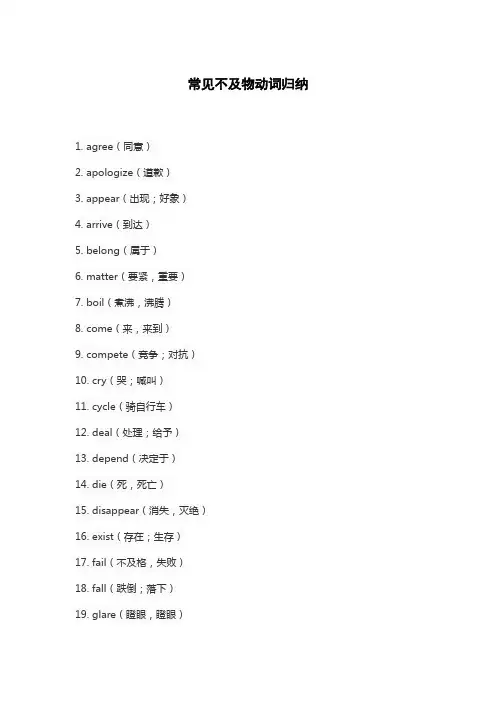
常见不及物动词及搭配
- 格式:docx
- 大小:39.08 KB
- 文档页数:12
常见的不及物动词
op erate vi. 动手术vt. 操作
常用的不及物动词
appear ,Appear calm come,Come easy (safe) go ,Go mad (crazy, bad,
sour, wrong, crazy, hungry, blind)
,Get angry (ill, wet, excited, married, paid)
,Fall asleep( fall ill, fall short, fall flat)
agree, go, work, liste n, look, come, die,
bel ong, fall, exist, rise, arrive, sit,
sail, hurry, fail, 常见的及物动词兼不及物动词
beatvi. 跳动 vt.敲、打;
grow vi. 生长vt.种植
p lay vi. 玩耍vt.打(牌、 球),演奏
smell vi.
feel ,Feel good (sleepy)
kee p ,Keep quiet (silent) 发出(气味)vt.
ring vi. (电话、铃)响vt.打电话
sp eak vi. 讲话vt.说(语言)
hang vi. 悬挂vt.绞死
get
fall look , Look fit (well, young, tired)
make Make certa in (sure, ready, a good teacher)
prove ,Prove an effective method (correct, accurate)
remain ,Rema in still (un cha nged)
rest , Rest satisfied (content)
rise , Rise red
seem , Seem happy
stand , Stand still
stay , Stay young (stay fresh, the same)
turn , Turn teacher =become a teacher (yellow)
turn out , Turn out true
常见不及物动词搭配
down (stop functioning 坏了,不好使了 )
That old Jee p had a tendency to break dow n just whe n I n eeded it the most.
on (become popu lar 出名)
Popu lar songs seem to catch on in California first and the n
spr ead eastward.
3. come back ( retu rn to a p lace
Father promised that we would never comeback to this horrible place.
4. come in ( En ter 进入)
They tried to comein through the back door, but it was locked.
to ( regain consciousness 恢复意识)
He was hit on the head very hard, but after several minu tes, he started to come to aga
in.
over (to visit 访问)
The childre n pro mised to come over, but they n ever do.返回) by (visit without appoin tme nt 顺便拜访)
Weused to just drop by, but they were never home, so we stopped
doing that.
out (di ne in a restaura nt
Whe n we visited P aris, we loved eat ing out in the sidewalk cafes.
9. get by ( survive 凑合,过得去)
Un cle Heine did n't have muchm on ey, but he always seemedto get by without borrow ing
money from relatives.
up ( Arise 起床)
Grandmother tried to get up, but the couch was too low, and she
could n't make it on her own.
11. go back ( retu rn to a p lace
It's hard to imagi ne that we will ever go back to Lithua nia.
on ( Con ti nue 继续)外出吃饭)
回到)
He would finish one Dicke ns no vel and the n just go on to the
next.
13. go on ⑵(Ha ppen 发生)
The cops heard all the no ise and stopped to see what was going
on.
14. grow up ( get older 变老)
Charles grew up to be a lot like his father.
away ( rema in at a dista nee 保持距离)
The judge warned the stalker to kee p away from his victim's
home.
16. kee p on (+ 动名称)(con ti nue with the same
He tried to kee p on singing long after his voice was ruined.
17. p ass out ( lose con scious ness, faint 昏过去,晕)
He had drunk too much; he p assed out on the sidewalk outside
the bar.
18. show off ( dem on strate haughtily 炫耀)
Whenever he sat downat the piano, we knew he was going to show off.
19. show up( Arrive 到达,出现)
Day after day, Efrain showed up for class twenty minutes late.
20. wake up (arouse from slee p 醒来)
I woke up whe n the rooster crowed.
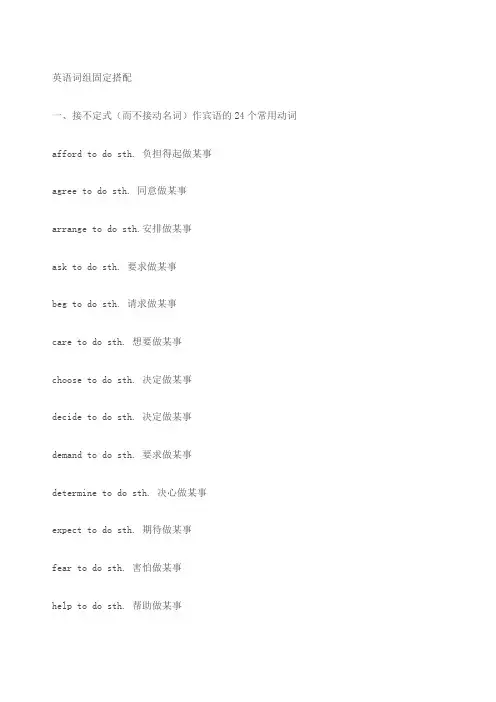
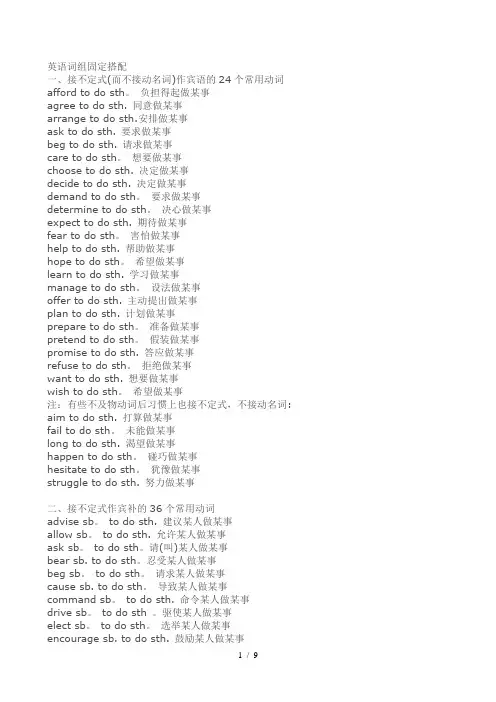
接不定式(而不接动名词)作宾语的24个常用动词
afford to do sth. 负担得起做某事
agree to do sth. 同意做某事
arra nge to do sth. 安排做某事
ask to do sth. 要求做某事
beg to do sth. 请求做某事
care to do sth. 想要做某事
choose to do sth. 决定做某事
decide to do sth. 决定做某事
dema nd to do sth. 要求做某事
determ ine to do sth. 决心做某事
expect to do sth. 期待做某事
fear to do sth. 害怕做某事
hel p to do sth. 帮助做某事