
英语课程表
- 格式:xlsx
- 大小:9.85 KB
- 文档页数:2
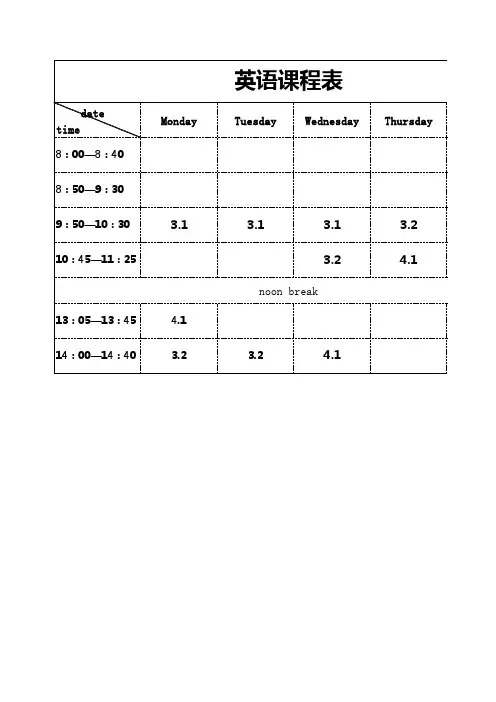

英语课程表介绍稿范文Good morning, everyone. I would like to take this opportunity to introduce our English course schedule for the upcoming semester.Our English curriculum is designed to provide a comprehensive and immersive learning experience that focuses on improving students' proficiency in reading, writing, speaking, and listening. We believe that a well-rounded language education is essential for students to succeed in today's globalized world.The course schedule is divided into different levels, catering to students with varying proficiency in English. We offer beginner, intermediate, and advanced levels, ensuring that each student is placed in the appropriate class that best suits their current language abilities.In our beginner level classes, students will be introduced to basic vocabulary, grammar, and sentence structures. Emphasis will be placed on building a strong foundation in English language skills, including reading and writing simple sentences, and conversing in everyday situations.For our intermediate level students, the focus will be on expanding vocabulary, improving reading comprehension, and honing writing skills. Additionally, students will be encouraged to engage in more discussions and debates to enhance their speaking and listening abilities.In the advanced level classes, students will delve into more complex topics and texts, further refining their language proficiency. They will be challenged to articulate their thoughts and opinions more effectively, while also enhancing their critical thinking and analytical skills through in-depth discussions and writing assignments.In addition to the core language classes, we also offer specialized courses such as Business English, Academic Writing, and English Literature for those who wish to explore specific areas of interest.Furthermore, our course schedule includes regular language practice sessions, where students can engage in conversational activities and language games to reinforce their learning and improve fluency.Overall, our English course schedule is designed to provide a well-rounded and engaging learning experience that will equip students with the language skills they need to succeed in academics, career, and life.Thank you for your attention, and we look forward to seeing you in our English classes.。

课程表英语单词课程表英语单词是我们在日常学习和生活中经常需要用到的,因为只有了解这些单词,才能方便地查询、理解和记忆课程表。
所以,本文将围绕课程表英语单词展开详细的讲解,帮助大家掌握这些重要单词。
第一步:基本课程表英语单词首先,我们来了解一些基本的课程表英语单词,如:Monday(星期一)、Tuesday(星期二)、Wednesday(星期三)、Thursday(星期四)、Friday(星期五)、Saturday(星期六)、Sunday(星期日)。
这些单词是课程表中时间及日期的基础。
第二步:课程表课程名称相关单词其次,我们要了解与课程名称相关的单词,如:course(课程)、class(班级)、lesson(课程)、subject(学科)、teacher(老师)、period(学时)、credit(学分)等。
这些单词不仅在课程表中常用,也是学习生活中必须掌握的基本词汇。
第三步:具体学科的英语词汇除了基本的课程表英语单词外,我们还需要学习各个具体学科相关的英语词汇。
例如,在数学课程中,我们需要掌握一些诸如algebra (代数)、geometry(几何)等单词;在物理课程中,需要学习force (力)、energy(能量)、magnetism(磁力)等词汇。
了解这些单词,不仅可以方便我们理解课程内容,还可以帮助我们更好地进行学习和记忆。
第四步:时间表中的单词最后,课程表中还有许多与时间相关的单词需要我们掌握,如:morning(早上)、afternoon(下午)、evening(晚上)、break(休息)、lunch(午饭)、dinner(晚饭)等。
了解这些单词,可以帮助我们更好地安排课程,更好地控制时间。
总结通过以上分步骤的讲解,相信读者已经对课程表英语单词的掌握有了更深入的了解。
无论是在学习还是日常生活中,这些单词都是不可或缺的。
建议大家可以通过多读多写来加深对这些单词的理解和记忆,以便更好地掌握它们,提高英语水平。

课程表英语Course schedule in EnglishIntroduction:A course schedule, sometimes referred to as a timetable or class schedule, is a document that outlines the specific times and dates for classes, lectures, and other academic activities. It serves as a guide for students and helps them manage their time effectively. In this document, we will provide a sample course schedule in English to help students familiarize themselves with the format and language commonly used in course schedules.Course Schedule:Monday:9:00 am - 10:30 am: English Composition10:45 am - 12:15 pm: Mathematics for Business12:30 pm - 1:30 pm: Lunch Break1:30 pm - 3:00 pm: History of ArtTuesday:9:00 am - 10:30 am: Introduction to Psychology 10:45 am - 12:15 pm: Digital Marketing12:30 pm - 1:30 pm: Lunch Break1:30 pm - 3:00 pm: Chemistry LabWednesday:9:00 am - 10:30 am: English Literature10:45 am - 12:15 pm: Introduction to Business 12:30 pm - 1:30 pm: Lunch Break1:30 pm - 3:00 pm: PhysicsThursday:9:00 am - 10:30 am: Cultural Anthropology 10:45 am - 12:15 pm: Public Speaking12:30 pm - 1:30 pm: Lunch Break1:30 pm - 3:00 pm: Biology LabFriday:9:00 am - 10:30 am: Music Appreciation10:45 am - 12:15 pm: Statistics12:30 pm - 1:30 pm: Lunch Break1:30 pm - 3:00 pm: Business EthicsExplanation:The course schedule provided above includes a typical week of classes for a college student. Each day is divided into four time slots: the morning session, the lunch break, the early afternoon session, and the late afternoon session.On Mondays, the day begins with English Composition from 9:00 am to 10:30 am, followed by Mathematics for Business from 10:45 am to 12:15 pm. After a one-hour lunch break, the afternoon session continues with a class in History of Art from 1:30 pm to 3:00 pm.Tuesdays start with Introduction to Psychology in the morning, followed by Digital Marketing. The chemistry lab is scheduled for the afternoon session.Wednesdays feature English Literature in the morning, followed by Introduction to Business. The afternoon session is reserved for a class in Physics.On Thursdays, Cultural Anthropology is scheduled in the morning, followed by Public Speaking. The biology lab takes place in the afternoon.Fridays begin with a class in Music Appreciation, followed by Statistics. The day concludes with a session on Business Ethics.Conclusion:Having a well-organized course schedule is essential for students to effectively manage their time and stay on top of their academic commitments. The provided sample course schedule in English aims to familiarize students with the language commonly used in course schedules and help them better plan their study routines. It is important for students to regularly refer to their course schedules and make adjustments as necessary to ensure they are attending the right classes at the right times.。

一重症调理severe disease treatment二体质调理。
constitution recuperation三颈椎病cervical osteoarthritis腰椎病lumbar spondylitis肩周炎scapulohumeral periarthritis风湿,类风湿rheumatic diseases牛皮癣psoriasis神经性皮炎neurodermation dermatitis男科调理male disease妇科调理female disease痛经调理dysmenorrhea recuperate空调病调理air-condition disease心梗调理myocardial infarction脑梗调理cerebral infarction肠胃病调理gastrointestinal infarction糖尿病diabetes康复调理范围scope of rehabilitation nursingUnit One Hello, Hi!Section I Talking Face to FaceSection II Being All EarsSection III Trying Your HandSection IV Maintaining a Sharp EyePassage I The Business Card: a Social Faux PasPassage II How to Say Hello in Different Languages Section V Appreciating Culture TipsUnit Two Saying Thanks or SorrySection I Talking Face to FaceSection II Being All EarsSection III Trying Your HandSection IV Maintaining a Sharp EyePassage I Thank you, Volunteers!Passage II How Can You Say “Sorry” and Really Mean It? Section V Appreciating Culture TipsUnit Three Road Signs and CommutingSection I Talking Face to FaceSection II Being All EarsSection III Trying Your HandSection IV Maintaining a Sharp EyePassage I Funny Road Signs from Around the World! Passage II How Do You Commute to Work?Section V Appreciating Culture TipsUnit Four Punctuality and CultureSection I Talking Face to FaceSection II Being All EarsSection III Trying Your HandSection IV Maintaining a Sharp EyePassage I Punctuality Pays!Passage II Are you punctual?Section V Appreciating Culture TipsUnit Five Our Weather and ClimateSection I Talking Face to FaceSection II Being All EarsSection III Trying Your HandSection IV Maintaining a Sharp EyePassage I We Can Make a DifferencePassage II The British Like Talking About the Weather Section V Appreciating Culture TipsUnit Six Olympics and SportsSection I Talking Face to FaceSection II Being All EarsSection III Trying Your HandSection IV Maintaining a Sharp EyePassage I Dancing BeijingPassage II Closing Speech by Jacques RoggeSection V Appreciating Culture TipsUnit Seven Holiday CelebrationsSection I Talking Face to FaceSection II Being All EarsSection III Trying Your HandSection IV Maintaining a Sharp EyePassage I Christmas Celebrations Around the World Passage II When I Was in AmericaSection V Appreciating Culture TipsUnit Fight From Fat to FitSection I Talking Face to FaceSection II Being All EarsSection III Trying Your HandSection IV Maintaining a Sharp EyePassage I Don’t Wait Until Death Does Its Part Passage II The Loving Heart Will Go OnSection V Appreciating Culture Tips。