外研社八年级上册 Module4Unit 1
- 格式:ppt
- 大小:4.19 MB
- 文档页数:51

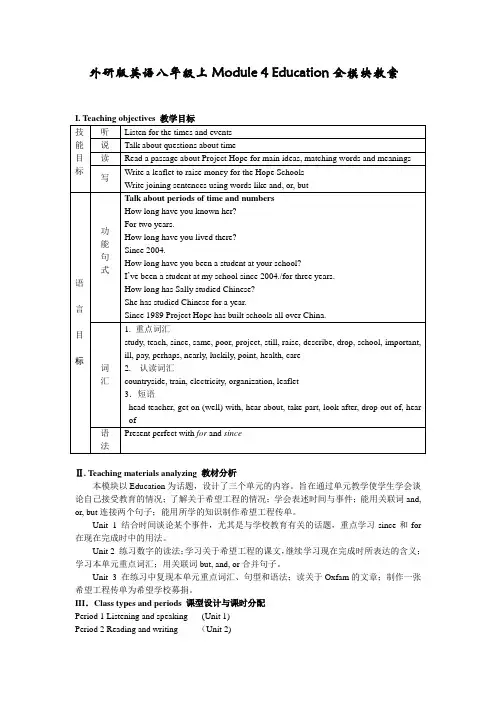
外研版英语八年级上Module 4 Education全模块教案Ⅱ. Teaching materials analyzing 教材分析本模块以Education为话题,设计了三个单元的内容。
旨在通过单元教学使学生学会谈论自己接受教育的情况;了解关于希望工程的情况;学会表述时间与事件;能用关联词and, or, but连接两个句子;能用所学的知识制作希望工程传单。
Unit 1 结合时间谈论某个事件,尤其是与学校教育有关的话题,重点学习since和for 在现在完成时中的用法。
Unit 2 练习数字的读法;学习关于希望工程的课文,继续学习现在完成时所表达的含义;学习本单元重点词汇;用关联词but, and, or合并句子。
Unit 3 在练习中复现本单元重点词汇、句型和语法;读关于Oxfam的文章;制作一张希望工程传单为希望学校募捐。
III.Class types and periods 课型设计与课时分配Period 1 Listening and speaking (Unit 1)Period 2 Reading and writing (Unit 2)Period 3 Language in use (Unit 3)ⅣTeaching plans for each period分课时教案Period 1 Listening and speakingTarget language 目标语言1. Words & phrases生词和短语study, teach, since, same, poor, project, get on (well) with, hear of2. Key sentences重点句子How long has Ms. James been a teacher? Since 1998.How long have you studied Chinese? For a year.She’s studied it for a year.It is easier to learn a foreign language when you visit the country.In fact, since 1989 Project Hope has built schools all over China.Ability goals 能力目标Enable students to listen to and talk about time and events.Teaching important/difficult points 教学重难点How to listen to and talk about time and events, using the Present Perfect Tense with since and for. Teaching aids教具准备A projector or some pictures a tape recorderTeaching procedures and ways教学过程与方式Step I Lead-inIn this procedure, present the word since and the sentence how long…? Give students a brief introduction to the sentence pattern and the word since in the present perfect.T: Hello. Boys and girls. Nice to see you again.S: Nice to see you.Draw a picture of a teacher on the blackboard to present the word since and how long…?T: Look at the blackboard, this is Mr. Li. He became an English teacher in 1998. He has taught English since 1998.Write the word since on the blackboard. Ask students to repeat. Make sure students understand the meaning of the word.T: What does since mean? It means from 1998 to the present time.Then ask the students: How long has he been a teacher?Help them to answer: He has been a teacher for eight years.Write the sentence on the blackboard.How long has he been an English teacher?He has been an English teacher since 1998. / He has been an English teacher for eight years.Ask the students to read the sentences. Then check some pairs to read the sentences.Step II Pair workIn this procedure, create certain situations for students to practise since and how long…?Show another two pictures with a foreigner named Mr. James with 2001 and a student with 2002 on them. Ask students to practice the word since and How long…? by doing pair work. First make a model with an individual.Sample conversation:T: How long has Mr. James lived in China?S: He has lived in China since 2001.Step III Listening and pair workIn this procedure, students will learn to talk about the “years” and activities. Ask them to listen to the conversation and match the years and activities correctly. Pay attention to the present perfect tense and how long…?T: Boys and girls, how long have you studied English?S: We have studied English since 2002.T: Very good. Look at part one of your textbooks. You can see some years above and some activities below. Two people are talking about the years and the activities. Look at the first year 1995. What happened? Can you guess? Now I’ll play the recording. For the first tine, just listen.Match the years and activities when you listen again.Check the answers with some pairs. Then ask some pairs to repeat the six activities using the word since and how long…?Sample conversation:S1: How long has Ms. James been a teacher?S2: She has been a teacher since 1998./Since 1998.Step IV Listening and readingIn this procedure, students will listen and read a dialogue, then they will answer some questions and do some exercises to find further information. At the same time, they will learn some new words and expressions.(1) Present the new words poor, project, foreign, difficult, get on well with, really, etc. Stress these words when talking to the students.T: OK. Let me tell you something about my friend Sally. I have known her since 2004 for two years. I haven’t met her, but I get on well with her because we love the same things. She can speak a little Chinese, but it’s really difficult to learn a foreign language. Sally wants to visit a school of Project Hope, a school for poor children.Read slowly to make sure the students understand the meaning of each word and write the new words and expressions on the blackboard. Ask the students to repeat.(2) Listen to the recording and answer the questions.T: Betty and Lingling are talking about my friend Sally. Now listen and find out what they are talking about. Books closed.After a few minutes.T: Have you got it? Now look at part 4, and then work in pairs, and ask and answers questions.One asks and the other answers. Then you’ll show your answers to the class.Sample conversation:S1: How long has Lingling known Sally?S2: Lingling has known Sally for two years.S1: Does she still know her?S2: Yes, she does.…Check some pairs of students. Then come to Activity 6. Ask students to read the conversation and complete the sentences.A few minutes later, check the answers.T: Have you finished? First, let’s do some chain work to check your answers. You’ll read thesentences in order from line one to line six.S1: Lingling knows Sally quite well, but she hasn’t met her.S2: Sally and Lingling get on well because they like the same things.S3: Sally hasn’t been to China, so speaking Chinese is difficult for her.S4: Sally is coming to China because her school orchestra has some concerts.S5: She has heard about the Hope School, so she wants to visit a school in Gansu or Qingdao.S6: Since 1989 Project Hope has built schools all over China.Step V DiscussionIn this procedure, practice the words and expressions in Activity 5.T: We have known something about Sally in the dialogue. You must want to know something about your friend. Now le t’s look at part five, imagine you are a reporter, you’ll ask your friend some questions. Work in pairs! Start!Sample conversation:S1: What do you find difficult in learning English?S2: I find new words difficult in learning English.S1: How many foreign countries have you visited?S2: I have visited three foreign countries.…Check the answers. Ask some pairs to make a dialogue in the front of the class.Step VI Pronunciation and speakingIn this procedure, encourage students to talk about themselves using how long… and since, for. T: Today, we have studied the word since and the sentence how long…? Now, let’s come back.Look at Activity 7. You’ll listen to some sentences and repeat.Play the tape recorder twice, give students a few minutes to read the sentences by themselves.T: Work in groups of four, asking and answering questions on your own activities. One of you asks and the others answer, then change your turns.Sample conversation:S1: How long have you studied English?S2: I have studied English for 3 years since 2003./Since 2003. How long have you lived here?S3: I have lived my hometown for 14 years since 1992. /Since 1992. How long have you been a student at our school?S4: I have been at this school for 2 years since 2005./Since 2005. How long have you known your best friend?S1: I have known my best friend for 4 years since 2002.…Check some groups. Then ask students to complete Activity 8.Step VII Homework1. Ask the students to learn the new words and expressions in this unit.2. Ask the students to finish the exercises in Grammar part on P124 in the workbook.Period 2 Reading and writingTarget language 目标语言1. Words & phrases生词和短语still, raise, describe, drop, drop out of school, important, ill, look after, pay, hear of, perhaps, take part, countryside, train, electricity2. Key sentences重点句子His parents have been ill and he has to look after them.With this money, Project Hope has built many schools and libraries.Most people in China have hear of Project Hope and have given money.Ability goals 能力目标Enable students to talk about numbers and Project Hope.Teaching important/difficult points 教学重难点How to talk about numbers and Project Hope.Teaching aids教具准备A projector or some pictures and some small pieces of paper and a tape recorder.Teaching procedures and ways教学过程与方式Step I Revision and lead inIn this procedure, review the usage of “since / for” and “how long”. Then begin with Activity 1 of this unit.T: Yesterday we have known something about Sally and Betty and Project Hope. I have some small pieces of paper with some questions on them. I’ll give them to some students and they will read the questions. The others will answer the questions as quickly as possible, OK?. Sample conversation:S1: How long has Sally known Lingling?S2: For two year.Ask a question about Project Hope and lead in this unit.T: Well, one more question. How long has the Project Hope built schools all over China?S: Project Hope built schools all over China for 15 years since 1989.T: Right. Do you want to know something more about Project Hope?S: Yes.T: OK. Let turn to page at 28 and look at Activity One.Step II Read the numbersIn this procedure, students will learn to read the numbers to talk about some facts of Project Hope. Encourage students to read the numbers by themselves.T: The Project Hope has raised, that is, collected, much money for poor students.Write the word raise on the blackboard and tell the students its meaning.T: Look at the form in activity 1. Try to read these numbers.Ask some students to try to read them. Then help them to find out how to read numbers.T: How do you read 15, 500, 156?S: Fifteen million, five hundred thousand, one hundred and fifty six.T: Well done. When you read numbers, you should first divide every three figures as a group by using a comma. When you read the last three figures, add a thousand; the next three, add a million, and …Ask students to practice reading the numbers.Step III Pair work (1)In this procedure, do some pair work to practice Present Perfect tense and talk about numbers. T: These numbers tell us some facts about the Project Hope. Work in pairs, ask and answer questions according to this form. Pay attention to the tense.Sample conversation:S1: How much money have they raised?S2: They have raised 15, 500, 156 yuan.S1: How many students have they helped?S2: They have helped 4, 178 students.S1: How many schools have they built?S2: They have built 56 schools.S1: How many people have taken part?S2: 294, 006 people have taken part.Ask students to do pair work following the sample. Then check some pairs’ work.Step IV ReadingIn this procedure, present the passage by using a picture. Then ask students to read the passage to find the main idea. Make sure they will learn the new words and expressions. Read the passage carefully.T: People often say the Project Hope is a life boat in a sea of need. It has helped many poor students to go back to school. Let’s look at the picture on page 28. This boy had to drop out of school because his family is very poor. The Project Hope helped him and paid for their education. The Project Hope has built many schools and trained some teachers.Write the new words and expressions help, pay for, train, and drop out of school on the blackboard.T: OK. Do you want to know more about the Project Hope? Let’s come to the passage Hope for the future. Read the passage quickly. After reading, please choose the main idea and discuss with your partner.After a few minutes.T: What is the main idea of the passage?S: Helping poor children go to school.T: You are right. When you want to find out the main idea, you should pay attention to the title and read the first paragraph or the last paragraph carefully, because the main idea often lies at the beginning or at the end of the passage. Now close your books. Le t’s listen to the recording of the passage.Play the tape recorder once. Encourage students to ask and answer questions in pairs.Sample conversation:S1: Did Liu Sanzi finish studying?S2: Yes, he did.Then play the tape recorder again, and ask them to check their answers by themselves.Ask students to read the passage for the third time and underline the new words and expressions. Deal with Activity 4 by doing a competition as follows:T: I’ll read a word or an expression. If you know its meaning, please read the meaning as quickly as you can. Ready? First, drop out of school.S1: to leave before you’ve finished studying…Ask students to practice in pairs. Make sure they are familiar with the words and meanings.Step V Pair work (2)In this procedure, do some group work to make the students understand the words and expressions and use them correctly.T: Look at Activity 5. There are some new words and expressions in this passage. What do they mean? Please read the passage quickly and underline them. And then read these sentences loudly and try to remember the words and expressions.Do group work to make the students use them correctly in real situations.T: Let’s work in pairs, and ask and answer questions about your own activities. One asks and the other answers, then exchange the roles.Sample conversation:S1: Who looks after you when you’re ill?S2: My mother looks after you when you’re ill.Check some pairs.Step VI WritingIn this procedure, help students learn the conjunctions like and, or and but. Make sure they know the functions of the three words. Help them make some sentences using these three words.T: Sometimes we have to speak a long sentence. It’s necessary to join two sentences. At this time, we often use conjunctions like and, or and but. Le t’s look at Activity 6 and read the sentences. After you finish, please think over a question: When should we use these tree words?Help students say the usage of these three words in Chinese. We use and in an affirmative sentence; or in a negative sentence; but shows the opposite.T: Now, work in groups of four. Let’s make some sentences with and, or and but. We’ll see which group can make the most sentences.Sample sentences:I like play basketball and football, but I don’t like volleyball. I don’t like tennis or table tennis. T: Now, please write the sentences you have made in your exercise-books.Step VII DiscussionIn this procedure, ask students to talk about their own education. Then practise writing by joining these sentences together, using words like and, or and but.T: In this lesson, we have known something more about Project Hope. Now, let’s talk about your own education. Discuss the questions and answers in Activity 7.Sample conversation:S1: Have you learnt a lot of English?S2: No, I haven’t learned a lot of English.Ask students to work in groups, and ask and answer these questions. Then ask them to try to write the answers together to form a short passage.Step VIII HomeworkAsk students to1.Write some sentences using and, or and but.2.finish the exercises 5—10 on pages 125 and 126 in the workbook.Period 3 Language in useTarget language 目标语言1. Words & phrases生词和短语nearly, luckily, point, health, care, organization, leaflet2. Key sentences重点句子How long have you studied Chinese? For a year.How long have you lived here? Since 2004.She’s studied it for a year.Since 1989 Project Hope has built schools all over China.Ability goals 能力目标Enable students to use Present Perfect with since and for.Teaching important/difficult points 教学重难点Learn the usage of Present Perfect with since and forTeaching aids教具准备Some pictures and a tape recorder.Teaching procedures and ways教学过程与方式Step I RevisionIn this procedure, check the homework as a review of Unit 2.Have a dictation of some new words and expressions.Ask some students to read sentences with and, or and but they have made.Step II GrammarIn this procedure, review the important points of this module. Ask students to do group and pair work and make short conversations to practise the present perfect tense with since and for.T: Work in groups of six, asking and answering questions in activity 1. You’d better choose a reporter and he will ask the rest of five some questions. The reporter will write the names and at last, he will make a report to the class.Sample conversation:S1: Wang Tong, have you been to England?S2: No, I haven’t.S1: Li Hui, have you been to England?S3: Yes, I have.S1: OK. I’ll write your name. Next question. Have you worn glasses for more than three years?S4: No I haven’t…Ask some groups to make a conversation. Then ask the reporter to make a report.Sample report:S1: Wang tong hasn’t been to England, but Li Hui has been to England. Li Ming has worn glasses for more than three years…T: Well done. In this module, we have learnt Present Perfect with since and for. Now work in pairs. Write a short conversation using the questions in activity 4.Sample conversation:S1: How long have you known your teacher?S2: I have known my teacher for three years since 2003.Ask some pairs to ask and answer questions in the front of the class. Then ask them to write the conversation down and check the work with each other.Step III ListeningIn this procedure, ask students to listen to the tape first, and then answer the questions in activity 7.T: Books closed! We’ll listen to the taper recorder. Please listen carefully and answer some questions.After listening, ask some pairs to ask and answer the questions in activity 7.S1: How long has Charlie lived in Beijing?S2: Since…/For…Then ask them to listen again, and help to check their answers.Step IV PracticeIn this procedure, ask the students to do some exercises to make sure they have understood and grasped the important points of Present Perfect with since and for and how long pattern.Ask students to do activities 2—9 on their own. Then check the answers with the class.Step V Module taskIn this procedure, ask students to practise writing a leaflet to raise money for the Hope Schools. First ask students to read about Oxfam.T: Do you know Oxfam? What does it do? Let’s read Around the world and find out.Give the students some minutes to read this passage and think about the main idea.Check the answers.T: Well. We’ve known much about Project Hope and Oxfam. If we want to raise money for Project Hope, Oxfam can help a lot, right?S: Yes.T: And do you want to do something for it? Now let’s write a leaflet to raise money for it. Read the instructions in activities 10, 11 and 12 first.Things Project Hope can do:1.bring hope to people with difficulties and to their families.2.offer help to persons of all special needs, ages and places.3.talk to and keep in touch with persons with a special need or in great trouble.Things Project Hope has done:1.helped many children go back to school.2.given health care to people all over the world.3.helped train the health workers.Sample leaflet:The Project Hope offers help to poor children with difficulties receiving education. Now we arebuilding another Hope School. And we are now raising money for it. We hope you can help. Your help will ensure 3,000 school-age children return to school.Many thanks!Volunteers of Class 107Step VII HomeworkAsk students to1. review this Module.2. finish the rest exercises in the workbook.Teaching resources教学资源库I. 重点知识详解(1) 现在完成时中的for和sincefor和since是现在完成时重要的标志,这两个词区别在于:for后接表示一段时间的状语;since后接表示一个时间点的状语。

2020年外研版英语八年级上册Module 4 Planes, ships and trains教学课题:Module 4 Planes, ships and trainsUnit 2 What is the best way to travel?项目设计内容备注课时第 1 课时课型阅读课教具Tape recorder,OHP教学目标知识与能力To understand the passage on travel and transportation。
Tobe able to understand specific information in a textKey vocabulary: jouney, park, outside, however, costKey structures:The more information, the better.And it takes you about twelve hours to get there. It is thefastest and the second cheapest…过程与方法Interactive and communicative approach态度与情感通过学习,使学生能够比较各种交通方式,流利地和他人交流。
重点 1.本单元单词和短语。
2.形容词和副词的比较级及最高级的用法。
难点理解形容词和副词的比较级及最高级的用法。
教学手段方法Communicative教学过程教师活动学生活动说明或设计意图1.Warming up.Revision:How do yougo to school?2.Learn some new words.Look at the blackboard,Answer the questions.Look and say. Look at the blackboard,prounce, and spell read the words.让学生熟悉生词和短语。