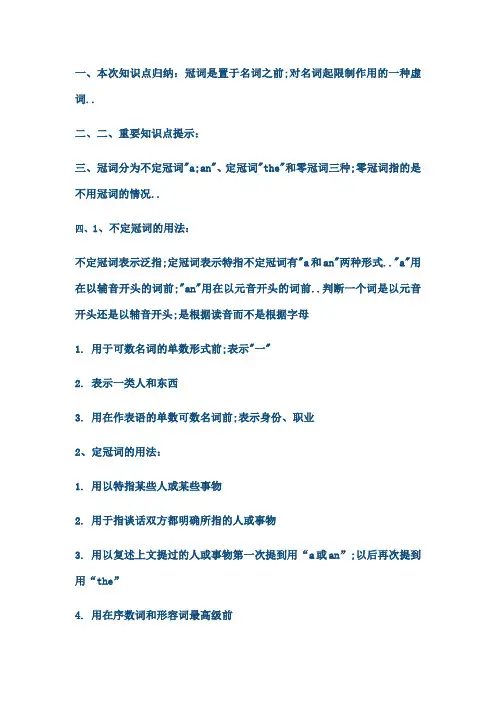
小升初英语冠词用法总结及练习
- 格式:docx
- 大小:19.41 KB
- 文档页数:6
冠词
重点知识归纳及讲解
(一)概说 1.冠词是一种虚词,不能独立担任一个成分,只能附着在一个名词上,帮助说明其词义。 英语中有两个冠词:
1)定冠词 the
2)不定冠词 a/an
定冠词 the 通常读作 [] ,在元音前读作 [i] ,特别强调或单念时读作 [i:] 。 不定冠词在元音音素开始的单词前用 an 这个形式,读作 [n] ;在其他情况下则使用 a,读作
[] 。
2.冠词的基本意义
不定冠词 a/an 与数词 one 同源,表示“一个”的意思,用在可数名词单数前。
例如:
She is a nurse. 她是个护士。
He is an Englishman, with an Irish wife. 他是一位英国人,有一个爱尔兰妻子。 定冠词 the ,与 this
同源,有“这(那)个”的意思,但比较弱,表示一(几)个特定的 人或东西,有时可译作“这个(些)”或“那个(些)”。
例如:
That 's the book you want. 这就是你要的那本书。
Who' s the young man over there? 那边那个年轻人是谁?
但在很多情况下,“这”或“那”这类词在译文中并不出现。
例如:
Put it on the table. 把它放在桌上。
Shut the door, please. 请把门关上。
3.特指和泛指 一般来说,名词有特指和泛指两种情况,请比较下面的句子: A gentleman is asking
to see you. 有位先生要求见你。(泛指)
Ask the gentleman to come in. 请那位先生进来。(特指)
在特指时一般前面要加定冠词, 而泛指时则有三种情况: 1 )在可数名词单数前加不定冠词。 例如:
She sent me a postcard 她寄给我一张明信片。
2)在可数名词复数前可不加冠词,可使用 some, any 这类词。
例如:
These are new words. 这些是生词。
She sent me some flowers. 她送给我一些花。
3)在不可数名词前多不加什么,有时也可加 some, any 等。
例如:
It ' s lovely weather. 天气真好。
Do you want any sugar in your tea? 你茶里要放点糖吗?
Give us some help. 给我们一些帮助。
(二)不定冠词的基本用法 1.泛指某一类人或事物中的一个,代表某一类别(不一定译为“一”) 例如:
His father is a doctor. 他父亲是医生。
2.代表某一类人或事物,相当于 any(+名词) (不必译为“一”,但必须用 例如:
A horse is a useful animal. 马是有用的动物。
3.指某人或某物(不是指某一类),但不具体说明何人或何物(一般译为“一”) 例如:
This book was written by a worker. 这本书是一位工人写的。
4.表示数量,有“一”的意思,但数的概念没有 one 强烈(一般译为“一”)
例如:
Wait a moment. 等一下。 5.表示单位,相当于“每”的意思 例如:
We have three meals a day. 我们每日吃三餐。
6.用于某此固定词组中 例如:
a few, a little, a bit (of), a lot of 等。
(三)定冠词的基本用法 1.特指某(些)人或某(些)事物 例如:
Give me the book. 把那本书给我。 2.指谈话双方都知道的人或事物 例如:
Where is the doctor? 医生在哪儿?
3.再次提到上文提到过的人或事物 例如:
I bought a dictionary yesterday. The dictionary is at home. 昨天我买了一本词典。词典在家里。
4.用在大家所熟悉的、世界上独一无二的事物 例如:
The earth is bigger than the moon, but smaller than the sun. 地球比月亮大,但比太阳小。
5.用在序数词和形容词最高级前 例如:
Mr Wang teaches the first class. 王先生上第一节课。
Of all the stars the sun is the nearest to the earth. 在所有的恒星中,太阳离地球最近。 6.用在单数可数名词,表示某一类人或事物 例如: The horse is a useful animal. 马是有用的动物。 7.与下列专有名词连用
1)在江、河、湖、海、群岛、山脉的名称前 例如:
the Changjiang River, the Great Lake 2)在姓氏的复数名词前,表示夫妇二人或全家人 例如:
The Greens are sitting at the breakfast table. 格林一家人正围坐在早餐桌旁。 8.和某些形容词连用,表示一类人
例如:
the old 老人 the young 年轻人
the rich 富人 the poor 穷人
the sick 病人 the dead 死人 9 .在一些习惯说法中
the east (west, south, north)
in the morning (afternoon, evening)
on the left (right)
in the end
go to the cinema
(四) 不用冠词的几种情况 1.在专有名词,抽象名词和物质名词前 例如:
Have you ever been to Shanghai? 你到过上海吗?
We love science. 我们爱好科学。 2.在表示一类人或事物的复数名词前 例如:
Girls can be scientists. 女孩子可以当科学家。
3.在季节、月份、星期、一日三餐的名称前 例如: a,表示类别) It is hot in summer. 夏天天气热。
It ' s Tuesday, August the 22nd. 今天是八月二十二日,星期三。
Have you had breakfast? 你吃过早饭没有?
4.称呼语或表示头衔,职务的名词前 例如:
What' s the matter with you, Mike? 怎么啦,迈克?
He is headmaster of our school. 他是我们学校的校长。
5.学科和球类运动的名称前 例如:
We study English. 我们学习英语。
Do you like to play football? 你喜欢踢足球吗?
6.名词前已有用作定语的 this, that my, your, some, any, no, whose, every, each
等代词时,不用冠词 例如:
That is her bike. 那是她的自行车。
Each student in his class studies hard. 这个班的每个学生都努力学习。
7.在某些固定词组的名词前 例如:
at home, at night, after school, by bus, in bed, in town, in front of, go to school, go to bed 等。
三、随堂监测 A 组
I. 在下列句子的空格中填上适当的冠词,不需要的地方用“ / ”表示:
1. This is ____ old map. It is _____ useful map. 2. We have no classes in ____ afternoon on ______ Saturday.
3. ___ spaceship flies at about eleven kilometers ______ second.
4. Beijing is ____ capital of _____ China. It is ______ beautiful city.
5. Roman was not built in ____ day.
6. Chinese is quite ____ difficult language for Mike.
7. Many _____ students will take _____ active part in sports meet.
8. There is _____ interesting picture on ____ wall.
9. Jenny found ______ wallet lying on ___________ ground. _____ wallet was Mr.
Black ' s.
10. Which is ___ biggest, _____ sun, _____ moon, or _____ earth?
11. --- Which picture is more beautiful? --- _____________ one on ______ left, I think.
12. --- Which is _ way to _______ hospital?
--- Go down this road and turn left on ____ second crossing.
13. _____ more, _____ better.
14. ____ Turners are sitting at breakfast table.
15. Joe Hill was ______ fighter for _____ working class.
16. When was ____ People ' s Republic of China founded?
17. In China ________ first English textbooks were published in __________________ late
nineteenth century.
18. After ____ breakfast he went to _____ school on _____ foot.
19. ____ Huanghe River lies in _____ north of China.
20. He likes playing ____ football. His sister likes playing _____ piano.
II. 单项选择:
1. 上学 A. go to school B. go to the school C. go to a school