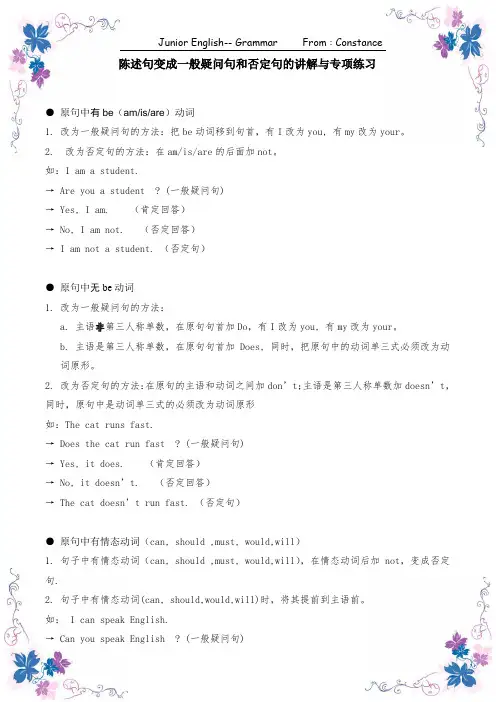
一般疑问句和否定句的改法
- 格式:docx
- 大小:213.45 KB
- 文档页数:2
一般疑问句和否定句的改法
Company number:【WTUT-WT88Y-W8BBGB-BWYTT-19998】
一、陈述句改为一般疑问句:
1.当句子中含有be动词(am is are was were)或情态动词(can, could, may, should等)时,把be动词或情态动词提到句首。
如:①He is a he a docter ②They were in the house they in……
另外,为符合实际习惯
I am/We are..…------Are you… I was/We were…-----Were you….
I /We can…-----Can you…..
2.当句中含有实义动词时,也就是句子不含上面所提到那些be 动词或情态动词时,必须在句首加DO/Does/Did,具体情况分以下三方面:
㈠当句子中含有动词原型时,在句子前加Do, 其中,I + 动词。。。------Do you…
如:①I like you like music ②They work they work here
㈡当句子中含有的动词加S或es时,即句子是一般现在时,且主语为第三人称单数时,在句子前加Does.如: ①He likes he like music
②Tom comes from Tom come from China
( 注意 在此情况下,应把疑问句中的动词变原型。)
㈢当句子中的动词为过去式,在句子前加Did 再把动词变原型。如:
I went to the park you go to the….
He played football this he play……
二、陈述句改为否定句:
1.当句子中含有be动词(am is are was were)或情态动词(can, could , should等),在be动词或情态动词后加not.如:
①He is a docter. ----He is not a docter.
②They were in the house were not in……
③Tom can can not swim.
2.当句中含有实义动词时,也就是句子不含上面所提到的be动词或情态动词时,必须在原句动词前加don’t,或doesn ’t或didn’t:
㈠当句子中含有动词 原型时,在动词前加don’t:
如:I like music,-----I don’t like music. They go to school by don’t go to……
㈡当句子中含有的动词加s或es时,即句子是一般现在时,且主语为第三人称单数时,在句子中的动词前加doesn ‘t,再把动词变原型:
如:He likes doesn’t like music.
Tom works here----- Tom doesn’t work here.
㈢当句子中的动词为过去式,在动词前加didn’t,再把动词变原型
如:I went to the park didn’t go to……….
He played football this morning ------He didn’t play football…….