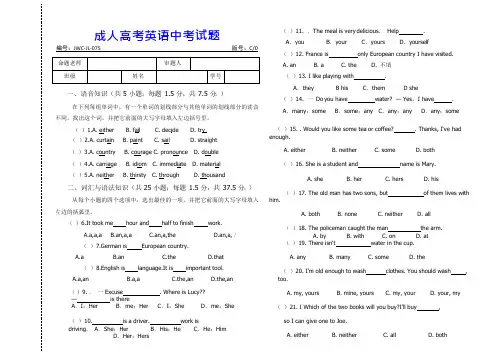
第1篇Section I: Listening Comprehension (30 points, 15 minutes)Directions: In this section, you will hear 10 short conversations and 3 long conversations. After each conversation, one or more questions will be asked about what was said. Both the conversation and the question will be spoken only once. After each question, there will be a pause. During the pause, you must read the four choices marked A), B), C), and D), and decide which is the best answer. Then mark the corresponding letter on Answer Sheet 1 with a single line through the center.1. A) The woman is tired and wants to go to bed.B) The woman is feeling unwell.C) The woman is busy with her work.D) The woman is planning a trip.2. A) The man is looking for a job.B) The man is going to start a new business.C) The man is taking a break from work.D) The man is on vacation.3. A) They are discussing a book.B) They are planning a party.C) They are talking about a movie.D) They are discussing a restaurant.4. A) The man is a teacher.B) The man is a doctor.C) The man is a lawyer.D) The man is a student.B) The woman is a dancer.C) The woman is an actress.D) The woman is a painter.6. A) They are going to a concert.B) They are going to a movie.C) They are going to a restaurant.D) They are going to a museum.7. A) The man is good at playing the piano.B) The man is good at playing the guitar.C) The man is good at playing the violin.D) The man is good at playing the drums.8. A) They are planning a hiking trip.B) They are planning a camping trip.C) They are planning a skiing trip.D) They are planning a scuba diving trip.9. A) The woman is a chef.B) The woman is a baker.C) The woman is a nutritionist.D) The woman is a dietician.10. A) The man is a photographer.B) The man is a graphic designer.C) The man is a web developer.Long Conversations (20 points)Questions 11 to 13 are based on the following conversation.11. What is the topic of the conversation?A) Travel plansB) Job interviewsC) Education opportunitiesD) Health issues12. Why does the woman want to study abroad?A) She wants to improve her English skills.B) She wants to experience a different culture.C) She wants to earn a higher salary.D) She wants to gain more work experience.13. What advice does the man give to the woman?A) She should choose a program that is in high demand.B) She should find a job that is related to her field of study.C) She should look for scholarships to cover her expenses.D) She should make sure she has a good command of the local language. Questions 14 to 16 are based on the following conversation.14. What is the main concern of the woman?A) Her healthB) Her studiesC) Her familyD) Her job15. What advice does the man give to the woman?A) She should take more breaks.B) She should go to the doctor.C) She should exercise more.D) She should get more sleep.16. How does the woman feel at the end of the conversation?A) RelievedB) AnxiousC) HappyD) SadQuestions 17 to 20 are based on the following conversation.17. What is the man's profession?A) A teacherB) A doctorC) A lawyerD) A psychologist18. What is the woman's problem?A) She is unable to concentrate.B) She is feeling overwhelmed.C) She is experiencing panic attacks.D) She is suffering from insomnia.19. What does the man suggest as a solution?A) She should take medication.B) She should exercise regularly.C) She should meditate.D) She should talk to a counselor.20. How does the woman respond to the man's advice?A) She is skeptical.B) She is grateful.C) She is indifferent.D) She is angry.Section II: Structure and Usage (30 points, 30 minutes)Directions: There are 30 incomplete sentences in this section. For each sentence there are four choices marked A), B), C), and D). Choose the one that best completes the sentence. Then mark the corresponding letter on Answer Sheet 1 with a single line through the center.21. If you _________ (A) had known about the traffic jam, you would have left earlier.22. The professor _________ (A) spoke about the latest research in his field.23. I wish I _________ (A) had not wasted my time on that movie.24. The company _________ (A) is planning to expand its operations.25. _________ (A) I arrived late, I missed the first half of the lecture.26. _________ (A) you will pass the exam if you study hard.27. _________ (A) she was feeling sick, she decided to stay home.28. _________ (A) we should all take care of the environment.29. _________ (A) I had enough money, I would travel around the world.30. _________ (A) you can't solve the problem on your own, ask for help.Section III: Reading Comprehension (40 points, 40 minutes)Directions: There are 4 passages in this section. Each passage is followed by some questions or unfinished statements. For each of them there are four choices marked A), B), C), and D). You should decide on the best choice and mark the corresponding letter on Answer Sheet 1 with a single line through the center.Passage 1The Internet has revolutionized the way we communicate, work, and access information. With just a few clicks, we can connect with people from all over the world, access a vast amount of information, and even conduct business transactions. However, this convenience comes with a price. The Internet has also introduced numerous challenges, such as cyberbullying, online fraud, and privacy concerns.One of the most significant challenges of the Internet is cyberbullying. Cyberbullying occurs when someone uses digital communication to harass, intimidate, or harm another person. This can happen through social media, email, or online forums. Cyberbullying can have severe consequences, including emotional distress, anxiety, and even depression.Another challenge is online fraud. With the increase in online shopping and banking, there has been a rise in fraudulent activities. Scammersuse various tactics to steal personal information and money, such as phishing scams, identity theft, and malware attacks. This can lead to financial loss and damage to one's credit rating.Privacy concerns are also a significant issue. With the amount of data we share online, it is difficult to ensure that our personal information remains secure. Many websites and apps collect and sell user data, which can be used for targeted advertising or even identity theft.Despite these challenges, the Internet has many benefits. It has made communication easier, access to information more accessible, and has created new opportunities for businesses and individuals. To mitigatethe risks, it is important to be aware of the potential dangers and take steps to protect ourselves online.31. What is the main topic of the passage?A) The benefits of the InternetB) The challenges of the InternetC) The impact of the Internet on societyD) The future of the Internet32. What is one of the consequences of cyberbullying?A) Financial lossB) Emotional distressC) Identity theftD) Privacy concerns33. What is the main purpose of the passage?A) To persuade readers to use the Internet responsiblyB) To inform readers about the challenges of the InternetC) To compare the benefits and challenges of the InternetD) To provide solutions to the problems caused by the InternetPassage 2The importance of education cannot be overstated. It is the foundation upon which societies are built and the key to personal and economic success. Education equips individuals with the knowledge, skills, and values necessary to contribute to their communities and to leadfulfilling lives.One of the primary benefits of education is that it improves employment prospects. A higher level of education often leads to better job opportunities, higher salaries, and greater job security. Education alsoprovides individuals with the skills they need to adapt to a rapidly changing workforce.Another benefit of education is that it promotes social mobility. Education can help break the cycle of poverty and provide individuals with the tools they need to improve their lives. It can also help reduce income inequality by providing everyone with an equal opportunity to succeed.Education also plays a crucial role in fostering social cohesion. It promotes understanding, tolerance, and respect for others, which are essential for building a harmonious society. Education can also help reduce crime rates by providing individuals with the skills and opportunities they need to make positive contributions to their communities.Despite the many benefits of education, there are still challenges that need to be addressed. Access to quality education remains a significant issue for many people around the world. In addition, there is a growing concern about the cost of education, which can be a barrier for many students.To ensure that everyone has access to quality education, it is important to invest in education and to address the challenges that prevent people from achieving their educational goals.34. What is the main purpose of the passage?A) To discuss the benefits of educationB) To compare the benefits of education and other factorsC) To argue against the importance of educationD) To provide solutions to the challenges of education35. What is one of the ways education can promote social mobility?A) By providing better job opportunitiesB) By reducing income inequalityC) By fostering understanding and toleranceD) By reducing crime rates36. What is one of the challenges that need to be addressed in education?A) The cost of educationB) Access to quality educationC) The lack of qualified teachersD) The increasing dropout ratePassage 3The environmental crisis is one of the most pressing issues of our time. Climate change, pollution, and resource depletion are threatening the planet and its inhabitants. It is essential that we take immediate action to address these challenges and ensure a sustainable future for generations to come.One of the most significant actions we can take is to reduce our carbon footprint. This means reducing the amount of greenhouse gases we emit into the atmosphere. We can do this by using renewable energy sources, such as solar and wind power, and by reducing our reliance on fossil fuels.Another important action is to reduce pollution. Pollution can have devastating effects on the environment, including air and water pollution, and soil contamination. We can reduce pollution by reducing our use of harmful chemicals, recycling, and properly disposing of waste.We also need to address the issue of resource depletion. Many natural resources, such as water, forests, and minerals, are being used at an unsustainable rate. We can address this by promoting sustainable practices, such as reforestation, water conservation, and recycling.In addition to individual actions, we need to support policies and initiatives that promote sustainability. This includes supportingregulations that reduce emissions, investing in renewable energy, and promoting sustainable development.37. What is the main topic of the passage?A) The causes of the environmental crisisB) The effects of the environmental crisisC) The actions we can take to address the environmental crisisD) The future of the environment38. What is one way we can reduce our carbon footprint?A) By using public transportationB) By reducing our reliance on fossil fuelsC) By planting more treesD) By reducing our energy consumption39. What is one way we can reduce pollution?A) By using renewable energy sourcesB) By recyclingC) By reducing our use of harmful chemicalsD) By promoting sustainable development40. What is one way we can address the issue of resource depletion?A) By investing in renewable energyB) By promoting sustainable practicesC) By reducing our consumptionD) By supporting policies that promote sustainabilitySection IV: Writing (30 points, 30 minutes)Directions: Write an essay of about 300 words on the following topic:"Education: A Key to Personal and Social Development"In your essay, you should:1. State your opinion on the importance of education.2. Support your opinion with specific reasons and examples.3. Explain how education can contribute to personal and social development.You should write neatly on Answer Sheet 2. Do not write your name on the essay.---This English test for adult higher education entrance examination for higher professional education covers a wide range of topics, including listening comprehension, structure and usage, reading comprehension, and writing. It is designed to assess the English language proficiency of candidates and their ability to understand and respond to academic content.第2篇Section I: Reading Comprehension (30%)Part A: Skimming and Scanning (10%)Read the following passage quickly and answer the questions below.Passage:In recent years, there has been a significant shift in the way people learn. With the advent of online education, students now have access to a vast array of courses and resources from around the world. This has revolutionized the traditional classroom setting and has opened up new opportunities for adult learners who wish to pursue higher education.Online education offers several advantages over traditional learning methods. Firstly, it provides flexibility in terms of time and location. Students can access course materials and lectures at any time and fromany place with an internet connection. This is particularly beneficial for adult learners who have other commitments such as work or family.Secondly, online courses often come at a lower cost compared to traditional education. Many institutions offer free or low-cost courses, which make it more accessible for students who might not be able to afford the high tuition fees associated with attending a brick-and-mortar university.Moreover, online education allows students to learn at their own pace. They can review materials multiple times and take as much time as they need to understand complex concepts. This personalized learning experience can lead to better retention of information.However, there are also challenges associated with online learning. One of the main concerns is the lack of face-to-face interaction with instructors and peers. This can lead to feelings of isolation and may hinder the learning process. Additionally, some students may lack the self-discipline required to manage their time effectively and stay motivated.Questions:1. What is the main topic of the passage?A. The advantages of traditional classroom learningB. The impact of online education on adult learnersC. The challenges of online learningD. The cost of online education compared to traditional education2. According to the passage, what is one of the advantages of online education for adult learners?A. Higher tuition feesB. Limited access to course materialsC. Flexibility in terms of time and locationD. No interaction with peers3. What is a potential challenge mentioned in the passage regarding online learning?A. Increased opportunities for collaborationB. Improved self-discipline among studentsC. Lack of face-to-face interactionD. Lower costs for studentsPart B: Reading in Depth (20%)Read the following passage carefully and answer the questions below.Passage:The Importance of Critical Thinking in EducationCritical thinking is an essential skill that should be nurtured in every student. It involves the ability to analyze, evaluate, and interpret information in a logical and systematic manner. In an era where information is abundant and easily accessible, critical thinking is more important than ever.Educational institutions have a responsibility to teach students how to think critically. This skill is not only crucial for academic success but also for personal and professional development. Here are some reasons why critical thinking is important:1. Problem-Solving: Critical thinking enables individuals to identify problems, analyze possible solutions, and make informed decisions. In today's fast-paced world, the ability to solve problems efficiently is a valuable asset.2. Decision-Making: Critical thinking helps individuals make better decisions by considering multiple perspectives and evaluating the potential consequences of their actions.3. Adaptability: In a rapidly changing world, being able to adapt to new situations and challenges is essential. Critical thinking skills allow individuals to analyze new information and adjust their strategies accordingly.4. Ethical Reasoning: Critical thinking is crucial for ethical reasoning. It helps individuals understand the ethical implications of theiractions and make responsible decisions.5. Lifelong Learning: Critical thinking encourages lifelong learning. It motivates individuals to seek knowledge, ask questions, and continue learning throughout their lives.To develop critical thinking skills, students need to be exposed to a variety of perspectives and ideas. They should be encouraged to question assumptions, challenge stereotypes, and engage in constructive debates. Here are some strategies that can help:1. Encourage Inquiry: Educators should create an environment that encourages students to ask questions and seek answers.2. Teach Analytical Skills: Students should be taught how to analyze information, identify biases, and evaluate the credibility of sources.3. Foster Collaboration: Group work and collaborative projects can help students develop critical thinking skills by requiring them to work together and consider different viewpoints.4. Provide Diverse Perspectives: Educators should expose students to a variety of perspectives and ideas to broaden their understanding of the world.5. Promote Self-Reflection: Students should be encouraged to reflect on their own thinking processes and consider how they arrived at their conclusions.Questions:4. What is the main argument of the passage?A. Critical thinking is a skill that is unnecessary for students.B. Critical thinking is important for academic success and personal development.C. Critical thinking is only beneficial for students in technical fields.D. Critical thinking is a skill that can be developed through traditional education methods only.5. According to the passage, what are some of the benefits of critical thinking?A. Improved test scores, but no impact on real-life decision-making.B. Increased self-esteem, but limited problem-solving abilities.C. Better decision-making, adaptability, ethical reasoning, and lifelong learning.D. No significant benefits, as critical thinking is not applicable in the real world.Section II: Vocabulary and Structure (20%)Part A: Vocabulary (10%)Choose the correct word to complete each sentence.1. The professor's lecture was so ___________ that the students found it difficult to follow.A. complicatedB. confusingC. fascinatingD. boring2. The government's new policy has ___________ many debates among economists and politicians.A. sparkedB. triggeredC. inspiredD. prevented3. The team's victory was a ___________ to their hard work and dedication.A. reflectionB. rewardC. resultD. signPart B: Grammar (10%)Choose the correct answer to complete each sentence.1. If I had more time, I ___________ the book by now.A. would have finishedB. will finishC. am finishingD. finish2. The book was so interesting that ___________.A. I couldn't put it downB. I couldn't put it upC. I couldn't put it onD. I couldn't put it offSection III: Writing (30%)Task 1: Essay (20%)Write an essay on the following topic:"The role of technology in education: A blessing or a curse?"Your essay should be approximately 400-500 words. You should:- State your position clearly.- Provide supporting evidence and examples.- Discuss both the positive and negative aspects of technology in education.- Conclude with a restated position and final thoughts.Task 2: Short Answer Questions (10%)Answer the following short answer questions in approximately 100-150 words each.1. Explain the difference between skimming and scanning.2. Describe the importance of critical thinking in problem-solving.3. Discuss one challenge that adult learners may face in online education.---This English试卷 is designed to test the reading, vocabulary, grammar, and writing skills of adult learners preparing for college-degree programs. The questions are designed to be challenging yet accessible, reflecting the level of difficulty typically found in adult higher education entrance examinations.。