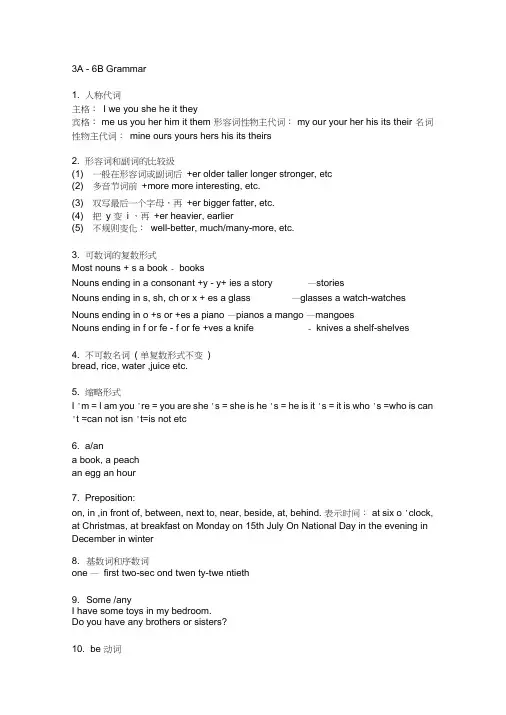
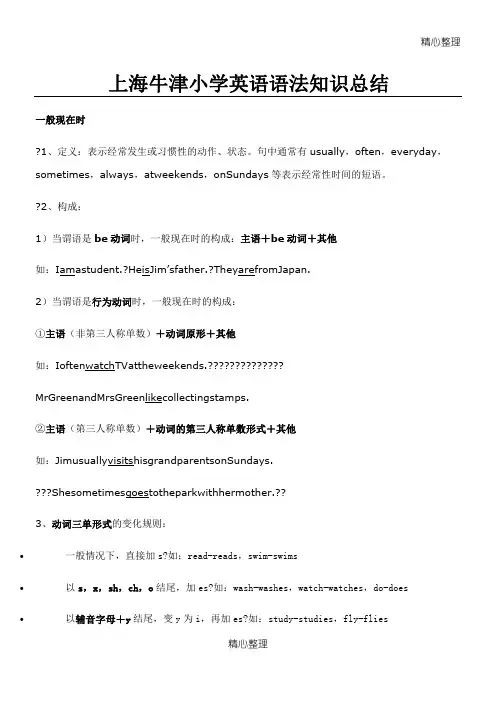
牛津小学英语语法点汇总
- 格式:docx
- 大小:25.27 KB
- 文档页数:33
语法及练习1 be动词
Be 动词的用法:
(1) Am--was Is --was Are--were 口诀:我用am, 你用are, is用在他她它,复数全用are。
(2) 肯定和否定句 I am (not) from London. He is(not) a teacher. She
is(not) in the dining room. My hair is(not) long. Her eyes are(not)
small.
(3) 一般疑问句 Am I a Chinese? Yes, you are. No, you aren’t. Are they
American? Yes, they are. No, they aren’t. Is the cat fat? Yes, it is.
No, it isn’t.
用恰当的be动词填空。
1. I ______ a boy. ______ you a boy? No, I _____ not.
2. The girl______ Jack's sister.
3. The dog _______ tall and fat.
4. The man with big eyes _______ a teacher.
5. ______ your brother in the classroom? 6. Where _____ your mother? She ______ at home.
7. How _______ your father?
8. Mike and Liu Tao ______ at school.
9. Whose dress ______ this?
10. Whose socks ______ they?
11. That ______ my red skirt.
12. Who ______ I?
13.The jeans ______ on the desk.
14. Here ______ a scarf for you.
15. Here ______ some sweaters for you.
16. The black gloves ______ for Su Yang.
17. This pair of gloves ______ for Yang Ling.
18. The two cups of milk _____ for me.
19. Some tea ______ in the glass. 20. Gao shan's shirt _______ over there.
21. My sister's name ______Nancy.
22. This ______ not Wang Fang's pencil.
23. ______ David and Helen from England?
24. There ______ a girl in the room.
25. There ______ some apples on the tree.
`26. _______ there any kites in the classroom?
27. _______ there any apple juice in the bottle?
28. There _______ some bread on the plate.
29. There _______ a boy, two girls, three men and ten women in the park.
30. You, he and I ______ from China.
语法及练习2 人称代词和物主代词
人称代词和物主代词 1.人称代词主格和宾格的区别:主格通常位于句中第一个动词之前(有时候位于than 之后),宾格一般位于动词或介词之后。
2.物主代词形容词性与名词性的区别:形容词性用时后面一般要带上名词,名词性则单独使用,后面不带名词。
一.填写代词表主格。
I it we
you them
his your
hers
二.用所给词的适当形式填空。
1. That is not _________ kite. That kite is very small, but _________
is very big. ( I )
2. The dress is _________. Give it to _________. ( she )
3. Is this _________ watch? (you) No, it’s not _________ . ( I ) 4. _________ is my brother. ________ name is Jack. Look! Those stamps
are _________. ( he )
5. _________ dresses are red. (we) What colour are _________? ( you )
6. Here are many dolls, which one is _________ ? ( she )
7. I can find my toy, but where’s _________? ( you )
8. Show _________ your kite, OK? (they)
9. I have a beautiful cat. _________name is Mimi. These cakes are
_________. ( it )
10. Are these ________ tickets? No, ________ are not _________.
________ aren’t here. ( they ) 11. Shall _________ have a look at that
classroom? That is _________ classroom. ( we )
12. _________ is my aunt. Do you know _________ job? _________ a nurse.
( she )
13. That is not _________ camera. _________is at home. ( he )
14. Where are _________? I can’t find _________. Let’s call _________
parents. ( they ) 15. Don’t touch _________. _________ not a cat, _________ a tiger!(it)
16. _________ sister is ill. Please go and get _________. ( she )
17. _________ don’t know her name. Would you please tell _________.
( we )
18. So many dogs. Let’s count _________. ( they )
19. I have a lovely brother. _________ is only 3. I like _________ very
much. ( he )
20. May I sit beside _________? ( you )
21. Look at that desk. Those book are on _________. ( it )
22.The girl behind _________ is our friend. (she )
语法及练习3 名词复数和动词三单
一、名词复数规则
1.一般情况下,直接加-s,如:book-books, bag-bags, cat-cats, bed-beds
2.以s. x. sh. ch结尾,加-es,如:bus-buses, box-boxes, brush-brushes,
watch-watches 3.以“辅音字母+y”结尾,变y为i, 再加-es,如:family-families,
strawberry-strawberries
4.以“f或fe”结尾,变f或fe为v, 再加-es,如:knife-knives
5.不规则名词复数: man-men, woman-women, policeman-policemen,
policewoman-policewomen, mouse-mice child-children
foot-feet,.tooth-teeth fish-fish, people-people, Chinese-Chinese,
Japanese-Japanese
练习:写出下列各词的复数。
I _________ him _________ this _______ her ______ watch _______
book_______
child _______ photo ________ diary ______ day________
foot________ dress ________ tooth_______ sheep ______ box_______
strawberry _____ thief _______yo-yo ______ peach______ sandwich
______ man______ woman_______ paper_______ people________
二.动词三单的变化规则
1.一般情况下,直接加-s,如:cook-cooks, milk-milks 2.以s. x. sh. Ch, o结尾,加-es,如:guess-guesses, wash-washes,
watch-watches, go-goes
3.以“辅音字母+y”结尾,变y为i, 再加-es,如:study-studies
练习: 写出下列动词的第三人称单数。
drink ________ go _______ stay ________ make ________ look
_________
have_______ pass_______ carry ____ come________
watch______
plant_______ fly ________ study_______ brush________
teach_______
语法及练习4 一般现在时
一般现在时一般现在时基本用法介绍