
牛津8A Unit 6第3课时
- 格式:ppt
- 大小:1.97 MB
- 文档页数:12
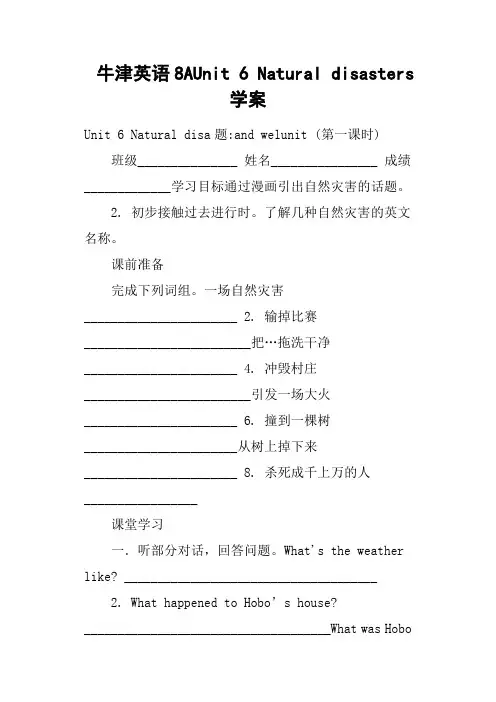
牛津英语8AUnit 6 Natural disasters学案Unit 6 Natural disa题:and welunit (第一课时) 班级_______________ 姓名________________ 成绩_____________学习目标通过漫画引出自然灾害的话题。
2. 初步接触过去进行时。
了解几种自然灾害的英文名称。
课前准备完成下列词组。
一场自然灾害_______________________ 2. 输掉比赛_________________________把…拖洗干净_______________________ 4. 冲毁村庄_________________________引发一场大火_______________________ 6. 撞到一棵树_______________________从树上掉下来_______________________ 8. 杀死成千上万的人_________________课堂学习一.听部分对话,回答问题。
What's the weather like? ______________________________________2. What happened to Hobo’s house?_____________________________________What was Hobodoing warted to rain?______________________________________When did Hobo hear the rain?_____________________________________课堂检测一.根据句意、首字母或中文提示完成单词。
I don’t like living in aIlive a quiet life in av______________________.2. There are many n_____________________ disasters every yeau should tuur computerwl______________________They wlagot all______________________ (潮湿的)The snow andad caused many ______________________ (事故) last w 二.用所给动词的正确形式填空。

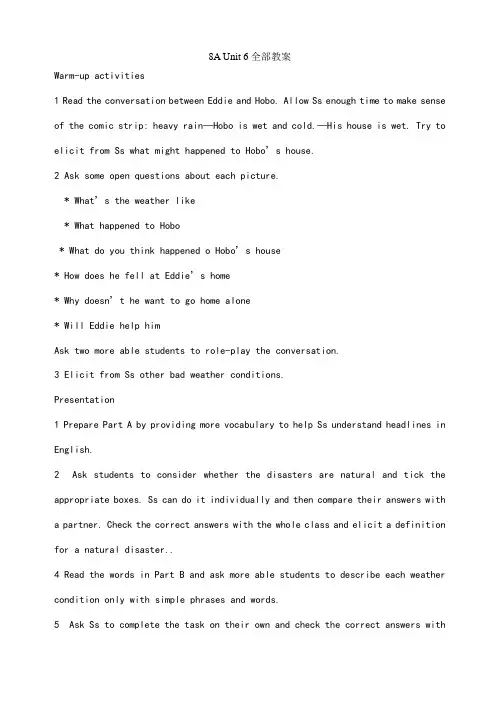
8A Unit 6全部教案Warm-up activities1 Read the conversation between Eddie and Hobo. Allow Ss enough time to make sense of the comic strip: heavy rain—Hobo is wet and cold.—His house is wet. Try to elicit from Ss what might happened to Hobo’s house.2 Ask some open questions about each picture.* What’s the weather like* What happened to Hobo* What do you think happened o Hobo’s house* How does he fell at Eddie’s home* Why doesn’t he want to go home alone* Will Eddie help himAsk two more able students to role-play the conversation.3 Elicit from Ss other bad weather conditions.Presentation1 Prepare Part A by providing more vocabulary to help Ss understand headlines in English.2 Ask students to consider whether the disasters are natural and tick the appropriate boxes. Ss can do it individually and then compare their answers with a partner. Check the correct answers with the whole class and elicit a definition for a natural disaster..4 Read the words in Part B and ask more able students to describe each weather condition only with simple phrases and words.5 Ask Ss to complete the task on their own and check the correct answers withthe class as a whole.Language pointsNatural disasters, really warm, for too long, mop it up, lose the game, kill thousands of people, a car accident, crash into a tree, wash the village away, start a big fireHomework1 Learn the language points by heart.2 一课三练3 Preview the Reading Part.Presentation (Reading A)1 Talk to Ss about the context of surviving an earthquake. Elicit any information about the earthquakes in Taiwan or in other parts of the world. Bring some newspaper articles about earthquakes.2 Ask Ss to quickly skim the text on their own. Ask them to highlight the words they do not know. Then ask Ss to discuss them in pairs and try to work out their meaning from the context.3 Ask Ss to make list of words and phrases used in the text which describe noise and movement/destruction, fear and hope.* noise: big noise, thunder, screamed, real noise, bombs, shouted* movement/destruction: slight shaking, earth started to shake, ran (wildly), pieces of glass and bricks fell down, walls began to come down* fear: screamed, frightened, dark, could not at all, a moment of fear* hope: calm down, still alive, bright daylight, safe4 Read Timmy’s story aloud. Ask Ss to listen carefully.5 Check general understanding of the different paragraphs by asking some ‘ wh-‘ questions.Para 1: Where was TimmyWhat happened in the shopping centrePara 2: What happened to the buildingHow did people reactWhat did Timmy doPara 3: Where was Timmy when the shaking stoppedHow did Timmy feelPara 4: What did Timmy do while he was waiting for helpPara 5: How was he rescuedPresentation (Reading B)1 Explain the context of Part B. Ask students to do Part B1 on their own. Encourage students to check their answer with a partner.3 Ask students to study the words in the box for one minute, then cover them and complete the diary entry in Part B2.Presentation (Reading C)1 Explain the context and point out to Ss the idea of telling a story with pictures. Divide the class into teams of 4-5 students to study each picture first.2 Ss write the captions in the blanks individually. Check answers with the whole class.3 Ask Ss to arrange the pictures in the right order.Presentation (Reading D)1 Explain the context and remind them about story telling from memory. Ss work in pairs to complete the task.2 Check the answers with the whole class.Language points (Part A)Feel a slight shaking through my body, a big noise like thunder, in fear, be frightened, start to shake, run in all directions, know where to go, run wildly, fall down, calm down, be over, could not see at all, be trapped, say to oneself, a moment of fear, go through my mind, since, hear excited shouts, in a great hurry, move away, see the bright daylight.Language points (Part C)Be very good at telling jokes, voteHomework1 Learn the language points by heart.2 一课三练3 Preview the Vocabulary Part.。

8A Unit 6全部教案Warm-up activities1 Read the conversation between Eddie and Hobo. Allow Ss enough time to make sense of the comic strip: heavy rain—Hobo is wet and cold.—His house is wet. Try to elicit from Ss what might happened to Hobo’s house.2 Ask some open questions about each picture.* What’s the weather like?* What happened to Hobo?* What do you think happened o Hobo’s house?* How does he fell at Eddie’s home?* Why doesn’t he want to go home alone?* Will Eddie help him?Ask two more able students to role-play the conversation.3 Elicit from Ss other bad weather conditions.Presentation1 Prepare Part A by providing more vocabulary to help Ss understand headlines in English.2 Ask students to consider whether the disasters are natural and tick the appropriate boxes. Ss can do it individually and then compare their answers with a partner. Check the correct answers with the whole class and elicit a definition for a natural disaster..4 Read the words in Part B and ask more able students to describe each weather condition only with simple phrases and words.5 Ask Ss to complete the task on their own and check the correct answers with the class as a whole.Language pointsNatural disasters, really warm, for too long, mop it up, lose the game, kill thousands of people, a car accident, crash into a tree, wash the village away, start a big fireHomework1 Learn the language points by heart.2 一课三练P.673 Preview the Reading Part.Presentation (Reading A)1 Talk to Ss about the context of surviving an earthquake. Elicit any information about the earthquakes in Taiwan or in other parts of the world. Bring some newspaper articles about earthquakes.2 Ask Ss to quickly skim the text on their own. Ask them to highlight the words they do not know. Then ask Ss to discuss them in pairs and try to work out their meaning from the context.3 Ask Ss to make list of words and phrases used in the text which describe noise and movement/destruction, fear and hope.* noise: big noise, thunder, screamed, real noise, bombs, shouted* movement/destruction: slight shaking, earth started to shake, ran (wildly), pieces of glass and bricks fell down, walls began to come down* fear: screamed, frightened, dark, could not at all, a moment of fear* hope: calm down, still alive, bright daylight, safe4 Read Timmy’s story aloud. Ask Ss to listen carefully.5 Check general understanding of the different paragraphs by asking some ‘ wh-‘ questions. Para 1: Where was Timmy?What happened in the shopping centre?Para 2: What happened to the building?How did people react?What did Timmy do?Para 3: Where was Timmy when the shaking stopped?How did Timmy feel?Para 4: What did Timmy do while he was waiting for help?Para 5: How was he rescued?Presentation (Reading B)1 Explain the context of Part B. Ask students to do Part B1 on their own. Encourage students to check their answer with a partner.3 Ask students to study the words in the box for one minute, then cover them and complete the diary entry in Part B2.Presentation (Reading C)1 Explain the context and point out to Ss the idea of telling a story with pictures. Divide the class into teams of 4-5 students to study each picture first.2 Ss write the captions in the blanks individually. Check answers with the whole class.3 Ask Ss to arrange the pictures in the right order.Presentation (Reading D)1 Explain the context and remind them about story telling from memory. Ss work in pairs to complete the task.2 Check the answers with the whole class.Language points (Part A)Feel a slight shaking through my body, a big noise like thunder, in fear, be frightened, start to shake, run in all directions, know where to go, run wildly, fall down, calm down, be over, could not see at all, be trapped, say to oneself, a moment of fear, go through my mind, since, hear excited shouts, in a great hurry, move away, see the bright daylight.Language points (Part C)Be very good at telling jokes, voteHomework1 Learn the language points by heart.2 一课三练P.68-693Preview the V ocabulary Part.当前中学英语课堂教学存在的主要问题及对策林会猛[ 摘要] :中学英语课堂教学是提高教学质量的关键。